Tuesday, November 16, 2010

Chicana Perk/Latté Mi Corazón forced to close by City of San Diego


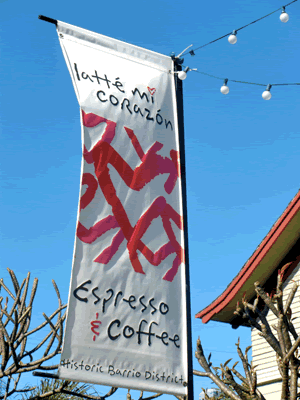
Latté Mi Corazón, formerly known as Chicano Perk, will be permanently closing its original location located at 129 25th Street, San Diego, CA 92102 on Friday, November 12th, 2010. After following up on a complaint, the City of San Diego has decided that Latté Mi Corazón does not meet current code compliance. “After 7 years of operating our family business, this is the first time the City of San Diego decides to raise a flag. We have paid for our business permits each year and are completely shocked that the city is doing this to us now,” stated Jerry Guzman-Vergara, co-owner of Latté Mi Corazón.

Latté Mi Corazón is an icon in the Historic Barrio District (Sherman Heights, Logan Heights, Grant Hill, Memorial, & Stockton). It is the only family owned coffee shop in the community that supports local grass roots groups/organizations and provides a comfortable place for students and community members to gather and organize. “In the current state of the economy, we are deeply saddened that the city would request that we close our family business. We are also very disappointed and shocked that it took The City of San Diego over 7 years to come to a conclusion that our business is not in compliance with local zoning guidelines. We feel that the City has let us down,” said Ricardo Medina, co-owner of Latté Mi Corazón.

Following the closing of Latté Mi Corazón, the owners will be looking for a new and permanent space within the Imperial Avenue Business Corridor to once again reopen their doors to the community as soon as possible.

Meanwhile, the Sherman Heights Community Center Board of Directors has pledged to help the small business by offering to house their coffee cart at the Sherman Heights Community Center Facility at 2258 Island Avenue, San Diego, CA 92102. "As a community development corporation, we feel that we need to do our part in the revitalization of our local economy. Keeping our local family owned coffee-shop in business while they find a new home is just the first step in the process," said Venus Molina, President of the Sherman Heights Community Center. Latté Mi Corazón hopes to start operations at its new proposed temporary location no later than January 2011.

For more info please contact Jerry Guzman-Vergara at 619.352.6863 or at jerry [at] lattemicorazon.com.

-30-

Sunday, November 14, 2010

Suitable For Printing - Chicano Photographer Sample Photos


[Click photo to enlarge. Copyright 2010 Jesús Manuel Mena Garza. All rights reserved.]

You are invited to download (non-commercial use) sample photos from the Chicano Photographer exhibition. The letter size JPG file are suitable for laser or ink-jet printing. Save the file and ask your photo lab or color laser printer to make a copy or two. Yes, color laser prints always look better than black and white ones.

I typically cut the sheet of photos lengthwise, then distribute the photo strips at my exhibitions and events. Have fun trimming and framing the photos for your personal use. The photos are not for commercial distribution or use.

-30-

Friday, November 05, 2010

Museums unite to chronicle post-war LA art scene


By Zorianna Kit

Reuters

More than 60 California cultural institutions are coming together to tell the story of the birth of the Los Angeles art scene, in the largest such collaboration ever undertaken in the region.

Southern California museums and university programs such as the Getty Museum, the Los Angeles County Museum of Art, the Hammer Museum and the University of California, Los Angeles (UCLA) Chicano Studies Research Center will take part in the 2011-2012 event, titled "Pacific Standard Time: Art in L.A 1945-1980", organizers said on Thursday.

Each of the institutions will make a contribution to the story of art and social change in Los Angeles through simultaneous exhibitions and programs.

"What began as an effort to document the milestones in this region's artistic history has expanded until it is now becoming a great creative landmark in itself," said Deborah Marrow, interim president of the J. Paul Getty Trust, which has initiated the event through grants totaling $10 million.

"We know that this era has had a million moments of impact on arts and culture across the United States and beyond," added Mark Siegel, chairman of the Getty's Board of Trustees.

The event will begin in October 2011 and will run through April 2012 at locations including Los Angeles, San Diego, Santa Barbara and Palm Springs.

The exhibitions, festivals and programs will showcase the influence of post-war California architecture, Pop Art, the emergence of African-American artists and 1970s feminist performance art.

-30-

Wednesday, November 03, 2010

How Obama Saved Capitalism and Lost the Midterms

By Timothy Egan
New York Times

[Click image to enlarge]

If I were one of the big corporate donors who bankrolled the Republican tide that carried into office more than 50 new Republicans in the House, I would be wary of what you just bought.

For no matter your view of President Obama, he effectively saved capitalism. And for that, he paid a terrible political price.

Suppose you had $100,000 to invest on the day Barack Obama was inaugurated. Why bet on a liberal Democrat? Here’s why: the presidency of George W. Bush produced the worst stock market decline of any president in history. The net worth of American households collapsed as Bush slipped away. And if you needed a loan to buy a house or stay in business, private sector borrowing was dead when he handed over power.

As of election day, Nov. 2, 2010, your $100,000 was worth about $177,000 if invested strictly in the NASDAQ average for the entirety of the Obama administration, and $148,000 if bet on the Standard & Poors 500 major companies. This works out to returns of 77 percent and 48 percent.

But markets, though forward-looking, are not considered accurate measurements of the economy, and the Great Recession skewed the Bush numbers. O.K. How about looking at the big financial institutions that keep the motors of capitalism running — banks and auto companies?

The banking system was resuscitated by $700 billion in bailouts started by Bush (a fact unknown by a majority of Americans), and finished by Obama, with help from the Federal Reserve. It worked. The government is expected to break even on a risky bet to stabilize the global free market system. Had Obama followed the populist instincts of many in his party, the underpinnings of big capitalism could have collapsed. He did this without nationalizing banks, as other Democrats had urged.

Saving the American auto industry, which has been a huge drag on Obama’s political capital, is a monumental achievement that few appreciate, unless you live in Michigan. After getting their taxpayer lifeline from Obama, both General Motors and Chrysler are now making money by making cars. New plants are even scheduled to open. More than 1 million jobs would have disappeared had the domestic auto sector been liquidated.

“An apology is due Barack Obama,” wrote The Economist, which had opposed the $86 billion auto bailout. As for Government Motors: after emerging from bankruptcy, it will go public with a new stock offering in just a few weeks, and the United States government, with its 60 percent share of common stock, stands to make a profit. Yes, an industry was saved, and the government will probably make money on the deal — one of Obama’s signature economic successes.

Interest rates are at record lows. Corporate profits are lighting up boardrooms; it is one of the best years for earnings in a decade.

All of the above is good for capitalism, and should end any serious-minded discussion about Obama the socialist. But more than anything, the fact that the president took on the structural flaws of a broken free enterprise system instead of focusing on things that the average voter could understand explains why his party was routed on Tuesday. Obama got on the wrong side of voter anxiety in a decade of diminished fortunes.

“We have done things that people don’t even know about,” Obama told Jon Stewart. Certainly. The three signature accomplishments of his first two years — a health care law that will make life easier for millions of people, financial reform that attempts to level the playing field with Wall Street, and the $814 billion stimulus package — have all been recast as big government blunders, rejected by the emerging majority.

But each of them, in its way, should strengthen the system. The health law will hold costs down, while giving millions the chance at getting care, according to the nonpartisan Congressional Budget Office. Financial reform seeks to prevent the kind of meltdown that caused the global economic collapse. And the stimulus, though it drastically raised the deficit, saved about 3 million jobs, again according to the CBO. It also gave a majority of taxpayers a one-time cut — even if 90 percent of Americans don’t know that, either.

Of course, nobody gets credit for preventing a plane crash. “It could have been much worse!” is not a rallying cry. And, more telling, despite a meager uptick in job growth this year, the unemployment rate rose from 7.6 percent in the month Obama took office to 9.6 today.

Billions of profits, windfalls in the stock market, a stable banking system — but no jobs.

Of course, the big money interests who benefited from Obama’s initiatives have shown no appreciation. Obama, as a senator, voted against the initial bailout of AIG, the reckless insurance giant. As president, he extended them treasury loans at a time when economists said he must — or risk further meltdown. Their response was to give themselves $165 million in executive bonuses, and funnel money to Republicans this year.

Money flows one way, to power, now held by the party that promises tax cuts and deregulation — which should please big business even more.

President Franklin Roosevelt also saved capitalism, in part by a bank “holiday” in 1933, at a time when the free enterprise system had failed. Unlike Obama, he was rewarded with midterm gains for his own party because a majority liked where he was taking the country. The bank holiday was incidental to a larger public works campaign.

Obama can recast himself as the consumer’s best friend, and welcome the animus of Wall Street. He should hector the companies sitting on piles of cash but not hiring new workers. For those who do hire, and create new jobs, he can offer tax incentives. He should finger the financial giants for refusing to clean up their own mess in the foreclosure crisis. He should point to the long overdue protections for credit card holders that came with reform.

And he should veto, veto, veto any bill that attempts to roll back some of the basic protections for people against the institutions that have so much control over their lives – insurance companies, Wall Street and big oil.

They will whine a fierce storm, the manipulators of great wealth. A war on business, they will claim. Not even close. Obama saved them, and the biggest cost was to him.

-30-

Monday, November 01, 2010

Boise State MEChA: ‘Grounded in a philosophy, not a nationality’

[Click photo to enlarge]


By Riley Nelson

MEChA stands for Movimiento Estudiantil Chicano-a de Aztlan, or Chicano-a Student Movement of Aztlan. Aztlan is defined as Mexico, but with almost 30 percent more land extending into the United States, this also includes land owned by Mexico before the Mexican-American War.

The club MEChA originated in Santa Barbra, Calif. in 1969. It is now a nationwide network with chapters in junior high schools, senior high schools, community colleges and universities.

“We are an organization that has an interesting history,” senior math major and one of MEChA’s co-chairmen Mario Venegas said. “It came out during the ’60s and ’70s with Mexican-American students protesting for an education.”

MEChA, however, does not simply center on education. It has a broad range of topics, focusing on community, social and political aspects of their culture. Each group member showed appreciation for different aspects of the club and they all agreed community involvement is one of the most important aspects of their club. In the past, MEChA has been involved with several events including the Chicano Art Show at the Cinco de Mayo event and Cesar Chavez Week. They also pass out fliers to encourage people to vote and conduct outreach programs at local high schools.

“What our club does is promote higher education as well as educate ourselves about our culture and our history in general,” said MEChA Treasurer Elizabeth Ortiz said. Ortiz is a senior double majoring in resource management and general business management.

According to a study done by the National Center for Education Statistics, the percentage of Hispanics who drop out of high school is consistently double the percentage of Caucasians or African-Americans. In 2008, 4.8 percent of Caucasian students dropped out of high school, while 9.9 percent of African-American students dropped out of high school. Hispanics topped the charts with a staggering 18.3 percent dropout rate. MEChA aims to drive down this number.

“We want to inspire students to get a higher education, at least a GED,” Co-Chair Nancy Orizaba said. She is a junior majoring in political science.

Because it is a relatively small group, MEChA often partners with other clubs for events on campus. Among these events are the Anti-Columbus Day, which they did in conjunction with the Intertribal Native Council, the Student Diversity Center (formerly known as the Cultural Center) and other student organizations. They are also going to be a part of the Tunnel of Oppression, scheduled for Nov. 6 and 7 in the Hatch Ballroom of the Student Union Building. They highly encourage students to attend.

MEChA members describe themselves as a family. Orizaba says they may not always agree on everything but they have gained a deep respect for one another which is something they all agree is important. They want to encourage everyone to join, especially underclassmen. The group promotes pride in the Chicana-Chicano culture. However, Venegas explained the word Chicana or Chicano is defined not as an ethnicity but rather a state of mind.

“Don’t be intimidated by the name,” Venegas said. “We’re not exclusionist to begin with. Anybody is welcome.”

Friday, October 22, 2010

CSUN professor publishes women’s empowerment guide

By Angela Melero - The Daily Sundial


Chicana/o studies professor Diana Shakti Contreras is teaching college women a lesson in identity in her book titled “Meditations of a Warrior Goddess Diva.”

Contreras writes that all women possess within themselves the three traits mentioned in the title, yet they remain dormant.

She elaborates on the roles that all three concepts play in the female experience once they are realized and unleashed, using some of her own experiences as a reference. The result is a brave manuscript that takes readers on an insightful and sometimes uncomfortable ride into the female spirit.

Contreras writes, “A woman’s full potential comes when the three powers (warrior, goddess, diva) are put to use, in harmony with each other, and in sync with the laws and rhythms of the universe.”

The book has an appropriate target audience, as the content focuses on elements like identity and self reflection, which are often confronted in college years.

Contreras’ first published manuscript acts as a guide with designated journal sections that include questions and exercises for the reader.

Readers will find themselves in unfamiliar and somewhat awkward territory, writing letters to their parents and doing an internal body cleanse that requires consuming a tablespoon of olive oil every morning for a week.

The book, which is divided into three sections dedicated to the title’s concepts, challenges women to put aside their stiletto heels and designer bags and explore a more raw aspect of themselves.

Contreras’ warrior concept encourages the female reader to be more independent in words and actions.

Contreras defines a female warrior as a woman who “uses the power of her voice to defend herself and the people for whom she cares.”

The writer instructs the reader to live on their own for a year, and to take some time off from dating. She writes that often a woman’s “lovey-dovey” energy invested in a relationship can hinder self development.

Contreras also challenges readers to connect with their inner goddess by focusing on building and restoring positive relationships and loving their bodies.

She writes, “A goddess nurtures her body, understands and cares for it like a sacred temple; she is aware of her emotions, heals them when needed and enjoys life to the fullest.”

This includes tackling issues that are normally considered awkward and taboo, such as the act of forgiving your parents.

“It is crucial you learn to heal any wounds of negativity in your relationships with your parents, otherwise you will drag these feelings into your future relationship,” Contreras writes.

This portion of the book also confronts the topic of female body image, a common issue among women. The author discourages the unhealthy eating habits plaguing the country, repeatedly insisting that “we are using our bodies as a trashcan.”

Contreras urges readers to “embrace your body as a sacred temple, by simply respecting and treating it with love, and realizing that organs inside your body are working tirelessly to keep you alive.”

Contreras redefines the diva concept in the final section, encouraging readers to dismantle the common themes associated with the term.

These days, the concept of being a diva is often associated with self-absorbed celebrities taking part in excessive lifestyles and behavior.

“(Diva) is a force centered around women’s sexuality,” Contreras writes. “If only women knew the power of their sexuality, we would have a completely different world.”

This section is perhaps the most frank and compelling. The chapters instruct readers on how to pick the perfect mate, career path and lifestyle, and master the art of managing their finances.

It concludes with an exercise in which the reader devotes an entire day to channeling her true diva essence. In a fun twist, readers are encouraged to dress to impress and to maintain their diva walk.

Each chapter ends with journal questions and exercises that are meant to put the book’s concepts into practice. It also offers the reader reflection time to allow the information and concepts to sink in.

“Warrior Goddess Diva” is not one of those books breezed through on a long car ride or during a day at the beach. It’s not a book to retire to an empty space on the bookshelf.

The book’s concepts are meant to change the way a woman looks at her life and herself.

Contreras writes, “In the process, you are creating a healthier, stronger, and more beautiful you.”

-30-
Wednesday, October 20, 2010

SAN BERNARDINO: Students celebrate world's cultures


[Marina Rojas/Special to The Press-Enterprise Christopher Quast, Jose Rodriguez and David Quintero of Son Merekumbe provide the beat for Indigenous People's Day at San Bernardino Valley College recently.]

By MARINA ROJAS


Students at San Bernardino Valley College recently celebrated Indigenous People's Day with exhibitions of dance and music from different cultures around the world.

The event, sponsored by the Movimiento Estudiantil Chicano de Aztlan (MEChA) Club, is held every year on the Wednesday nearest to Columbus Day as a way to celebrate the world's ancestral cultures.

Presented at the Greek Theatre on campus, Mexican forklorico dancers twirled on stage in their brightly colored native costumes as women in attire from South America gathered to talk around the tables that were laden with offerings of foods. One group, Son Merekumbé, presented African influenced Columbian from the region of Cartagena on the Caribbean.

Henry Vasquez, who has made an appearance in the festival for the past 12 years, performed several songs on different pipes and flute-like instruments.

Paula Juarez, 20, of San Bernardino, encouraged people to come out every Monday during the month of October to attend a film festival at SBVC from 12:30 to 3:30 p.m. to take in showcased documentaries of indigenous people around the world.

Edward Gomez, associate professor of history and faculty adviser of the MEChA Club, explained that the main purpose of this yearly event is to bring together groups representing the many cultures throughout the world to help people learn about one another's traditions.

"This was an answer to Columbus Day; we learned about that culture, so we wanted to make sure all cultures were included for a time of celebration too," he said.

-30-

Wednesday, October 13, 2010

Seis Poetas / Six Latino Poets 2 of 3 - 1976

Some old friends do the poetry thing at KQED TV back in 1976. Daniel del Solar is the director... the man. Yes, there are three parts. Go to YouTube to see the rest.


-30-

2011 San Bernardino County Museum Photography Exhibition Focuses on the 70s Chicano Experience

[Photo by Ann Marie Leimer, Ph.D. Click to enlarge]

Chicano Photographer, an exhibition by Riverside, California documentary photographer Jesús Manuel Mena Garza opens at the San Bernardino County Museum (SBCM) Schuilling Gallery, March 26, 2011. The exhibition continues to November 6. A reception open to the public takes place on March 25, from 5:30 to 8:30 PM.

The photographs were captured from 1970 to 1975. During this period, Garza took intimate photographs of Chicano icons César E. Chávez, Rodolfo “Corky” Gonzáles and others. The photographs provide a retrospective glimpse from the unique perspective of the photojournalist and activist. The SBCM exhibition lists thirty-one select images from the photographer’s Imágenes Xicano Archive, a portion of which has already been exhibited on both coasts.

University of Redlands Professor Dr. Ann Marie Leimer adds, “During the past decades, Garza has extensively published and exhibited several documentary photographic series. The Chicano Photographer series explores important aspects of the American experience, historic events and cultural practices often marginalized by the dominant culture.” Photographs from the series have already been published in journals and books. Dr. Leimer recently completed a book on the photographic series. The Chicano Photographer series can be viewed at Garza’s website, jmmgarza.com.

Please contact the SBCM for details about lectures and events coinciding with the Chicano Photographer exhibition. The March 25, 2011 reception is a family-friendly event featuring free entertainment, food and refreshments. Parking is also free.

Chicano Photographer Exhibition and Lecture Series

Location:

San Bernardino County Museum

Schuilling Gallery

2024 Orange Tree Lane

Redlands CA 92374

Voice (909) 307-2669 ext. 227 Fax (909) 307-0689

www.sbcountymuseum.org

Contacts:

Ann Marie Leimer, Ph.D., University of Redlands, 909-557-7159, ann_leimer@redlands.edu

Michele Nielsen, Curator of History, San Bernardino County Museum, (909) 307-2669 ext. 240, mnielsen@sbcm.sbcounty.gov

-30-

Thursday, October 07, 2010

Baldo co-creator big hit at Lyceum Series (Victoria, Tejas)

[Photo by Maya Cantu. Click to enlarge.]

He may be a great writer and cartoonist but judging by the reactions Thursday at the Victoria College Lyceum Series, Hector Cantu may have missed his calling as a stand-up comedian. The co-creator of the nationally syndicated comic "Baldo" had the audience in stitches as he shared his stories of growing up, how Baldo came to be and how he deals with hate mail.

One of the biggest influences in Cantu's life happened after his family moved to Crystal City, at the height of the Chicano Power Movement when he was 10, he said. Being surrounded by all these characters and powerful people, Cantu's childhood heroes included Cesar Chavez and Spiderman, the latter of whom had "a more colorful costume."

"It was also at this time that I was reading comics like crazy and Mad Magazine, which I never put down. I remember my dad would tell me 'Come on, we're going to the Chicano Power Rally,' and I'd say 'Again, dad?' So I'd bring the magazine with me and read it while I was there," Cantu said as he mimed reading while half-heartedly pumping his fist and chanting. "And then there was the time Cesar Chavez was in Crystal City and didn't have a place to sleep. My dad offered him my bed and the part I remember is being pissed some man kicked me out of my bed. Sure, it was Cesar Chavez but I didn't care. I still had to sleep on the couch."

Cantu added that one of the things his childhood heroes, which also included Spy vs. Spy creator Antonio Prohias, taught him was to set your own destiny and that you have to decide what you want to do and not let anyone else decide.

Eventually Cantu followed his own heart and become a journalist.

"Although I was writing non-fiction, I always kept my eye on the comics. The guys on the comics page always seemed to have a lot more fun," he said.

It was after moving to California in the late 90s and meeting Carlos Castellanos that the two came up with Baldo, the first nationally syndicated comic strip featuring a Latino-American family. Cantu added that some of the things that make Baldo different from other comic strips is that he gleans storylines from current news stories, e-mails from readers, and his own life experiences, as well as making use of playful language.

"I play with language a lot. For example, in one comic I used the word 'impalated,' which is a trancelike state induced by the sight of a '64 Chevy Impala," he said.

Of course, Cantu isn't afraid to take on more serious topics. When high schools across the country were having walkouts to protest immigration laws, Cantu did a comic in which the same thing happened at Baldo's high school.

"I got tons of e-mail on that one, most of it telling me to go back to Mexico," he added.

-30-

Tuesday, October 05, 2010

'Galeria 4.0': Retrospective, Galeria de la Raza

[Click image by SFGate to enlarge]

Galeria de la Raza may have been born out of the 1960s Chicano movement, but it has managed to remain relevant for 40 years.

The art studio in San Francisco's Mission District has served Latino artists since it was founded in 1970. Its 40-year retrospective exhibition, "Galeria 4.0," is designed around concepts that encapsulate Latino art over the years.

Those concepts derive from the Chicano civil rights movement, during which artists reclaimed their Mexican American ethnicity and culture via art.

"Basically we looked at the Chicano art movement and the Galeria's place in that movement," said Raquel de Anda, the Galeria's associate curator. "What's beautiful about it is it's very porous and the concepts bleed from one to another."

In the past four decades, Latino artists the world over have been embraced here through a common thread of passionate work steeped in community pride and cultural activism.

"Galeria 4.0" boasts acclaimed artists such as José Antonio Burciaga, whose work is juxtaposed with that of young talent such as Mitsy Avila Ovalles and Rio Yañez.

Yañez essentially comes from Chicano art royalty - his parents are Yolanda Lopez and Rene Yañez, one of the gallery's founding members - yet he's crafted his own techniques and style while remaining true to an art movement his parents helped create.

Work from Rio Yañez's "Ghetto Frida: Mission Memories" series is featured in the show, where he reinterpreted Frida Kahlo as a modern-day chola, replete with distinctive tattoos of teardrops falling from her right eye and "Diego" tattooed on her neck. The series is set in the Mission against such symbolic landmarks as the New Mission movie theater.

Many of the outdoor billboard mock-ups, like Rio Yañez's, that have graced the Galeria are being showcased, along with other emblems of the studio's past, like tear sheets from calendars that local artists used to produce.

"There's so much history, so it's difficult to meld 40 years of Latino artwork, but hopefully it'll start conversations about the Mission," de Anda said of the exhibition. "Something the Galeria has always tended to do is educate. There's going to be a lot of history here and vignettes and lessons about Chicano art and how it's broken out of its framework in a lot of ways."

Other portions of the show offer a Día de los Muertos display and other installations involving video and photo. What it comes down to, de Anda said, is an exhibition that reinforces the studio's roots.

"The Galeria has always been about voicing and creating a space for people who have been stifled or ignored," de Anda said. "The times have changed, but there's still a need for that."

Through Jan. 29. 1-7 p.m. Tues., noon-6 p.m. Wed.-Sat. Galeria de la Raza, 2857 24th St., S.F. www.galeriadelaraza.org.

- Danielle Samaniego, 96hours@sfchronicle.com

This article appeared on page G - 14 of the San Francisco Chronicle

Best Fishing Combo For Oregon Coast Striped Bass

 I ASKED GOOGLE Ai: Suggest a rod and real combo for catching 20 pound striped bass off the coast of Oregon? PHOTO: August 2026 fishing in C...