|
Ernesto Yerena is shown with some of the political art he has created during the Inaugural Imperial Valley Festival and Artist Showcase at the Imperial Valley Mall in 2011. Click photo to enlarge.
|
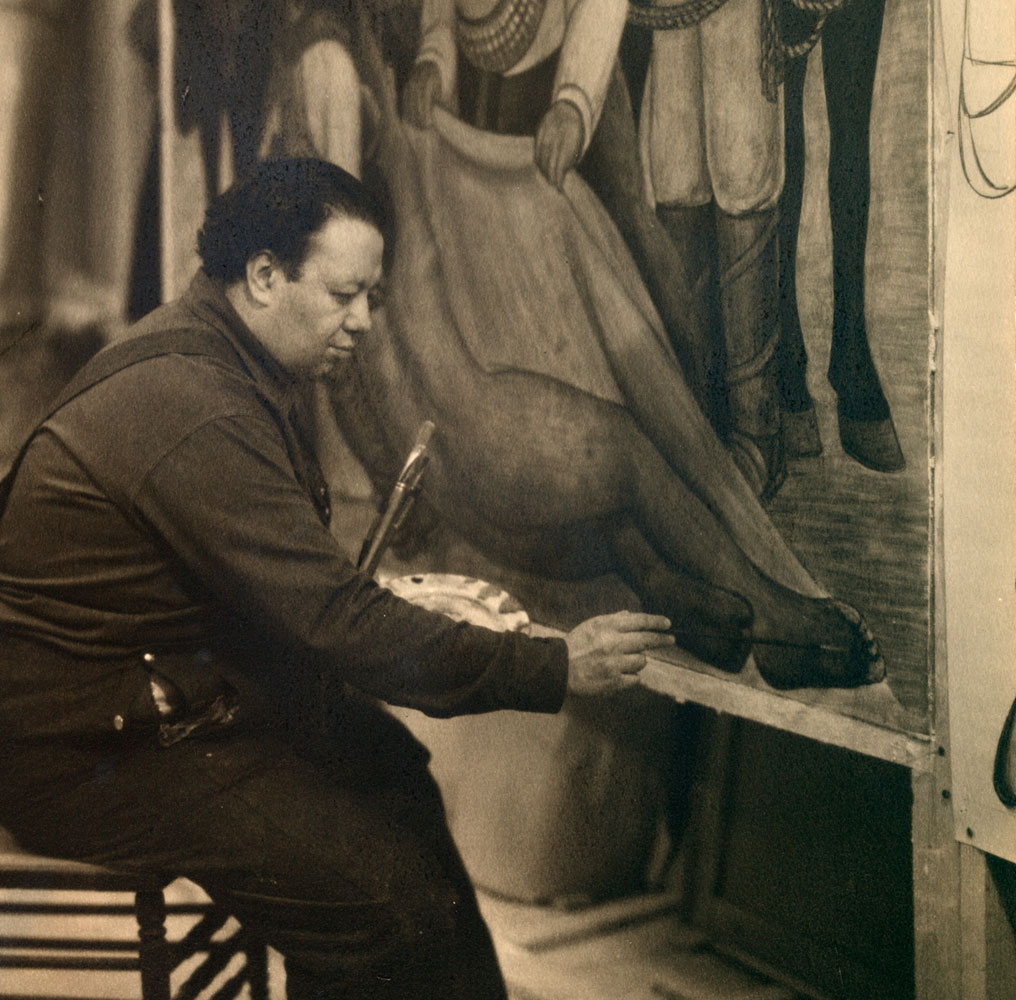
When Calexico resident and lifelong artist Sergio Gaytan said he thinks of muralists, the three Mexican greats of the early 20th century spring to mind — Diego Rivera, Alfaro Siqueiros and Jose Clemente Orozco.
Like theirs, his own art often incorporates representations of iconic cultural images, social issues and historical events for effect, Gaytan said.
Yet he feels there isn’t much of a clamor to see such imagery in public spaces anymore, he said.
“Muralism is not as strong or as powerful as it used to be,” Gaytan said.
While Gaytan’s artwork has yet to be affixed to a large-scale public project, neither has he had the opportunity to make a living as an artist, instead working for about 20 years with Imperial Valley College’s counseling office before his recent retirement.
These days Gaytan continues to draw and paint and doesn’t shy away from using imagery that may offend, he said.
In that respect Gaytan cleaves close to the ethos of the Mexican muralists as well as their Chicano counterparts, who used art to examine their identity and history as well as speak out about social issues — often in a controversial way.
A combination of street art and community activism, the Chicano murals of a generation ago were seen as a way to rally and unite the community, decorating space and using it to educate the public, said Eva Margarita Nieto, professor of Chicano Studies at California State University, Northridge.
“That period was intense,” Nieto said, adding that the energy that existed in the ‘60s and ‘70s is not as commonly found in contemporary artists and muralists.
Locally, the vestiges of the muralist movement are still visible in some Valley locales, but locals also speak of an equal number that have fallen to time and indifference.
“You used to see a lot of (murals) around the Valley,” said Calexico Arts Commission chairwoman Hildy Carrillo.
The local drive to produce art in public spaces was akin to a “movement,” Carrillo said, noting that a sense of hope also accompanied the popular medium of those bygone days.
In the past, Carrillo said that artwork that celebrated “our roots,” commented on the Vietnam War, or honored field workers, were the norm.
As of late, she said that she hasn’t “seen any mural around here that catches my attention or says anything.”
The Arts Commission is in the process of cataloguing the murals within the city, she said, adding that the commission is also open to funding public works. Yet such an effort may also require the help of Calexico City Council and grant writing.
While the Valley is not lacking for artists, gallery space, instructors and performance artists, Carrillo said the scene still needs lots of support.
“We don’t really have public art,” she said, noting that Mexicali has a thriving public art scene.
But local efforts are afoot. A grant-seeking proposal that would unite various arts agencies throughout the Valley is also aiming to have a small mural adorn the J. Lowe Gallery at Imperial Valley College, said Carol Hegarty, IVC humanities department chairwoman.
And, officials are considering having another Cesar Chavez mural adorn the new Campesinos Unidos building in Brawley, executive director Jose M. Lopez said.
But devoting oneself to creating public art, many said, hardly pays the bills.
As someone who was highly attuned to political issues, the civil rights movement and Cesar Chavez’s United Farm Workers movement, the late Domingo Ulloa produced numerous works that captured the spirit of those turbulent times, his daughter Martha Ulloa-Sanchez said.
Yet her father made a career as a house painter, she said, and is widely referred to as an “undiscovered master” in art circles.
The late Ulloa spent many decades in the Valley, where he often painted pictures depicting the struggles of farmworkers. Several years prior to his passing, the Assembly honored him in 1993 as the “Father of Chicano Art.”
“He voiced opinions through his artwork,” Ulloa-Sanchez said.
And as many contemporary Chicano artists have found, praise is hard to come by in an environment where their work is constantly being compared to those pioneering artists that exhibited an activist streak. Yet tastes and opinions keep evolving regardless of what the so-called experts may have to say, Nieto said.
T-shirt art seems to have picked up the torch and become something of a preferred and easily accessible medium, Nieto said. It is not uncommon to find Latinos producing and wearing T-shirts that often contain a deeper message and evoke important social commentary.
“T-shirts are a class-breaking type of clothing,” she said. “It’s just another kind of public space.”
Staff Writer, Copy Editor Julio Morales can be reached at 760-335-4665 or at jmorales@ivpressonline.com.
-30-