Showing posts with label mexico. Show all posts

Friday, January 27, 2017

Photos of Oaxaca, Alebrijes and More


If you have the time or the inclination please check out my photographs of Oaxaca Mexico in a UHD … 4k YouTube video. In 2005, I captured the original pix using a Nikon D70s … a 6-megapixel camera. Today, I use a 36-megapixel camera. Yes, in photography bigger sensors are typically better.

I haven't gone to Europe, Africa, Asia or even Hawaii, but I have traveled a bit. Primarily throughout the American Southwest and Mexico. I have enjoyed the amazing diversity and photography opportunities this region has to offer. 

In Oaxaca, I photographed the communities, artists and workshops. Along with photographs of Oaxaca, I have several images of Mexican artists creating wood sculptures called Alebrijes. These fantastical and colorful creatures are popular in Mexico City and Oaxaca. My photographs explore the artistic transformation from roughly hewn pieces of wood, to sculpting fine details to painstakingly adding colorful lines, dots and textures. 

If you like my YouTube video ... don't forget to like, subscribe and share my video. Support my photography and video efforts by visiting my Patreon page. Your professional comments and questions are always appreciated. 


Thanks!

Si se puede! Hablo español.

Friday, March 14, 2014

How the CIA bought Juan Rulfo Some Land in the Country: Meditations on Eric Bennett’s “How Iowa Flattened Literature”


by Patrick Iber

Did the CIA fund creative writing in Mexico? The answer is “yes.” In the second half of the twentieth-century, Mexico’s most prestigious creative writing center, Mexico City’s Centro Mexicano de Escritores, gave writers year-long grants to devote themselves exclusively to writing. Senior authors taught technique and supervised workshops based on the model of the Iowa Writers’ Workshop. Beginning in the late 1950s the CME began to receive funding from the Farfield Foundation, a CIA front, for its publications. Later, more money that was likely from the CIA arrived via the Congress for Cultural Freedom, facilitated by John Hunt, a novelist and CIA case officer who had once taught courses at Iowa. The Farfield Foundation, in the late 1960s, even helped Juan Rulfo, the CME’s prize graduate and teacher, purchase a parcel of land in the countryside.

This February, the Chronicle of Higher Education ran a dynamic and engaging essay, “How Iowa Flattened Literature,” by Eric Bennett, offering both an early look at the findings of his forthcoming book, and a story of how that work came to be.[1] The hook at the beginning of his article is structurally the same as the one used here: “Did the CIA fund creative writing in America?” and the answer is also the same: it is “yes.” The mechanisms and timing were also identical: the Farfield Foundation, John Hunt, mid-to-late 1960s. But in spite of their similarities, putting the two cases side-by-side seems to me not to suggest a reading of the evidence that does not speak to the power of the CIA over culture at the height of the Cold War, but of the successful mobilization of Cold War politics by program directors seeking to fund necessarily unprofitable work. Put differently, it suggests that institutional writing programs used the CIA more than the other way around.

Before turning to an examination of the evidence, let me begin with an elaborate set of personal disclaimers, for Eric Bennett’s essay arrived at my virtual doorstep like an unexpected gift. The great majority of my childhood was spent in Iowa City, the home of the Iowa Writers’ Workshop. As a young man surrounded largely by cornfields, in a state with many more pigs than people, the Writers’ Workshop provided a serviceable illusion of cosmopolitanism. Important things happened elsewhere, but important writing happened there. I still remember the feeling of embeddedness in a larger cultural universe that came when, at age 14 or 15, I read Iowa teacher Kurt Vonnegut mention the local Sears Roebuck in Slaughterhouse-Five. (Though Bennett’s essay makes one wonder whether this might have been some sort of canny product placement.) Though I left Iowa City some fifteen years ago, as with Bennett, it remains one of my favorite places on earth. But there is more: I have since become a scholar of the cultural Cold War. Bennett’s book, forthcoming with the University of Iowa (!) press—is one that I have been hoping desperately that someone would write. As soon as it is published, it will immediately move to the front of my reading list. If the book in any way resembles the essay to which we now have access, it will be almost everything that we can ask of a book: thoughtful, bold, and entertaining.

But will it also be right? Bennett’s essay is occasionally difficult to pin down; like an anxious bug, its argument seems to change direction just as it is about to be caught. If I have understood it correctly, there are two related central claims. The most important is that something is amiss in the world of literary fiction: a universe that now produces an excess of technically sound work without producing anything that meets the highest standards of what Bennett thinks fiction should be—a literature of ideas.

The second claim is that this is not some accident, but that the field of fiction programs was given shape by the politics of the Cold War, including in direct contributions by the CIA to Iowa, the standard-bearer of the MFA army.
These arguments need to be addressed in reverse order, so let me begin with the claim that the hegemony of Iowa in the creative writing ecosystem is responsible for certain deformities in the environment of literary fiction. Bennett’s essay is, in part, a memoir of frustration. Before he did his Ph.D.—where he did the research from which his recent essay was drawn—he too was a student at the Writers’ Workshop. There, he says, there were three types of writing that were possible: 1) modernist fiction à la Eliot, Hemingway, or Munro; 2) “winningly loquacious” writing like Fitzgerald or Cheever; and 3) magical realism. What was discouraged was “postmodernism”; the starting point of fiction was not supposed to be in the world of ideas but in the realms of sense and emotion. This attitude then cascaded throughout the country, for Iowa’s program influenced the formation of all the others: Stanford created the second by hiring Wallace Stegner, one of Iowa’s first graduates, to replicate the model. (And, as Bennett notes, Stegner shared similar impulses, believing that a novelist was “a vendor of the sensuous particulars of life […] not a dealer in concepts.”) The proliferation of MFA programs that came in the years to come bore the Iowa imprint as well, making our era of fiction The Program Era, to borrow the title of Mark McGurl’s book about it.[2] And that landscape resembles the cornfields from which it sprung: pleasantly rolling—not flat—but certainly not dramatically changeable.

This argument has a level of plausibility to it that is hard to dismiss. It seems to have struck a chord with many of my friends with MFAs in creative writing, and it reminded me of a conversation that I had many years ago with my friend and teacher John L’Heureux, who taught writing and English at Stanford, and who warned me years ago against the “puzzle literature” of David Foster Wallace that I found exciting in those days. But there is a slippage in Bennett’s essay that I can’t follow: from a dislike of “cute” postmodern literature at Iowa to an absence of a literature of ideas. The authors that Bennett’s teacher Frank Conroy at Iowa discouraged from serving as models were the “postmodernists” like Barth and Pynchon: “Meaning, Sense, and Clarity” was the mantra. Bennett seems to be arguing that imposing these structural and stylistic constraints make it difficult to write Something Very Important. In a Bourdeauian sense, the “field” of literary fiction has been structured in a way that excludes the kind of work that would be foundational to a literature of ideas. “Texts worth reading,” Bennett writes in the final paragraph of the essay, “worth reading now, and worth reading 200 years from now—coordinate the personal with the national with the international; they embed the instant in the instant’s full context and history.” As an historian and not as a fiction writer, this seems to me perfectly reasonable. But the writers who Bennett signals are coming closest to that standard today, Jonathan Franzen and Marilynne Robinson, are working in a different tradition than Barth and Pynchon.[3] (And, for what it might be worth, Robinson teaches at Iowa.)

Additionally, speaking as a teacher, asking students to attempt to write something that will have value in two hundred years seems like an invitation to total disaster. Bennett wants us to work to produce a great work of ideas: the kind of thing that will come around every half century years or so, summoning the spirit of the age with one hand and asking it to wait with the other. But perhaps the work has already been written; what people fifty and a hundred years from now will find remarkable about our age may well not be what we think it is today. Though some miasmatic version of Bennett’s argument about the influence of Iowa seems plausible, I can’t help but think that even Iowa could not stand in the way of Something Very Important being written, at least over the long run.

But whatever my own doubts might be, this is world to which I cannot speak from experience. Many of my MFA-graduate friends seemed to find significance in Bennett’s piece, as if their exquisitely rendered career frustrations could be likened to a hollow novelty birthday cake out of which had just popped a man with dark glasses and an obvious record of human rights abuses. And to this second point, I can speak with more authority: what does it mean that the CIA funded creative writing at Iowa?

The “smoking gun” is a contribution to Paul Engle of the Iowa Writers’ Workshop from the Farfield Foundation, dated 1967. As Bennett notes, the Farfield Foundation was not an ordinary charitable organization: it was a CIA front.  Its most important task was to provide the public face for the money that to the Congress for Cultural Freedom, the CIA’s major vehicle for the support of anti-Communist artistic and intellectual work during the Cold War. The Farfield Foundation was “in” on the whole thing. Julius “Junkie” Fleischmann, the head of the Foundation, saw himself as doing the CIA a favor. One of the CIA officials who arranged for the money to be transferred described him as one of the many “rich people who wanted to be of service to government…They were made to feel they were big shots because they were let in on this secret expedition to battle the Communists.”[4]

The full scope of CIA engagement with culture is beyond the scope of this essay, but let me be clear that it is not something that I want to defend. Indeed, around the time of Farfield’s contribution to Engel, such activities were becoming (appropriately, in my view), unacceptable. The Congress for Cultural Freedom had arranged to sever its financial relationship with the CIA in 1965; bailed out by a long-term grant from the Ford Foundation that substituted for it beginning in late 1966. The CIA was worried that its actions were close to being exposed (and they were, in newspaper articles in the New York Times in 1966 and in more detail in the magazine Ramparts in 1967). Subsequent actions required that these CIA contributions to cultural and “civil society” groups be wound down; a few of the most valuable properties, like Radio Free Europe/Radio Liberty, were maintained, and most were not and such functions were eventually passed over to quasi-governmental National Endowment for Democracy, created in the 1983. The contribution to Iowa in 1967 comes at the very end of possibility for such a transaction from the CIA.

But what are we to make of it? Here, I think the contrast with the Mexican Writing Center is instructive. The Centro Mexicano de Escritores was founded in fits and starts during the early 1950s; its prime mover was a North American novelist named Margaret Shedd. She was a semi-permanent resident of the Bay Area, and had witnessed Stegner building the program at Stanford, where she sometimes taught extension courses. (In that sense, the Mexican Center is probably the first attempt to internationalize the Iowa model, at two steps of remove.) Shedd’s husband had worked in the U.S. embassy in Mexico, and her boredom led her to formulate plans for a binational writing workshop. As with Iowa, a lot of money in the 1950s came from the Rockefeller Foundation, which provided year-long grants, mostly for Mexican writers but occasionally for some from the U.S. or elsewhere in Latin America, to devote themselves exclusively to their craft. Shedd and others taught much-ridiculed courses in technique, while students met in frequent workshops. The record of selecting promising writers was extraordinary: over its life, graduates of the CME included Juan Rulfo, Carlos Fuentes, Elena Poniatowska, Rosario Castellanos, Carlos Monsiváis, and many others that number among Mexico’s best novelists, poets, playwrights, and essayists.

National security concerns were always present in the motivations of the CME’s foreign funders. The Rockefeller Foundation believed that exchange between North American and Mexican writers would improve relations between the two countries at an important node, making the (implausible) assumption that writers “spoke for their countries.” In 1959, the CIA-front Farfield Foundation began contributing a small percentage of the annual budget—something like 2% of the total. In the early 1960s, the Congress for Cultural Freedom itself grew interested, and paid the salary of Juan Rulfo for at least a couple of years. Rulfo’s lifetime literary output consisted of a celebrated short novel, Pedro Páramo, and a book of short stories, El llano en llamas (The Burning Plain), both finished on CME grants in the early 1950s. He would never publish anything else again. Money from the Congress for Cultural Freedom paid for Rulfo’s salary in the mid-1960s, hoping that he would become a more prominent author to rival famous Communist writers like Pablo Neruda. In the late 1960s, the Farfield Foundation seems to have been persuaded to buy him that plot of land in the country—to give him the peace and quiet to write, of course—something he never did again.

It would be easy, at this juncture, to decry the CIA’s influence over Mexican culture. And indeed, the CME does seem to have had a policy of not admitting Communists in the 1950s. In turn, some on the literary left insulted the “Gringo-Mexican Institute” for its Rockefeller funding, and imagined that Shedd was writing a novel called the Subterranean Penetration of the USA in Mexico. But in the 1960s, when the CIA was providing some of the budget, there were actually several Communist students. Plenty of others who passed through the Center, such as Carlos Fuentes, Elena Poniatowska, and Carlos Monsiváis, remained associated with one variety or another of left-wing politics and certainly did not shy from criticism of U.S. imperialism. The CIA’s manipulations seem entirely wasted: it is very difficult to see any clear relationship between the politics of the Center’s funders and what its literary output. The Rockefeller Foundation wanted Mexico and the U.S. to “understand” each other better; the CIA wanted to boost the profiles of anti-Communist writers. But the naïve Pan-Americanism and anti-Communist both went unfulfilled. After the 1960s, when the Mexican government and private corporations supplied most of the budget, they wanted the Center to produce great writers that would redound to the glory of Mexico. But this too was a failure: it was the years of most compromised foreign funding that produced the best graduates. It seems to me that the CME was a remarkable failure as an instrument of cultural diplomacy, but was, all the same, one of the most important and successful writing centers in the world during its best years. It closed in 2005, and looks to me like a noble monument to success through failure.

What is striking, then, given the parallels to Iowa—where many of the same features were present—is not the influence of the CIA over culture, but the ability of cultural producers to use the politics of the Cold War to further their own endeavors. “[Iowa’s Paul] Engle constantly invoked the need to bring foreign writers to Iowa so they could learn to love America,” writes Bennett. “That was the key to raising money. If intellectuals from Seoul and Manila and Bangladesh could write and be read and live well-housed with full stomachs amid beautiful cornfields and unrivaled civil liberties, they would return home fighting for our side. This was what Engle told Midwestern businessmen, and Midwestern businessmen wrote big checks.” Yes, Paul Engle at Iowa was a Cold Warrior. He accepted money from the CIA, and used the language of the Cold War to earn sponsorship from both local businesses and the state bureaucracy. Just as in Mexico, creative writing in the United States depended on shining the boots of the capitalist class and the state bureaucracy that defended it. But if the effects of this on what was written were minimal, then who, exactly, was using whom?

[1] http://chronicle.com/article/How-Iowa-Flattened-Literature/144531/ The essay is adapted from a somewhat longer essay in a brand-new edited volume: Eric Bennett, “The Pyramid Scheme,” in MFA vs. NYC: The Two Cultures of American Fiction, ed. by Chad Harbach (New York: n+1/Faber and Faber, 2014), 51–72.
[2] Mark McGurl, The Program Era: Postwar Fiction and the Rise of Creative Writing (Cambridge, Mass.: Harvard University Press, 2009).
[3] Additionally, there are clearly graduates of MFA programs who have worked in the “postmodern” tradition. I think, for example, of Chris Bachelder, a graduate of the University of Florida in 2002 and his satire Bear vs. Shark. And also his later U.S.!, a masterful novel of ideas that describes the world’s reaction to the resurrection of the undead corpse of Upton Sinclair—one of the smartest things about the left in the United States that I have ever read.
[4] Frances Stonor Saunders, The Cultural Cold War: The CIA and the World of Arts and Letters (New York: New Press: Distributed by W.W. Norton & Co., 2000), 126.
_____________________________
Patrick Iber is a lecturer in the Department of History at the University of California, Berkeley. His first book, provisionally titled The Disenchantment of the Word: Artists, Writers, and the Cold War in Latin America, is due out from Harvard University Press in 2015.

Sunday, November 04, 2012

Zetas Cartel Occupies Mexico State of Coahuila


By Tracy Wilkinson for LA Times

Few outside Coahuila state noticed. Headlines were rare. But steadily, inexorably, Mexico's third-largest state slipped under the control of its deadliest drug cartel, the Zetas.

The aggressively expanding Zetas took advantage of three things in this state right across the border from Texas: rampant political corruption, an intimidated and silent public, and, if new statements by the former governor are to be believed, a complicit and profiting segment of the business elite. It took scarcely three years.

What happened to Coahuila has been replicated in several Mexican states — not just the violent ones that get the most attention, but others that have more quietly succumbed to cartel domination. Their tragedies cast Mexico's security situation and democratic strength in a much darker light than is usually acknowledged by government officials who have been waging a war against the drug gangs for six years.

"We are a people under siege, and it is a region-wide problem," said Raul Vera, the Roman Catholic bishop of Coahuila. A violence once limited to a small corner of the state has now spread in ways few imagined, he said.

What sets the Zetas apart from other cartels, in addition to a gruesome brutality designed to terrorize, is their determination to dominate territory by controlling all aspects of local criminal businesses.

Not content to simply smuggle drugs through a region, the Zetas move in, confront every local crime boss in charge of contraband, pirated CDs, prostitution, street drug sales and after-hour clubs, and announce that they are taking over. The locals have to comply or risk death.

And so it was in Coahuila. One common threat from Zeta extortionists, according to Saltillo businessmen: a thousand pesos, or three fingers.

With the Zetas meeting little resistance, wheels greased by a corrupt local government, there was little violence. But the people of Coahuila found themselves under the yoke of a vicious cartel nonetheless.

"It was as if it all fell from the sky to the Earth," said Eduardo Calderon, a psychologist who works with migrants, many of whom have been killed in the conflict. "We all knew it was happening, but it was as if it happened in silence."

The "silence" ended in rapid-fire succession in a few weeks' time starting mid-September. Coahuila saw one of the biggest mass prison breaks in history, staged by Zetas to free Zetas; the killing of the son of one of the country's most prominent political families (a police chief is the top suspect); and, on Oct. 7, the apparent slaying of the Zetas' top leader by federal troops who say they stumbled upon him as he watched a baseball game.

"Apparent" because armed commandos brazenly stole the body from local authorities within hours of the shooting. The military insists that the dead man was Heriberto Lazcano, Mexico's most feared fugitive, acknowledging that he had been living comfortably and freely in Coahuila for some time.

"He was like Pedro in his house," former Gov. Humberto Moreira said, using an expression that means he was totally at home and could go anywhere.

The Zetas had such confident dominion over the state that Lazcano, alias the Executioner, and the other top Zeta leader, Miguel Angel Trevino, regularly used a vast Coahuila game reserve to hunt zebras they imported from Africa.

Since their formation in the late 1990s and early 2000s as a paramilitary bodyguard for the then-dominant Gulf cartel, the Zetas operated primarily in Tamaulipas state on Mexico's northeastern shoulder and down the coast of Veracruz and into Guatemala.

For most of that time, Coahuila, rich in coal mines and with a booming auto industry, was used by cartels as little more than a transit route for drugs across the border. The Zetas maintained a presence limited to Torreon, the southwestern Coahuila city that served as a bulwark against the powerful Sinaloa cartel that reigned in neighboring Durango state.

In 2010, the Zetas broke away from the Gulf cartel, triggering a war that bloodied much of Tamaulipas and spilled over into neighboring states. Coahuila, with its rugged mountains and sparsely populated tracts, became a refuge for the Zetas, and they spread out across the state, including this heretofore calm capital, Saltillo.

Even if the violence hasn't been as ghastly as in other parts of Mexico, nearly 300 people, many of them professionals, have vanished in Coahuila, probably kidnapped by the Zetas for ransom or for their skills.

The man in charge of Coahuila during most of the Zeta takeover was Moreira, the former governor. After five years in office, he left the position a year ahead of schedule, in early 2011, to assume the national leadership of the Institutional Revolutionary Party on the eve of its triumphant return to presidential power after more than a decade.

But scandal followed Moreira, including a debt of more than $3 million he had saddled Coahuila with, allegedly from fraudulent loans. He was eventually forced to quit the PRI leadership, dashing what many thought to be his presidential aspirations.

Tragedy followed when Moreira's son Jose Eduardo was shot twice in the head execution-style in the Coahuila town of Acuna early last month. Investigators believe that most of the Acuna police department turned Jose Eduardo over to the Zetas as a reprisal for the killing of a nephew of Trevino. The police chief was arrested.

Killing the son of a former governor — and nephew of the current one, Humberto's brother Ruben — was a rare strike by drug traffickers into the heart of Mexico's political elite.

In mourning, Humberto Moreira gave a series of remarkably candid interviews in which he accused entrepreneurs from Coahuila's mining sector of sharing the wealth with top drug traffickers who in turn used the money to buy weapons and pay off their troops. They killed his son, he said.

Mining in Coahuila is huge and notoriously dangerous, with companies routinely flouting safety regulations and workers dying in explosions and accidents. The depth to which drug traffickers have penetrated the industry is being investigated by federal authorities.

The question on the minds of many Mexicans was: If Moreira was so aware of criminal penetration, why didn't he stop it?

Critics suggest that during his tenure, he was happy to turn a blind eye to the growth of the Zetas as long as he could pursue his business and political interests. He denies that now and says fighting organized crime was up to the federal government; the federal government blames state officials, in Coahuila and elsewhere, for coddling the drug lords.

"The northern governors have long cut deals with the cartels that operate in their domains. The pattern in the north is cooperation," said George W. Grayson, a Mexico scholar at the College of William & Mary in Williamsburg, Va., who has written extensively on the Zetas and Mexican issues.

"The Coahuila police are among the most corrupt in all Mexico."

The extent to which the Zetas' tentacles had penetrated state government became clear this year when federal authorities discovered a protection racket that dated well into

Humberto Moreira's administration and was led by none other than the brother of the state attorney general. According to the federal investigation, he and 10 other state officials were being paid roughly $60,000 a month by the Zetas to leak information to the gang.

The nearly 3 million residents of Coahuila, meanwhile, find ways to survive and accommodate.

In rural areas where the Zetas are most commonly seen on the streets, people have learned to be mute and blind. In cities such as Saltillo, they change their habits, don't go out at night, send their children to school in other cities.

A businessman whose family has lived here for generations said, "We are in a state of war, without realizing when or how we got there."

wilkinson@latimes.com

-30-

Thursday, January 05, 2012

How US Policies Fueled Mexico's Great Migration


By David Bacon (really?) for The Nation

This article was reported in partnership with The Investigative Fund at The Nation Institute and the Puffin Foundation. Some names of the people profiled in this article have been changed.

Roberto Ortega tried to make a living slaughtering pigs in Veracruz, Mexico. “In my town, Las Choapas, after I killed a pig, I would cut it up to sell the meat,” he recalls. But in the late 1990s, after the North American Free Trade Agreement (NAFTA) opened up Mexican markets to massive pork imports from US companies like Smithfield Foods, Ortega and other small-scale butchers in Mexico were devastated by the drop in prices. “Whatever I could do to make money, I did,” Ortega explains. “But I could never make enough for us to survive.” In 1999 he came to the United States, where he again slaughtered pigs for a living. This time, though, he did it as a worker in the world’s largest pork slaughterhouse, in Tar Heel, North Carolina.

His new employer? Smithfield—the same company whose imports helped to drive small butchers like him out of business in Mexico.

David Ceja, another immigrant from Veracruz who wound up in Tar Heel, recalls, “Sometimes the price of a pig was enough to buy what we needed, but then it wasn’t. Farm prices were always going down. We couldn’t pay for electricity, so we’d just use candles. Everyone was hurting almost all the time.”

Ceja remembers that his family had ten cows, as well as pigs and chickens, when he was growing up. Even then, he still had to work, and they sometimes went hungry. “But we could give milk to people who came asking for it. There were people even worse off than us,” he recalls.

In 1999, when Ceja was 18, he left his family’s farm in Martinez de la Torre, in northern Veracruz. His parents sold four cows and two hectares of land, and came up with enough money to get him to the border. There he found a coyote who took him across for $1,200. “I didn’t really want to leave, but I felt I had to,” he remembers. “I was afraid, but our need was so great.”

He arrived in Texas, still owing for the passage. “I couldn’t find work for three months. I was desperate,” he says. He feared the consequences if he couldn’t pay, and took whatever work he could find until he finally reached North Carolina. There friends helped him get a real job at Smithfield’s Tar Heel packinghouse. “The boys I played with as a kid are all in the US,” he says. “I’d see many of them working in the plant.”

North Carolina became the number-one US destination for Veracruz’s displaced farmers. Many got jobs at Smithfield, and some, like Ortega and Ceja, helped lead the sixteen-year fight that finally brought in a union there. But they paid a high price. Asserting their rights also made them the targets of harsh immigration enforcement and a growing wave of hostility toward Mexicans in the American South.

The experience of Veracruz migrants reveals a close connection between US investment and trade deals in Mexico and the displacement and migration of its people. For nearly two decades, Smithfield has used NAFTA and the forces it unleashed to become the world’s largest packer and processor of hogs and pork. But the conditions in Veracruz that helped Smithfield make high profits plunged thousands of rural residents into poverty. Tens of thousands left Mexico, many eventually helping Smithfield’s bottom line once again by working for low wages on its US meatpacking lines. “The free trade agreement was the cause of our problems,” Ceja says.

Read the whole article in The Nation by clicking here or the header...

-30-

Saturday, June 11, 2011

Blood Daughters: A Romilia Chacón Novel

A Novel by Marcos M. Villatoro

A child dies on the border between California and Mexico. This is nothing new: immigrants die crossing the border all the time, escaping from poverty and violence in Latin America. They bake in the desert. But this death is different. Someone has taken body parts from the child.

FBI Agent Romilia Chacón, a Salvadoran American, follows this case into a world that swallows her with its horror, a world that exists alongside ours, where children are bought and sold like cattle and shipped to men all across the country. The dealers in this blackest of markets have no moral barometer, only the lust for cash. And one among them has taken murder to a level beyond serial killing.

Romilia comes to this case already broken: the man she loved and yet had to hunt—drug runner Tekún Umán, a regular on the FBI’s Most Wanted List—is gone. Romilia has two friends, her partner Nancy Pearl—who lives a double life between the Feds and the cartels—and a bottle of booze. Romilia’s mother is on her back to get sober; her son drifts further away. And the killer is taking away pieces of Romilia’s life, day by day.

Blood Daughters: A Romilia Chacón Novel

A Novel by Marcos M. Villatoro

ISBN: 978-1-59709-426-9

5.5 x 8.5; Tradepaper

232 pages

Price: US $21.95

Scheduled Release: October 1, 2011

-30-

Thursday, January 21, 2010

Humberto Montes de Oca To Speak In San Jose On Mexican Labor Lockout


Bay Area Tour of Humberto Montes de Oca
Interior Secretary, Mexican Electrical workers Union (SME)
January 18-28, 2010


Forty-four thousand electrical workers in central Mexico have been locked out of their jobs since October 10, 2009, when the government of President Felipe Calderon, who was imposed by fraud in the July 2006 election, closed the public utility company Luz y Fuerza del Centro with the aim of privatizing this nationalized corporation and destroying the powerful and militant Mexican Electrical Workers Union (Sindicato Mexicano de Electricistas, or SME).

Learn first hand from one of the central leaders of this union, Humberto Montes de Oca, about this struggle which is being waged by these energy industry workers and their union - with the support of hundreds of thousands of others who have taken to the streets for more than three months to protest the firings at Luz Y Fuerza and the attack on the SME union.

Learn about the history of SME and how it has spearheaded the movement across Mexico against NAFTA, privatization, and the entire predatory corporate agenda. And learn what we can do to help these workers in their struggle -- which, in many ways, is our fight too.

The ten-day tour is sponsored by the San Francisco Labor Council, supported by the South Bay AFL-CIO Labor Council, Santa Clara County Building Trades Council, Plumbers & Fitters Local 393, UFCW 5, many other unions and councils, MAIZ Movimiento de Accion Inspirando Servicio and many other community organizations.

In San Jose, Humberto Montes de Oca will appear at the Labor Temple, 2102 Almaden Road (corner of Canoas Garden Road), Tuesday, January 26, 7:00-8:30 P.M.
Performances by vocalist, Tema Quinonez and poet, Agustin Palacios
Refreshments provided For information about the San Jose event call 408/250-9245 or 408/831-1394.

To learn more about the tour and where Humberto Montes de Oca will be appearing at public forums, organizational meetings and fundraisers, please call 415/513-5393.

To offer immediate solidarity with both the tour and the struggle of the energy workers in SME, write your check to the San Francisco Labor Council (SME Organizing Tour) 1188 Franklin St., San Francisco, 94109-6852. For more information call 415/513-5393

Article courtesy of Fred Hirsch fredhirsch@cruzio.com

-30-

Tuesday, September 16, 2008

The Invisible Chicano


[Click image of the printable PDF poster to enlarge. Copyright 2008 Jesus Manuel Mena Garza. All rights reserved.]

If you travel outside the Southwest, a strange phenomenon occurs. Chicanos* become invisible.

This ubiquitous phenomenon is most obvious on East Coast campuses. Chicano culture is not valued here. Chicanocentric art and history are dismissed with nary a thought.

[Click: To learn more about Chicano Studies]

They value traditional courses (you know what they are.) Occasionally they deliver a course on African-Americans or Afro-Latins. East Coasters know a bit (only a little bit) about the African Diaspora. Please don't ask them about Nepantla and Aztlan.

I am a strong proponent of more diversity. We need more classes on Asian-American, American-Indian, African-American and Chicano culture. Lord knows we are drowning in European culture, like it or not.

Here is an important fact. Today (2008), Chicanos are the largest minority group in the USA. Even with a new fence on the border, Chicanos will continue to expand their presence. Chicanos are migrating all across our country including Iowa, New York and Georgia. Yes, the Mexicano/Chicano Diaspora is changing the face of America. Some Americans don't appreciate the new paradigm. Do you?

The University of Minnesota understands what is taking place. Unlike those East Coast schools, they are hiring professors in Chicano Studies. Eventually, hopefully, some East Coast schools will consider expanding their knowledge base. In the interim, you can take classes on the Northern-Renaissance and the Crusades.

By the way you don’t have to be brown to teach Chicanocentric courses. In my opinion, all you need is a healthy respect and understanding of the cultural nuances. Admitting that Chicano culture is relevant in today's world is the first step towards creating a curriculum that effectively embraces the new American paradigm.

*Chicanas, Chicanos and Chicana/os

###

Tuesday, April 10, 2007

Comment About Documentary Photography

[Photo: Old Man From Juarez, Mexico, 1975. Click on image to enlarge. Copyright 2007 Jesús Manuel Mena Garza. All rights reserved.]


Some documentary photographers treat their subjects like quarry in the jungle. They stalk them, take their shot and then hang their desiccated representation on a distant sterile wall. The jungle can be the Amazon or the streets of a barrio, it is all the same to them.

As outsiders, their images lack any humanity and show a disdain for their subjects. At the photography reception, the shooter can be seen prancing around, weaving fanciful tales of his adventures to the spellbound audience.

The assembled, saturated by the stench of privilege, sip on wine. Esoteric rhythms waft in the background. The photographs remain mute. Surrounded, the captured photographs witness the decadence.

Jesús Manuel Mena Garza

-30-

Wednesday, February 28, 2007

Chicano Photographer Exhibition


[Photo: Chicano Photographer poster. Click on image to enlarge. Photo and design are copyright 2007 Jesús Manuel Mena Garza. All rights reserved.]


I have never been to the East Coast. That is about to change. This fall, I will be showing select prints from my Chicano Photographer series at St. Mary's College of Maryland.

Chicano Photographer is a historic collection of documentary photographs exploring the Chicano community and activism during the 1970s. The images illuminate the panoply of activists, artists and issues of that period. For this important book and exhibition project, I have gleaned images from several thousand slides and negatives from my personal archive.

During the 70s, I had the privilege of touring with theater groups throughout Mexico and California. From this singular vantage point, I took intimate portraits of people fighting for human rights. From United Farm Workers President César E. Chavez to Teatro de La Gente, the photographs are a retrospective glimpse from the unique perspective of a photojournalist and activist.

One thing is certain, you can't go back to the 70s and take pictures of iconic figures César E. Chávez and Rodolfo "Corky" Gonzales. That is what makes this photographic series so valuable.
-30-

Sunday, June 25, 2006

June Oaxaca Trip - Where is the Beach?


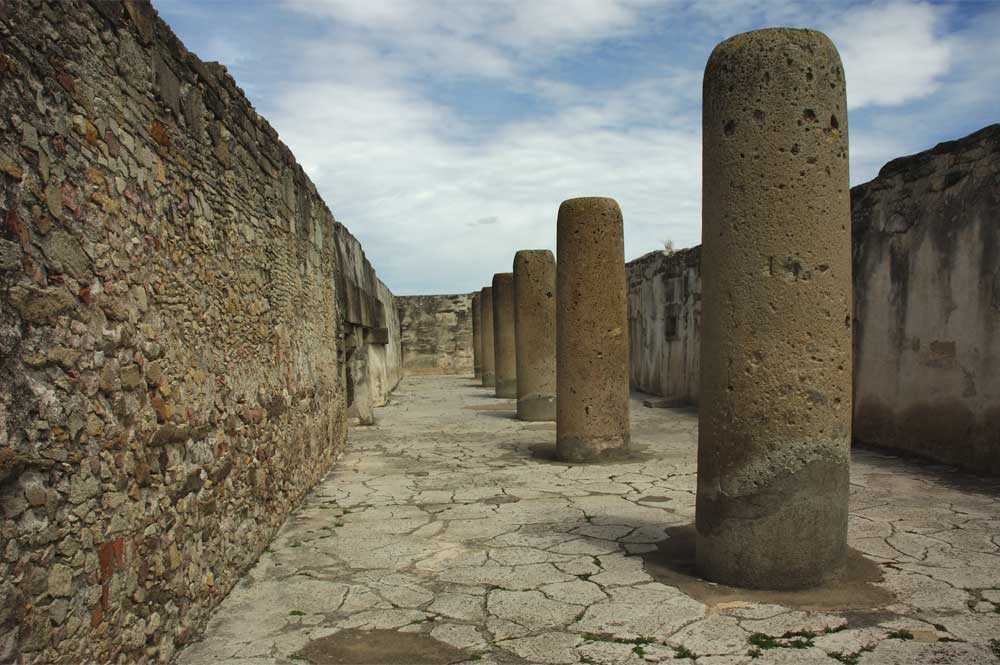
[Photos: Mitla Temple, Oaxacan Cat, Santa Domingo Church, 2006 - Click on the image to view a larger version]


My wife and I came to this Southern Mexico city so she could take Spanish classes. We rented a modest cinder-block apartment on the wrong side of the tracks. We had to dodge potholes and cars just to get to downtown Oaxaca.

The downtown Zocalo was packed during our visit, not with tourists but demonstrating teachers. I had to carefully step around these protesters who were sleeping on the ground. To avoid decapitation, I had to duck under hundreds of guy wires supporting make-shift homes.

It was more tranquil a few short blocks away near Santa Domingo Church. The church sits in the middle of the colonial and trendy part of town. Here, there were plenty of great restaurants, galleries and shops. Because of the artistic Mixtec and Zapotec Indians, the streets were very colorful. Yes, I brought home a few of mementos; they ranged from ceramic vases to colorful painted wood sculptures.

The weather in Oaxaca was predictable. Most days the rain would wash the streets around 6 p.m. Definitely, bring an umbrella during the summer. The weather is too humid for a jacket.

Would I come back to Oaxaca? I'd rather not. I suggested to my wife that we opt for less culture and more beach next time. However, my requests are often ignored. You see, my wife is an art historian specializing in Latin America and she loves this stuff. Frankly, I'd rather go fishing.

I hope you like the photos. Click on them for a larger view. Go to my web site for more: http://www.jmmgarza.com.


-30-

Best Fishing Combo For Oregon Coast Striped Bass

 I ASKED GOOGLE Ai: Suggest a rod and real combo for catching 20 pound striped bass off the coast of Oregon? PHOTO: August 2026 fishing in C...