Showing posts with label art. Show all posts

Tuesday, February 08, 2022

Corporate Friendly Museum of the American Latino?

(ArtWeek) The forthcoming National Museum of the American Latino in Washington, D.C., has named Jorge Zamanillo as its inaugural director, beginning May 2. He will take over for Eduardo Díaz, director of the Smithsonian’s Latino Center, who has served as the institution’s interim director while the search for a permanent director was underway.

Managed by the Smithsonian Institution, the new museum was established by Congress in December, along with the American Women’s History Museum, “to illuminate the story of the United States for the benefit of all by featuring Latino contributions to the art, history and culture of the nation since its early history.”

Zamanillo is currently the executive director of the HistoryMiami Museum in Florida, which is a Smithsonian Affiliate institution. During his tenure, he organized numerous exhibitions, including “Operation Pedro Pan: The Cuban Children’s Exodus” in 2015 and a rehang of the museum’s permanent collection galleries, titled “Tropical Dreams: A People’s History of Southern Florida,” and helped establish its Center for Photography. He started at the institution as a curator of object collections in 2000 and was promoted to senior curator and then deputy director before becoming executive director. In addition to managing the HistoryMiami Museum’s $6.2 million budget, Zamanillo spearheaded a $45 million expansion project that was completed in 2016.

In a statement, Smithsonian Secretary Lonnie G. Bunch III, who was founding director of National Museum of African American History and Culture when it opened in 2016, said, “Jorge’s accomplishments at HistoryMiami Museum highlight his commitment to exploring the full sweep of the American story by bringing to life the complex and profound narratives of Latinos in the United States. His transformational leadership will be invaluable as we build this necessary museum from the ground up, helping us create a robust, dynamic, responsive museum that exemplifies what a 21st-century cultural institution should be.”

Zamanillo was selected from a 10-person committee that included Díaz; Anthea Hartig, director of the National Museum of American History; Kevin Young, director of the National Museum of African American History and Culture; Taína Caragol, curator for Latino art and history at the National Portrait Gallery; and Kevin Gover, Under Secretary for Museums and Culture, who served as chair.

In a statement, Zamanillo said, “The Latino experience is American history, and I want to make sure our story will be preserved for future generations. This museum will celebrate Latino accomplishments and resiliency through powerful stories that capture the adversity faced over centuries by Latinos in the U.S. and their perseverance to move forward and create a legacy.”

Wednesday, October 27, 2021

 I've lived in many college towns. Both in Texas and California. Universities have varying degrees of civic interaction. From insular to interactive. 

Let me detail my experiences. I started life in the San Francisco Bay Area near SJSU and I currently reside in Fort Worth near TCU. 


I'm going to subjectively rate these schools from 1 to 5. Five being "very involved" in the community.


UCLA photography lecture. 2011


SJSU -3

Stanford -2

UC Berkeley - 2

UCLA - 5

CSULA - 4

UT Austin - 4

Midwestern State - 4

TCU - 1


TCU wants you to go to their football, baseball and basketball games. That's where they make money. Sadly, their primary community art gallery is located in a tiny strip mall off campus. Not much there.


UC Berkeley and Stanford are the proverbial ivory towers. It's all about academics and they don't offer much programming for the public. But they do much better than TCU.


UCLA is heavily involved in the Los Angeles arts and culture scene. When I lived in Southern California, it seemed every week there was either a lecture, an exhibition or an event my wife and I would find interesting. Same with CSULA.


So there you are. These are my impressions of various universities I've experienced. I loved going to UCLA and UT Austin. Too bad conservative TCU, just 10 minutes away, is a stick in the mud. I'd rather be in Austin or LA. Or in the Bay Area near my familia.


Friday, January 27, 2017

Photos of Oaxaca, Alebrijes and More


If you have the time or the inclination please check out my photographs of Oaxaca Mexico in a UHD … 4k YouTube video. In 2005, I captured the original pix using a Nikon D70s … a 6-megapixel camera. Today, I use a 36-megapixel camera. Yes, in photography bigger sensors are typically better.

I haven't gone to Europe, Africa, Asia or even Hawaii, but I have traveled a bit. Primarily throughout the American Southwest and Mexico. I have enjoyed the amazing diversity and photography opportunities this region has to offer. 

In Oaxaca, I photographed the communities, artists and workshops. Along with photographs of Oaxaca, I have several images of Mexican artists creating wood sculptures called Alebrijes. These fantastical and colorful creatures are popular in Mexico City and Oaxaca. My photographs explore the artistic transformation from roughly hewn pieces of wood, to sculpting fine details to painstakingly adding colorful lines, dots and textures. 

If you like my YouTube video ... don't forget to like, subscribe and share my video. Support my photography and video efforts by visiting my Patreon page. Your professional comments and questions are always appreciated. 


Thanks!

Si se puede! Hablo español.

Saturday, September 14, 2013

The Legacy of 70’s San José Chicano Arts Center Examined at SJSU

Performance, Art and Activism, a panel discussion on the legacy of El Centro Cultural de la Gente, will be held Sept. 25 at 6 pm at San José State University. The event is free and open to the public at the Dr. Martin Luther King, Jr. Library Room 225/229. A reception will follow in the Cultural Heritage Center (Fifth Floor).

In 1973, El Centro Cultural de la Gente came to life in an abandoned storefront near First and San Carlos Streets — where the Federal Building now stands. The cultural center became the epicenter for Chicana and Chicano artistic and political activism during the turbulent 1970s. The panelists will elaborate how “El Centro” informed arts production in San José and beyond.

The panel members include:
Teresa Castellanos - Moderator: Teresa currently serves as the coordinator of Immigrant Relations and Integration Services for Santa Clara County’s Office of Human Relations. She has a 25-year history of working on immigration issues through government, labor and community based organizations such as Justice for Janitors and the Health Workers Union and Catholic Charities.

Mary Jane Solis: Mary Jane has been involved in arts organizations that promote social justice and continues to support Latino art and artists in our community. She is a founding member of MACLA (Movimiento de Arte y Cultura Latino Americano) and is the former vice chair of the City of San José Arts Commission where she championed multicultural arts development.

Felipe Rodríguez: Felipe has performed for more than 50 years. Coming from an amazing family of activists and performers, it was natural for Felipe to sing and play his guitar in church, on stage and on the picket line.

Adrian Tepehua Vargas: Active in Silicon Valley’s artistic and cultural movement for over 35 years as a theatre and film director, playwright, actor, musician, and producer. For 10 years he directed San José’s former Teatro de la Gente and was co- founder of El Centro Cultural de la Gente.

Elisa Marina Alvarado: Elisa is the founding member and Artistic Director of the 29-year-old Teatro Visión. She has been active in the Chicano movement for over 40 years as an actress, director and community organizer. Elisa has taught theater for Teatro Visión, San José State University, San Francisco State University and many community organizations.

The panel discussion will take place in conjunction with Jesús Manuel Mena Garza’s exhibition, A Chicano Photographer’s Journey: 1970 to the Present. Garza will give a presentation at 3 pm of his documentary images in the same room.

Location and Time:
Dr. Martin Luther King, Jr. Library, SJSU
Wednesday, Sept. 25, 2013, Room 225/229, Second Floor
150 East San Fernando Street, San José, CA 95112
6 to 7:30 pm with reception to follow
Free and open to the Public

Sponsored by the MLK Library; SJSU School of Journalism and Mass Communication; the Cesar E. Chavez Community Action Center – SJSU Associated Students; Department of Mexican American Studies; and SJSU’s Chicano/Latino Faculty & Staff Association

Wednesday, February 22, 2012

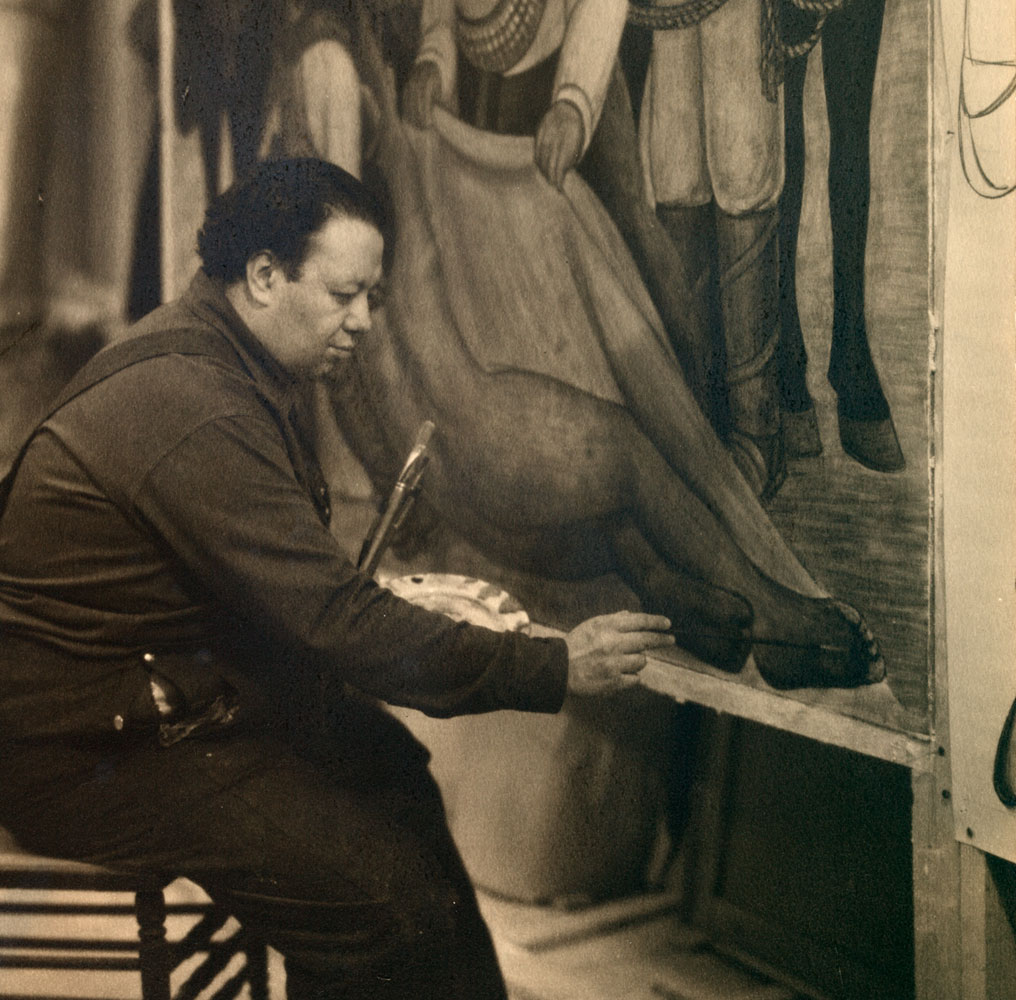
MOMA: Diego Rivera Murals


Inspect Diego Rivera murals up close. Click here!
In December 1931, The Museum of Modern Art mounted a major exhibition of work by the Mexican artist Diego Rivera. It was only the second retrospective at the Museum, and it was wildly popular, breaking attendance records in its five-week run.

Diego Rivera at work

Rivera was already an international celebrity. He was the most visible figure in Mexican muralism, a large-scale public-art initiative that emerged in the 1920s in the wake of the Mexican Revolution. But his murals—by definition fixed on a single site—were impossible to transport for exhibition. 

To solve this problem, the Museum brought Rivera to New York six weeks before the show opened and provided him with a makeshift studio in an empty gallery. There, Rivera produced five "portable murals"—freestanding frescoes commemorating events in Mexican history—which were prominently featured in the show. 

After the opening, to great publicity, Rivera made three more murals, taking on contemporary New York subjects through monumental images of the city during the Great Depression. The story of this extraordinary commission elucidates Rivera's pivotal role in shaping debates about the social and political value of public art during a period of economic crisis.
-30-

Saturday, January 14, 2012

Remembering the Chicano arts collectives of Los Angeles' Highland Park

By Esmeralda Bermudez, Los Angeles Times


They were bold enough to call it a revolution.

Back in the 1970s, when Chicano art was synonymous with East Los Angeles, its storied murals and its art center, Self-Help Graphics, a group of Mexican American artists decided to break away.

They headed north, seven miles, to start their own Chicano arts collective in Highland Park, an area that was still mostly white with little presence of Latino art.

"Our mission was to transform Highland Park into a super-revolutionary Chicano town," said artist Richard Duardo. "I drank the Kool-Aid. We all drank the Kool-Aid."

For about four years, the group set up an arts colony on the second floor of an old music building on North Figueroa Street. They printed an art magazine, created murals, paintings and silk-screen posters that became a part of the Chicano art movement — iconic political, social and cultural images.

Their legacy lives on in Highland Park's Avenue 50 Studio, a Chicano art gallery co-founded by Roberto Delgado, an artist involved with the movement.

Ten years ago he had the idea to showcase the story of the Chicano artists in Highland Park, and on Saturday it will finally be told.

Their work will be on display through Feb. 5 in an exhibit called "Resurrected Histories: Voices from the Chicano Arts Collectives of Highland Park." The gallery will also preview a one-hour documentary on the group, put together with grants and in partnership with KCET-TV.

"We felt this was an exciting story to uncover," said Kathy Gallegos, gallery director. "It was like an archaeological dig that let us understand who all was involved and how much they did while they were here."

The exhibit offers a look at all the Chicano art groups that sprouted in California four decades ago and how they were connected. They formed clusters in Fresno, San Francisco, San Diego and Los Angeles that supported one another at a time when Chicano art had no place in mainstream museums or galleries.

In Highland Park, two collectives came about in the mid-1970s. Both migrated from East L.A. in search of cheaper rent.

Mechicano Art Center, a nonprofit supported by grants to nurture art in the community, set up shop on North Figueroa, in a corner building that's now a produce market. It held exhibits, painted murals around the city and worked with local high school students.

"We were passionate about our work," said artist Sonya Fe. "The kids would come up with ideas, we'd have parties and we'd have fundraisers."

Down the street, in the old music building, Duardo and a handful of Chicano artists rented a 5,000-square-foot space for $300 a month. They called it Centro de Arte Publico, or the Center for Public Art.

Many were in their 20s and 30s, liberal college graduates with art degrees, and motivated by social injustices to express themselves through art.

They played lots of reggae, talked politics and took on a whole series of projects in the city, such as murals, picket signs for students organizing walk-outs, and posters supporting the then-revolutionary Sandinista socialist political party in Nicaragua.

To pay the bills, they did commercial work: signs for grocery stores, theaters and Realtors.

"The idea was to not depend on anyone — not grants or the government," said artist John Valadez. "We wanted to support ourselves with our own art."

Neighbors in the area never knew much about the Center for Public Art. They'd only see paintings and posters displayed on the windows of the building. Once, Carlos Almaraz, the most political of the bunch, hung a bright red flag of communist China and caused a stir on the block.

By 1980, the artists began to go their separate ways and the collective dissolved. Some married, moved away or relocated to downtown L.A., where an art scene was picking up momentum.

Many are now in the 50s and 60s, their work featured in galleries and museums across Los Angeles.

"It's good for people to know what we've done to influence art across L.A. and in the world," Delgado said. "I hope it connects us more."

esmeralda.bermudez@latimes.com

-30-

Tuesday, January 10, 2012

National Association of Latino Arts & Culture (NALAC) Names Adriana Gallego Deputy Director

Today the National Association of Latino Arts & Culture (NALAC) announces the hiring of Adriana Gallego as NALAC's new Deputy Director.

Gallego's hiring follows the addition of nationally recognized writer and digital media creator, TJ Gonzales as NALAC's Marketing and Outreach Associate. Also, Maria Tapia was brought on as the Executive Assistant to Executive Director Maria De Leon.

"I am pleased that Adriana will be joining NALAC as Deputy Director. She comes to NALAC with multiple years of experience at the Arizona Arts Commission developing grants programs and providing professional development services. Adriana is an alumnus of the NALAC Leadership Institute and has been involved with NALAC over many years. I am also pleased with the other new additions to the NALAC staff, TJ Gonzales and Maria Tapia. We will continue to strengthen NALAC's infrastructure over the coming months with additional staff to allow us the capacity to address the challenges facing the Latino arts community and the larger arts industry," said NALAC Executive Director, Maria Lopez de Leon.

During her tenure as Director of Strategic Initiatives at the Arizona Commission on the Arts, Gallego developed programs, grants, partnerships and services in support of arts organizations, artists, universities/schools, community groups and government agencies She served on many advisory boards and committees including the Transportation Enhancement Review Committee, the Asset Building for Artists of Color Advisory Board, the Flagstaff Cultural Partners Arts Advisory Board and the Arizona Public Art Network. As a painter, Gallego's artwork is forged from ideals about equality and understanding rooted in the Civil Rights and Feminist movements, with sensibilities born out of her upbringing alongside the United States-Mexico border. She received the Border-Ford Bi-national Painting Award and has completed several mural commissions in Arizona and California.

Commenting on her selection as NALAC's Deputy Director, Gallego said, "In my experience, NALAC's guiding principles are not only inspiring, but they are transformative in practice. I very much look forward to contributing to this trajectory in the service of cultivating a vibrant, diverse Latino arts and culture sector."

The addition of Gallego, Gonzales and Tapia in their respective positions comes as NALAC prepares for the 2012 National Conference to be held in Philadelphia, PA from October 17th to October 21st.

-30-

Tuesday, August 16, 2011

Chicano Photographer Exhibition Continues at San Bernardino County Museum


[Photo copyright 2011 Jesus Manuel Mena Garza. All rights reserved. Click header for more information about the exhibition.]

Chicano Photographer, an exhibition by Riverside, California documentary photographer Jesús Manuel Mena Garza is available for public viewing at the San Bernardino County Museum (SBCM) Schuilling Gallery. The show continues to November 6, 2011.

Please call (909) 307-2669 x227 or email kplimley@sbcm.sbcounty.gov for more information.

Thursday, June 16, 2011

Latina Students Land Gallery Row Exhibit for Their Interpretation of Historic Olvera Street


This month Cobá will open its headquarters to expose Art Walk attendees to a photography collection from students involved in Las Fotos Project, a non-profit, community-based program that seeks to empower Latina youth through photography. The collection of photographs is from “Nuestra Placita Olvera,” a project in which the young women captured the culture and life of the city’s historic landmark, Olvera Street, by documenting its annual celebrations.

Headquartered in the heart of the arts district in downtown Los Angeles, Cobá wanted to respect the culture of the neighborhood and thus transformed their office into a gallery featuring the work of various accomplished, local artists. Last month, Cobá featured the work of Yolanda Gonzalez, whose bold use of color and texture reflects her family’s long heritage of artists. In April, José Ramirez’s sociopolitical paintings, rich with images of Chicano culture, were a hit.

The Las Fotos Project encourages young women to express their individuality and creativity and hone their artistic talents with photography training, mentoring and field projects. On display will be the work of Valerie Beltran, age 16, Julie Cabral, age 18, Civil Hernandez, age 16, Jessenia Pineda, age 14, and Yoali Sayago, age 17. According to Las Fotos Project founder Eric V. Ibarra, “The students took a photojournalistic approach to this project by documenting historical celebrations that may be forever changed in the future. Their ability to create this beautiful installation full of color, culture, and life was very inspirational to the Las Fotos Project community and we are all very proud that their hard work and amazing accomplishments will be shared with such a large audience.”

Cobá CEO, Arnulfo Ventura stated, “Art Walk is a great venue and opportunity for these students to display their best work and I know how much this means to them.” Later adding, “Orozco’s murals in Guadalajara made an impact on me as a child and today, I see Yolanda (Gonzalez) and José (Ramirez) as some of the greats of our time. Arts have a rich history in the Latino culture and I’m just glad we’re able to provide a forum to keep celebrating these fabulous artists.”

The event takes place the evening of Thursday, June 9 during the general hours of Art Walk. Cobá, the first ready-to-drink all-natural aguas frescas company, will be providing samples of their authentic aguas frescas sweetened with organic agave.To learn more about Cobá and its work with local artists, please go to www.drinkcoba.com. For more information about Las Fotos Project, visit lasfotosproject.org.

-30-

Wednesday, May 18, 2011

HOY SPACE: Sonia Romero's Inner Landscape


HOY SPACE: Sonia Romero's Inner Landscape

Gallery 4
May 20 to August 19, 2011

Vincent Price Art Museum is delighted to present a solo show by Los Angeles-based artist Sonia Romero to inaugurate its new project gallery called the HOY SPACE. In Spanish, Hoy means “today” or “nowadays,” and fittingly the HOY SPACE features contemporary artists whose practice extends across media and who address current and active contemporary topics. The HOY SPACE offers emerging artists their first museum show, and for mid-career artists, a chance to make new work that may not fit in other contexts or venues.


Ms. Romero’s installation Inner Landscape is a mixture of painting, block printing, felt sculptures, and paper cuts that are intelligently unified both formally and conceptually. Romero began as a painter, and then in college at the Rhode Island School of Design (RISD), she majored in printmaking thereby exploring every printing process she could: etching, lithography, silkscreen and block printing. Rather than treat each medium as a distinct and separate creation, or as an end in itself, her work reflects a bold mixing of painting with print; a juxtaposition that has become decidedly her own.

Romero’s imagery is certainly recognizable: whimsical, quirky – and even at times – playful, the artist’s approach reduces elements down to their essentials without a sense of preciousness. The innocence of her drawing belies the complexity of her subject matter. Romero is a keen investigator: her work asks questions and explores social issues. However, there is no polemical stance or finger pointing.

The three large piles we see upon entering Inner Landscape are seemingly benign, arranged like haystacks; from left to right, we recognize bison skulls, kernels of corn, and bright, white eggs, piled up to about 9 feet each. Each of these piles is directly inspired by the artist’s keen interest in the historical and contemporary relationship of people with food. The bison skulls reference American perceptions toward nature and wildlife during the founding of this country; the corn kernels pay homage to a commodity that in its superabundance has become one of the most ubiquitous; and the egg pile to an almost half billion salmonella-related egg recall that occurred in 2010.

A long-time fascination with the politics of consumption has led Romero to create what she calls “gorgeous manifestations of abundance.” Void of darkness, gloominess or judgment, in each element of her installation, Romero invites us to consider imagining our own inner landscape, and seeks to engage us with our own personal stories that may resonate with the ones she has shared with us.

Sonia Romero is a Los Angeles native, and maintains a studio in Highland Park. She received her BFA from RISD in 2002. This is her first solo museum exhibition. She has had solo shows at The Folk Tree, Los Angeles, CA and Avenue 50 Studio, Los Angeles, CA, in addition to many group exhibitions across the United States. She is also well known for her public-art-commissioned projects for the Community Redevelopment Agency (CRA), Los Angeles; Los Angeles County Arts Commission and the Los Angeles Metropolitan Transportation Authority (MTA). Please visit the artist’s website:www.SoniaRomero.net for more information.

-30-

Tuesday, May 17, 2011

Santa Monica College hosts activism through art


Photo by Jeff Cote of the SMC Corsair

On Thursday, May 5, an event at Santa Monica College called "Movimiento" served as a focal point for others to see how art is incorporated into messages of activism.

The info session took place at the Pete and Susan Barrett Gallery of the Performing Arts Center, where Los Angeles based artists, activists, and organizers came together to discuss stories of successes and setbacks achieved in the convergence of activism and art.

A few of them have been inspired by student activism, confronting issues such as the Dream Act, concerning undocumented students struggling to find a place.

Bianca Hernandez, one of the first speakers, is President of SMC's Association of Latin American Students. Hernandez presented snapshots of ALAS's actions conducted on campus throughout the past couple years. She stressed the importance of political awareness, and how as a group, they try to fight what's right for them.

ALAS have also taken action in events such as the "March to End the Stereotypes," and more recently, they took part in the "March in March," a student protest fighting against tuition increases by going to Sacramento in March. Hernandez noted how they have incorporated the art of dance into their activities on campus.

Todos Somos Arizona is a collective of different community members, educators, activists, and artists who use different mediums of art and activism mixed together. Patricia Torres, a UCLA student in the Ph.D. department, and organizer with a couple of collectives in Los Angeles, said that they discuss the colonization of their communities and other concerns that they're seeing right now, such as SB 1070 and the attacks on ethnic studies.

According to Torres, INCITE! LA is an organization of radical feminists of color,committed to stopping interpersonal violence, domestic abuse, and police brutality within their communities. INCITE! LA also opposes SB 1070, Arizona's bill that allows criminalization or imprisonment of immigrants.

INCITE! held a major act of demonstration last May, in which 14 members chained themselves into a circle in front of the Downtown Los Angeles detention center, which caused it to close down for about six hours. "We saw it almost as a work of public art where we were actually stopping the everyday runnings of this detention torture place," Torres explained.

Artist Rodrigo Marti was one of the organizers of the info session. His art project that was installed in the room was called "Non-Resident Alien." He said the project will hopefully be the start of what will turn into different ways of working with the student groups he has been meeting and learning from.

Another artist named Felicia Montes had her artwork on display as part of the "Otis College of Art and Design 2011 Graduate Public Practice Degree Exhibition."

"Art is a tool for education, empowerment, and transformation," Montes said.

The special guest for the evening's event was Carlos Montes, an activist during the Chicano Movement of the 1960s. Montes spoke of his memories of the past, and said, "What art is about is creating controversy. It's for making movement in your community."

Article courtesy of the Corsair of SMC.


-30-

Tuesday, October 05, 2010

'Galeria 4.0': Retrospective, Galeria de la Raza

[Click image by SFGate to enlarge]

Galeria de la Raza may have been born out of the 1960s Chicano movement, but it has managed to remain relevant for 40 years.

The art studio in San Francisco's Mission District has served Latino artists since it was founded in 1970. Its 40-year retrospective exhibition, "Galeria 4.0," is designed around concepts that encapsulate Latino art over the years.

Those concepts derive from the Chicano civil rights movement, during which artists reclaimed their Mexican American ethnicity and culture via art.

"Basically we looked at the Chicano art movement and the Galeria's place in that movement," said Raquel de Anda, the Galeria's associate curator. "What's beautiful about it is it's very porous and the concepts bleed from one to another."

In the past four decades, Latino artists the world over have been embraced here through a common thread of passionate work steeped in community pride and cultural activism.

"Galeria 4.0" boasts acclaimed artists such as José Antonio Burciaga, whose work is juxtaposed with that of young talent such as Mitsy Avila Ovalles and Rio Yañez.

Yañez essentially comes from Chicano art royalty - his parents are Yolanda Lopez and Rene Yañez, one of the gallery's founding members - yet he's crafted his own techniques and style while remaining true to an art movement his parents helped create.

Work from Rio Yañez's "Ghetto Frida: Mission Memories" series is featured in the show, where he reinterpreted Frida Kahlo as a modern-day chola, replete with distinctive tattoos of teardrops falling from her right eye and "Diego" tattooed on her neck. The series is set in the Mission against such symbolic landmarks as the New Mission movie theater.

Many of the outdoor billboard mock-ups, like Rio Yañez's, that have graced the Galeria are being showcased, along with other emblems of the studio's past, like tear sheets from calendars that local artists used to produce.

"There's so much history, so it's difficult to meld 40 years of Latino artwork, but hopefully it'll start conversations about the Mission," de Anda said of the exhibition. "Something the Galeria has always tended to do is educate. There's going to be a lot of history here and vignettes and lessons about Chicano art and how it's broken out of its framework in a lot of ways."

Other portions of the show offer a Día de los Muertos display and other installations involving video and photo. What it comes down to, de Anda said, is an exhibition that reinforces the studio's roots.

"The Galeria has always been about voicing and creating a space for people who have been stifled or ignored," de Anda said. "The times have changed, but there's still a need for that."

Through Jan. 29. 1-7 p.m. Tues., noon-6 p.m. Wed.-Sat. Galeria de la Raza, 2857 24th St., S.F. www.galeriadelaraza.org.

- Danielle Samaniego, 96hours@sfchronicle.com

This article appeared on page G - 14 of the San Francisco Chronicle

Wednesday, September 29, 2010

The State of Latin American Art


Dr Mari Carmen Ramirez, Wortham Curator of Latin American Art and Director, International Center for the Arts of the Americas at the Museum of Fine Arts Houston, discusses Latin American Art at the Aspen Ideas Festival


What follows are my notes based on a talk given by Dr. Mari Carmen Ramirez at the Aspen Ideas Festival, July 10, 2010:

The ICAA:
The International Center for Arts of the Americas (ICAA) at the Museum of Fine Arts Houston is a unique resource center for the study of 20th Century Latin American and Latino Art. Established in 2001, its mission is to transform perceptions of Latin American and Latino Art and open new avenues of intercultural dialogue and exchange. The ICAA's signature initiative is the Documents of 20th Century Latin American and Latino Art: A Digital Archive and Publications Project whose web-based digital archive - which is scheduled to launch in the Fall of 2011 - will provide free universal access to key writings by artists, artistic movements, critics, and curators from Mexico, Central and South America, the Caribbean, and the United States.

The Problem:
Much of Latin American and Latino Art of the 20th century is poorly documented. The market, particularly the international market, for much of the work was not developed until relatively recently. For example, Sotheby's only created a category for Latin American Art in 1979 and there is no category or mainstream market for Latino art. An accessible resource that taps into the intellectual foundations of this art is needed.

The ICAA at Houston is now ten years old.

Our principal goals are to:

Recover and digitally publish primary and critical documents relevant to Latin American and Latino art of the 20th Century.

Provide open access to these documents for all those interested in 20th century Latin American and Latino Art.

Publish selections of these documents in the form of thematic anthologies that will complement the digital archive.

Establish a dynamic digital archive and research program devoted to providing a sound basis of scholarship for this work.

Recovery:
As part of our efforts we have initiated a systematic effort to recover original documents relevant to Latin American and Latino Art of the 20th century. This effort is encompassed by the ICAA's Documents Project. These include key documents from the artist's own papers and collections as well as contemporaneous press and art criticism. Our work is made difficult by a precarious infrastructure in many of the countries, poor distribution and lack of policies aimed at preserving books, archival material, and key documents.

Curate:
To address these and other issues we have created a "think tank" comprised of scholars and experts on the art produced along this cultural axis who generously contribute their expertise and are helping the ICAA further our goal to preserve and make accessible documents that will change perceptions of Latin American and Latino art. To date, the Center has published 11 books and catalogs and held 4 major international symposia.

Access:
We have established regional centers for the study of Latin American Art in 10 cities that include: Buenos Aires (Argentina), Santiago/Valparaiso (Chile), São Paulo (Brazil), Lima (Peru), Caracas (Venezuela), Bogotá (Colombia), Mexico City, Los Angeles, South Bend (Indiana), and Houston. The project also has research affiliates in San Juan (Puerto Rico), Miami, and New York. In each location we recover documents, scan and digitize them, catalogue and annotate them. Beginning in Fall 2011, we will make them all publicly available, free of charge, in the project's specially designed Website. Through this monumental undertaking, we are creating a "multinational super information highway."

This data is intended to provide a sound intellectual foundation for the long-term growth and development of the field of Latin American and Latino art. Our hope is that this archive will help fill gaps in the worldwide knowledge and appreciation of this art as well provide the necessary research tools for scholars, students, collectors, museum and arts professional, and anyone else interested in this art.

Scholarship:
At present we have over 100 researchers distributed amongst the ten project sites. Our headquarters are in Houston. The project's team members include senior and junior art historians, researchers, librarians, IT specialists, editors, translators, and administrators. We are governed by a 17-member Editorial Board and a 10-member steering committee. By the time we launch the project's website in Fall 2011 we will have a collection of over 10,000 critical document and more than 55,000 related images. We are committed to continue to expand this archive which, in theory at least, is limitless.

By art world standards, in which the perceived glamor resides in promoting artists and organizing exhibitions, the often tedious work of archiving and documenting is hardly enticing. The ICAA's work, in particular, is mostly behind the scenes and has an assembly line character. However, it fulfills the indispensable role of adding the crucial information and context to exhibitions and publications that enable a deeper appreciation of the art presented.

Several illustrations of the type of documents collected were shown in photos. These include photos artists at work, artists' notes, contemporary newspaper reviews, and gallery handouts.

Examples:
The profusely illustrated documents by Caracas' radical collective El Techo de la Ballena
-Luis Felipe Noé's art criticism of the 1950s (Argentina)
- Brazil's "Ruptura Manifesto"
-Documentation of a series of debates between Antonio Berni and David Alfaro Siqueiros in Argentina during 1933
- The precursory responses to a survey published in Havana's Revista de avance from 1927 to 1929 that debated the existence and definition of the concept of Latin American art
-The critical work of the Guatemala-born, Mexico City-based artist, Carlos Mérida that illuminates the work of other artists at a time when there was little established art criticism of their work.
-The recipes for colors and tonalities developed by Hélio Oiticica, the Brazilian avant-garde artist, for his Grand Nucleus installation (1960-68)

In 2011 we will launch the ICAA digital archive. The archive will be a free online resource for all. Simultaneous to the launching of the site, the ICAA will publish the first volume in the parallel Critical Documents of Latin American and Latino Art book series, 13 thematic anthologies that will provide English translations for documents from the online resource. Our hope is that the web-based archive and the book series will provide a visible space of Latin American Art in the United States and elsewhere and will transmit a rich legacy of knowledge to future generations.

Questions from the audience.

Q: Have we transcended the need for Latin American Specialists?
MCR: Absolutely not. Latin American Art is now mainstream yet there are still huge gaps in our understanding of the thousands of artists and movements at work in the more than twenty countries that make up the region throughout the 20th century. There is a lot of information out there about the contemporary manifestations of this art but very little serious historical scholarship. The field has grown horizontally yet lacks depth. This is what the ICAA's Documents Project is trying to address. We need a high degree of scholarship to support the understanding and appreciation of Latin American and Latino art in both its historical and contemporary manifestations.

Promoters of the global view argue that Latin American art is now global, yet we need to bear in mind that all art is both local and global. We cannot side-step the local and what it implies in terms of the contextual factors affecting the emergence and development of a particular form of art. Latin American art is no exception.

What is really at stake behind the "global" position is a market-driven, economic process that has transformed the status of Latin American art in contemporary artistic circuits. Globalization has turned Latin American art into a strategic economic resource. Over the last 10-15 year this art has become a favorite commodity in the current market, providing additional justification for careful scholarship and documentation. Curiously, all this attention has created a movement to re-regionalize, a tendency which calls for expert knowledge such as the one that the ICAA is trying to provide.

A persistent issue in the field is that Latin American art has traditionally been considered to be derivative. Those of us working in this field over the last three decades have set out to prove that this is not the case. Since the early 20th century, Latin American artists have engaged in original research. They have made important theoretical contributions to art and aesthetics and have produced forms of art that in many cases have anticipated important developments in Europe and the United States. To understand these developments we need to get roots of this art and understand its development in depth. This can only be done through key writings and other documentation that shed light on the intellectual process that nurtured the art. This is the ultimate goal of the ICAA Documents project.

Q: What is Latin American Art and what is Latino Art? How do they differ?
MCR: Latin American Art is an operational term used to describe art actually made in the more than twenty countries that make up Latin America and that encompass Mexico, Central and South America, and the Caribbean. Latino art refers to the work of artists of Latin American origin (usually by birth, family ties, or education) who work primarily in the United States.

Q: Doesn't the term Latino Art unfairly segregate artists? After all do we call Pollock a Polish-American Artist or de Kooning a Dutch-American artist? What do we call artists of Latin American origin who were born in the US?
MCR: I do not believe that the term Latin American or Latino Art is segregating as we use it. As I have said, this is another pressing reason why we need to document this work and also, I believe, to study this art in the social milieu in which it arose, either in Latin America or the United States. We do want to understand the social context of the work. We do want to examine patterns of inversion or assimilation of received artistic tenets.
We call artists of Latin American origin living in the United States "Latinos." This is a political term that signals the largest ethnic majority in the United States at present. The use of this term does not segregate these artists, instead it brings attention upon their roots and cultural heritage. As an ascendant minority, these artists need legitimization. We do have Museums of African American Art in the United States and there is a National Museum of Women's Art. However, I believe Latinos are best served by displaying their art next to the art of other groups, particularly North American, European, and even Asian artists.

Q:
Does your center also include architecture as art? Are you collecting original drawings by Latin American architects as does MOMA for example?
MCR: No. At the moment our collection does not include architecture.

Q: Will you extend your collection and research to Colonial Art of Latin America?
MCR: We may extend our collection to include colonial art, but have no plans at present to expand our research and documentation work in this area. Other institutions such as the Los Angeles County Museum of Art (LACMA) and the Denver Art Museum have established programs dedicated to Colonial Art. We gain by dividing the effort.

Q: And Chicano Art?
MCR: Both our research and our collection include "Chicano Art" (the art of Mexican-Americans, mostly living in California, Texas and the Southwest). To that effect, we have partnered with other research centers devoted to Chicano Art, such as UCLA's Chicano Studies Research Center and the University of Notre Dame's Institute for Latino Studies.

Q: And Puerto Rican Art?
MCR: It is interesting that both Chicano and Puerto Rican art in the United States form an important part of the Civil Rights legacy and dialog. The Documents Project has actively collected documentation on both island-based Puerto Rican art as well as Nuyorican art in the United States through partnerships and researchers ceded at the University of Puerto Rico's museum in San Juan and Hunter College's Center for Puerto Rican Studies in New York City, respectively.

-30-

Tuesday, April 27, 2010

They’re Chicanos and Artists. But Is Their Art Chicano?

... It has long been said that the identity-based show is an evil whose necessity would disappear in a more equitable world, but museums and grant-giving foundations will continue to support this kind of project because of its appeal to various interest groups. In truth, it as much a bureaucratic artifact as a curatorial one.


Photos by Julieta Cervantes for The New York Times


By KEN JOHNSON
NY Times

Is it time to retire the identity-based group show? Back in the 1970s, exhibitions devoted to the work of women, blacks, gay people, American Indians and other disenfranchised groups brought into the mainstream all kinds of new styles and ideas. They changed the course of modern art history.

If it is hard to imagine that sort of exhibition making waves now, there is good reason. Artists of many different backgrounds and sexual orientations have been assimilated into the art world. There are more women than men in this year’s Whitney Biennial. Questions of equitable representation probably will never go away, but at this point, many artists would balk at being included in an identity-based show. They want to go to the big dance.

These thoughts were occasioned by “Phantom Sightings: Art After the Chicano Movement,” a confused and confusing exhibition at El Museo del Barrio presenting works by Mexican-Americans who have come of age since the 1990s. In the catalog the exhibition’s curators acknowledge that some artists who were invited declined to be in a “surname-based” show. (The exhibition was organized by Rita Gonzalez and Howard N. Fox, curators at the Los Angeles County Museum of Art, where it opened in April 2008, and Chon A. Noriega, of the Chicano Studies Research Center of the University of California, Los Angeles.)

In his foreword to the catalog, Michael Govan, director of the Los Angeles museum, observes that the 27 artists and collectives in the show are not grouped “by their own volition or consensus.” Selecting by ethnicity is “a curatorial artifact, a device to reflect and speculate on the issues facing Chicano artists today.”

It becomes readily apparent that the artists are not unified by any single style or conceptual approach. The work ranges from Victor Estrada’s funky-surrealist paintings to Sandra de la Loza’s complicated installation of old documents and a digitally manipulated video dedicated to Fort Moore, a historic site in Los Angeles.

Few pieces resemble the ideologically charged paintings and graphics of the Chicano movement, which blossomed in the late ’60s and early ’70s. Christina Fernandez’s large color photographs of laundromats represent an experience that people from many backgrounds know intimately. Without the works’ titles, you would not know that Delilah Montoya’s sumptuous, wide-angle landscape photographs depict stopping places on illegal-immigrant trails out of Mexico. Turning ugly subjects into beautiful pictures is something photographers do all over the world.

Some works relate to Chicano art, but with knowing, retrospective sophistication. Carolyn Castaño’s brightly painted, cartoonish portraits of pretty Mexican women surrounded by flocked and glittery stripes or floral patterns could be mistaken for cheap beauty parlor décor (in a good way). Folksy, signlike paintings and cases displaying sneakers and sandals made of painted cardboard by Gary Garay similarly refer to low-budget commerce and extend to the present the Chicano movement’s affectionate embrace of “low-brow” Mexican-American culture.

Eduardo Sarabia’s room covered with faux-antique blue-on-white tiles with emblematic designs alluding to the drug wars adroitly combines popular tradition and contemporary political savvy. And Alejandro Diaz’s display of distressed cardboard signs bearing hand-written messages, like “I beg to differ” and “Wet Back by Popular Demand,” play with themes of homelessness and racism with unusual good humor. He first exhibited them while wearing a white suit outside of Tiffany & Company in New York.

The most impressive effort in this quasi-populist vein is Margarita Cabrera’s sculpture of a full-size yellow Volkswagen Beetle, a car that was produced in Mexico from 1967 to 2003. Made of mainly sewn-together pieces of colored vinyl, it evokes the soft sculpture of Claes Oldenburg. According to the catalog, it also draws attention to the poor working conditions of industrial laborers in Mexico.

The curators explain in the catalog that the point of the exhibition is not to show the evolution of a particular visual or formal style but to demonstrate how Mexican-American artists have adapted mainstream conceptual strategies to more local concerns. It is the top-down opposite of the Chicano movement, which raised conventions of popular culture into the realm of high art, and it looks as if the biggest influence on most of these artists were M.F.A. programs.

“Black on Black,” a sculpture by Juan Capistran consisting of a black Minimalist slab leaning against another bent one, as if with sexual intent, looks like the sort of postmodernist riff on formalist abstraction associated with artists like Peter Halley, Sherrie Levine and countless others who have toyed with Modernist semiotics.

Finish-fetish-style panel paintings by Rubén Ortiz-Torres, rendered in glossy and glittery auto-body paint, conflate Modernist abstraction and custom-car painting. “Rigor Motors,” a pair of sculptures in the form of coffins by Ruben Ochoa and Marco Rios — one is half upright with an automobile bucket seat inside — allude to a car culture of death.

Death is more grimly invoked by Ken Gonzales-Day’s display of old postcards bearing pictures of people standing around under trees. Before selective erasure by the artist, they depicted lynched Mexican-Americans, and thus symbolize a pernicious historic amnesia.

Taken altogether, it is not clear what this show says about today’s Mexican-American artists. Are they doing something unusual that the art world needs to catch up on? Not those in this show. Is it news that they are as creatively diverse as American artists in general? It should not be.


It has long been said that the identity-based show is an evil whose necessity would disappear in a more equitable world, but museums and grant-giving foundations will continue to support this kind of project because of its appeal to various interest groups. In truth, it as much a bureaucratic artifact as a curatorial one. A more astutely focused, judiciously selected exhibition might lead to different conclusions, but this one will not alter the impression that last rites for this type of show are in order.

“Phantom Sightings: Art After the Chicano Movement” continues through May 9 at El Museo del Barrio, 1230 Fifth Avenue, at 104th Street, East Harlem; (212) 831-7272, elmuseo.org.

-30-

Friday, December 18, 2009

The Big Filter


[Click image to enlarge. Photo by Jesús Garza. Delilah Montoya and Ann Marie Leimer at a Santa Monica gallery.]

In the world of American art and photography, there is one center. New York. Here, careers are made or destroyed.

This metropolis touts their power. What happens in New York according to sycophants reverberates worldwide. Artists must submit to the Big Filter.

Chicanas and Chicanos are not a concern to the Big Filter. In fact, Raza does not exist in their myopic eyes. Other cultures and groups supersede Raza. The Big Filter doesn’t hate Raza; they are just ignorant and arrogant.

They are ignorant of a growing Chicano/Chicana arts community. Also arrogant to assume that only their pain, love and creations are manifest. Raza has to be content to sit on the sideline.

A New Yorker will pass through the Big Filter’s sieve easily. Apparently they have the appropriate ethnic or religious qualifications. What are Raza to do?

###

Friday, November 06, 2009

Off target

A new show at the Colorado Springs, Colorado Sangre de Cristo Arts Center unveils the importance of fact-checking ... or not

by Edie Adelstein

Maria Lopez's upcoming exhibit at the Sangre de Cristo Arts & Conference Center features colorful, abstract works depicting Christian scenes. But the most eye-catching aspect of the Pueblo artist's self-titled show came within a press release.

"Her works," the Sangre wrote of Lopez, "are currently in the art collections of celebrities such as: Barack Obama, Dane Cook, Cheech Marin, George Lopez, Carlos Mencia, Chris Rock, David Letterman, Martha Stewart, Conan O'Brein [sic], Wanda Sykes, Tracy Morgan, John Leguizamo and others."

Sure enough, Lopez's Web site, lopezme.com, listed more than 20 celebrities who have one of her works in their "estate collections," and recently, the Pueblo Chieftain published an article that mentioned some of those names.

Asked her secret, Lopez happily shares: She goes to concerts, stand-up shows and other public appearances — and gives the works to famous people's handlers and representatives. She admits she doesn't know whether any of her works actually make it into celebrities' homes at all.

The Indy contacted several celebrity representatives about Lopez's paintings. While most inquiries were not returned, Melissa Richardson Banks, a representative of Cheech Marin, says she has no record of Lopez's work, despite Marin being an avid collector of Chicano art.

"I manage the collection, and I don't know who she is," says Banks, who adds that she'll ask Lopez to remove Marin's mention from her site.

A representative from Martha Stewart's publicity firm didn't know where to begin to look, but shares Banks' view that Lopez's paintings were probably classified as simple fan gifts, which generally reside well outside of estate collections.

When asked about the discrepancies, Lopez says she didn't know that her self-promotion — which she sees as both business plan and fan hobby — might have been seen as misleading.

Slim standard

At best, Lopez may be faulted for aggressive idealism or reckless naïveté. Either way, her claims didn't set off alarms at the Sangre.

Its curator of visual arts, Karin Larkin, approved Lopez's works hanging in the museum. She says she did not fact-check Lopez's credentials, and in fact is unapologetic about it. (Disclosure: Larkin is an ex-professor of mine.)

"Basically, we print the information that she gives us," says Larkin, adding, "To be quite honest, whose collections she's in doesn't really factor into my decision as to whether or not I display her. And the information that goes out into the press releases, I don't necessarily put together."

Plus, Larkin adds, "She's a foyer show. It's not like one of the big galleries that we're putting together."

Sangre's marketing specialist Nicki Hart, who assembled the press release, says taking information straight from the artist is good enough: "I take it in good faith that that information coming from the source is correct."

If that sounds strange, what's stranger is that few people in the arts sector seem bothered by it.

Dewey Blanton, an American Association of Museums media representative, says that in public relations, doing background research is a given, even if there's no standard for fact-checking exhibit information. And yet minutes later, Blanton calls back to confess that if he himself were an overextended, underpaid employee in a "small museum," he may be apt to overlook such things.

Kimberley Sherwood, a board member for the Colorado Springs Fine Arts Center and a local nonprofit consultant, puts it this way: "I think there's a lot of room for innocent mistakes ... when we have fairly slim resources and people wearing many hats doing lots of different kinds of tasks ... there's a lot of room for understanding.

"I don't know that there's anything really there," says Sherwood of the situation, "other than perhaps a slim staff working hard to get their programming schedule out there so that they can encourage people to come and look at cool art."

In nearly a half-dozen calls, no one was willing to comment on the record about any dangers inherent to the Sangre's sloppiness.

Colorado Springs Fine Arts Center curator Tariana Navas-Nieves is careful to say that all institutions are different, but that FAC releases and gallery text are fact-checked.

"I would say that every museum has their own processes on selecting artists to exhibit, or art into their collection," she says. "And obviously all museums generally fact-check the information, the biographical and support information for each artist."

Official approval
The irony here? Lopez probably doesn't need to embellish her biography. Recently, Lopez submitted a group of works to Navas-Nieves for consideration to become part of the FAC's permanent collection as a gift. And Lopez's art was accepted, receiving Navas-Nieves' formal recommendation as well as museum committee approval.

"My presentation of the works has to do with the works," says Navas-Nieves. "In her case, I found interesting how she takes religious subject matter and gives it kind of a modern take. ... So my selection of those works was based on that."

Meanwhile, at the Sangre, Hart says the staff is working on a plan for future situations like this one, but is not yet giving specifics. As of press time, Sangre had not released any clarification or statement. However, Lopez has changed her Web site, writing now that celebrities' paintings "were gifted."

— edie@csindy.com

Tuesday, September 22, 2009

Serie Project


Fall is finally on its way to Austin (Tejas), and with it we have some exciting news to share. Beginning this month, the Serie Project website now features a new and improved image gallery which will display higher quality images of our limited edition prints, along with current pricing and the opportunity to order our artists' work.

We were also lucky enough to have our work featured at 3 galleries this month, including a newly opened exhibit at the University of Texas at Brownsville. Also, if you're going to be in the Chicago area this week, be sure to visit our founder and director, Sam Coronado, at the Siglo XXI conference. This will also be a good opportunity to meet with the other members of Consejo Grafico, so we at the Serie recommend that you check it out! Several newer prints will also be available for sale at an art fair on the 25th and 26th.

Finally, this week is the last chance to snag a spot in one of Coronado Studio's successful workshop sessions for the month of September. The workshop will take place this Saturday, the 26th, and has a tuition of $200. Contact James to reserve your spot today.

Website

-30-

Friday, June 12, 2009

The Quiet Tale of the Campus Mural


Bruna Nessif
Pasadena City College Courier

Photo by Chi Hong Wong

As students scurry up and down the stairs on the south side of C Building (Pasadena City College), they rarely take the time to acknowledge their surroundings.

But had they taken a glance up, right before turning toward the stairs in the break of the second and third floor, they would have seen a work of art from 1973 by former student Guillermo Martinez, whose appreciation was lost along with its meaning.

When the mural catches one's eye, it has a strong attraction. It almost demands attention. It depicts a lot of emotion, whether its of accomplishment or struggle, one cannot be fully certain. Its interpretation is not limited. The piece offers clues as to what it could mean, but ultimately the viewer makes his or her own conclusion.

Students, who take the time to examine the artwork, came up with their own ideas about what the artist was trying to convey.

"It seems like the man in the middle is a combination of different races and everyone branching off is a part of him, like we're not just one kind, we're a mix of many. It represents Mexican culture and diversity," said 20-year-old liberal arts major Kate Krag.

Many images in the mural symbolize and illustrate Mexican culture, exemplifying Chicano pride. When observing the work in detail, you can find somewhat hidden messages, like the phrase "Viva La Raza," which can be closely translated as "long live the people" (or race) in Spanish, illustrated on the bottom of the mural. This motto can make one believe that the historic event of the Chicano resistance is the concept of the painting.

The colors are vivid and loud, yet they complement each other well. It's a very detailed work, which once caught by the eye requires a good amount of time to fully observe and admire. The meticulous aspect of the art makes it a bit busy. There's so much going on that you're not sure what to look at first or how to connect each image. But it's so enticing you want to try anyway. Other students noted on the physical characteristics of the work, despite not knowing its purpose.

"It looks like the artist has a lot to say. It's an interesting concept. It has a nice medium, very fluid, but no idea what it means," said 18-year-old theater major Giselle Gilbert.

"It reminds me of L.A. art, something I would see while I'm on the 101," said 28-year-old liberal arts major Armando Lacayo.

The mural's location is random. It's in the rear of C Building, in between two floors. Some may feel it's out of place, but it is right where it should be. The piece is Chicano work that is displayed in the building where numerous students pass by multiple times a day, and some, learning Chicano Studies.

"The location's obscure, but the C Building is mostly for literature so its good," said 45-year-old music major Pablo Baza.

Some feel that the random location of the artwork gives the campus a sense of spontaneity.

"It's at an unexpected place, but that makes you feel like you never know where you'll run into something at PCC," Lacayo said.

The sad part is that few people know about the mural. They vaguely recall seeing it, but when asked, cannot identify it. Students running up and down those stairs are too busy to notice the art that surrounds their daily life or the work someone put in to convey a message.

The record of the painting on campus is not available. The only information found by Visual Arts and Media Studies Dean Alex Kritselis and the department was that Martinez was awarded a scholarship to UCLA, but refused to go because the Mexican movement spoke against giving in to the system. Martinez took his life to the streets and dedicated himself to doing street art. No one has heard from him since.

With the loss of it's meaning, the public might never know its message. At one point, an artist devoted himself to a canvas, indulging in his art utensils to portray an important time in the history of his culture, and yet it goes unnoticed and undocumented.

The meaning will always be ambiguous. It's lost art, whose history is gone. It will remain a mystery instead of a tool of remembrance and depend on the viewer to carry its significance.

-30-

Saturday, February 07, 2009

A Horse of a Different Color Divides Denver

[Photo of Luis Jimenez's Horse Sculpture at the Denver Airport - Click on photo to view larger. Click on headline to go to the WSJ and see more photos and original article]

Blue Mustang Sculpture Shocks Visitors, Perturbs Poets; 'Because of This Thing, People Think They Are in Hell'


By STEPHANIE SIMON
Wall Street Journal

The mustang rears on splayed hind legs -- his nostrils flaring, his eyes glowing red, his taut body a slick, sweaty sheen of blue. Anatomically correct -- eye-poppingly so -- the 32-foot-tall fiberglass sculpture makes quite a statement at the gateway to Denver International Airport.

But that begs the question: What kind of statement, exactly?

"It looks like it's possessed," says Denver resident Samantha Horoschak. "I have a huge fear of flying anyway, and to be greeted at the airport by a demon horse -- it's not a soothing experience."

Many people here agree, calling the muscular steed a terrifying welcome to the Mile High City.

Now a local developer, Rachel Hultin, has launched a campaign to get the wild horse moved so it isn't the first thing visitors to Denver see. In the past month, Ms. Hultin has signed up about 7,600 supporters on her Facebook page, Bye Bye Blue Mustang. This week she dropped off 200 protest haiku at the mayor's office. (Sample verse: Because of this thing / People think they are in hell / Instead of Denver.)

But uprooting public art turns out to be quite tricky. Especially a piece as emotionally freighted -- and as critically acclaimed -- as Mustang.

The Denver airport commissioned the sculpture in 1992 from Luis Jimenez, a widely honored artist known for melding Chicano themes and Western history in exuberant sculpture. The airport is full of public art, most of it much tamer -- silver pinwheels in a tram tunnel, a fleet of sky-colored paper airplanes. The mustang was to be a symbol of Denver and the West.

Mr. Jimenez was killed working on the sculpture. In 2006, while he was hoisting pieces of the mustang for final assembly in his New Mexico studio, the horse's massive torso swung out of control and crushed the 65-year-old artist. Mr. Jimenez's widow and children helped finish the sculpture, and it was installed last February at the airport, at a cost to the city of $650,000.

'Built With Love'

"You look at the piece and you just know it was built with love," says the artist's widow, Susan Jimenez.

The jabs flung at the mustang by amateur critics -- who have described it as "mean," "scary," and "like the Ringwraith horse from 'Lord of the Rings' " -- perplex Ms. Jimenez. She says she's disappointed that people don't seem to grasp her husband's intent.

The eyes are light-emitting diodes, which burn red like taillights. They are an homage to Mr. Jimenez's father, who ran a neon-sign studio in El Paso, Texas, she says. The well-articulated body, laced with bulging black veins, pays tribute to a mighty breed that Mr. Jimenez saw as a symbol of freedom, strength and the American West.

When she looks at the mustang, framed against the wide prairie sky, Ms. Jimenez thinks of her husband petting his beloved appaloosa, Blackjack. "I know he didn't mean anything demonic by it," she said. "I'm sorry if people are afraid of ribs on a horse."

Mr. Jimenez's sculptures grace museums and public squares all over the country: rugged Mexican cowboys, or vaqueros; dancing señoritas in ruffled skirts; a huge purple ox; weary migrants. His "Southwest Pieta" -- which depicts a Native American bent over the body of a woman with flowing hair -- was designated a national treasure during the Clinton administration.

Awash in carnival colors, the sculptures may look like they've popped out of a comic book, but they're imbued with deep emotion and stamped with the history of a people and a culture, says Betsy Broun, director of the Smithsonian American Art Museum in Washington.

"His is not a quiet, meditative, reflective art," Ms. Broun says. "It's an art that says, 'This is important!' and reaches out to grab your attention."

Firm Support

Most cities have had controversies over public art, but Ms. Broun says she's shocked to hear that anyone opposes the Denver Mustang. "It's fabulous," she says firmly.

Many Denver citizens beg to differ.

"When they unwrapped it, I was just horrified," says Dena McClung, who watched from the airport tower, where she worked as an air-traffic controller until her recent retirement. "It makes me feel like I'm looking at something out of a science-fiction movie."

A list of nicknames suggested last year by readers of the Rocky Mountain News ran from Beelzebub's Blue Bay to Satan's Stallion. The protest haiku drew on similar themes, as in this one:

Ugly devil horse
horrifies the traveler
shames our fair city


"It's disturbing," says Nancy Harris, a Denver painter. "As an artist myself, I totally respect the artist's vision. But I don't think it's representative of the Denver community."

Mr. Jimenez's stallions have sparked uproars before. A much smaller (and more muted) version of the blue mustang "caused quite a stir" when installed at the University of Oklahoma's art museum in 1997, says Susan Baley, a curator. "It just didn't fit peoples' definition of public sculpture," she says.

Mr. Jimenez appeared on the campus to respond to the complaints in person, drawing an audience of 700, a record crowd for the art museum. The sculptor's charisma, passion and humor won over many of his detractors, Ms. Baley says. (It didn't hurt, either, that the museum moved the sculpture to a less-prominent location.)

"It's become a local landmark," Ms. Baley says. "People have adjusted."

Denver officials are hoping for a similar response. City rules require any public-art installation to remain in place for at least five years, to honor the artist's intent and give the work a chance to grow on the public.

Resigned to looking at it for at least the next few years, Ms. Hultin, the leader of the anti-Mustang campaign, now plans to launch a public-education effort to demystify the sculpture.

Art Workshops

She envisions brochures in the Denver airport, articles in in-flight magazines, and plaques describing the artist's style and intent mounted along concourse walls. She'd even like to hold workshops for taxi and shuttle-bus drivers so they can respond to startled comments from visitors coming across the mustang for the first time.

Her goal: Instead of being scared, "when people see it, they'll be like, 'Oh, that's interesting,' " she says.

Erin Trapp, director of the Denver Office of Cultural Affairs, hopes for more enthusiasm than that. She says the city has logged plenty of nasty calls about the statue, but also many glowing comments from fans who find it clever and powerful. The passion on both sides thrills her, and she hopes it doesn't fade.

"The point of art is not just to make beautiful public spaces but also to engage people," Ms. Trapp says. "That's when we know we've had a success -- when people care."

-30-

Write to Stephanie Simon at stephanie.simon@wsj.com

Best Fishing Combo For Oregon Coast Striped Bass

 I ASKED GOOGLE Ai: Suggest a rod and real combo for catching 20 pound striped bass off the coast of Oregon? PHOTO: August 2026 fishing in C...