Tuesday, February 08, 2022
Corporate Friendly Museum of the American Latino?
Monday, April 12, 2021
My Chicanocentric Photography Website
Tuesday, April 06, 2021
Flor del Pueblo Zoom Event
A Zoom Facilitated Event
Thursday, April 22, 2021
8:00 PM to 10:00 PM CDT
Link to registering for the Zoom event:
https://www.eventbrite.com/
The Luis “El Machete” Valdez Annual Speakers Series honors the work and accomplishments of people of Mexican ancestry in the areas of social justice, community involvement, culture, politics, and the arts. Past speakers have included Luis Valdez, Blanca Alvarado, and Dr. José Carrasco.
This year’s guest speakers will be the members of the San José-based Flor del Pueblo, one of the most influential musical ensembles of the Chicana/o Movement whose music inspired activism for social justice with local roots and intergenerational reach.
Formed in the 1970’s through their participation with different South Bay Teatro Chicano groups. Including El Teatro Campesino. The members of Flor del Pueblo, (Ed Robledo, Deborah Rodríguez, Felipe Rodríguez, Francisco Rodríguez, Ben Cadena, Yolanda Pérez, Ramiro Pérez, Enrique Castillo, Clay Shanrock, and Richard Garcia) found a meaningful avenue of engagement through the arts with the ideals of the Movimiento Chicano.
Members of the group were active at numerous events, including being on stage at the Chicano Moratorium on August 29, 1970, when police violence broke a peaceful demonstration. Their 1977 recorded album, Música de Nuestra América, established a new sound of Movimiento music with the incorporation of Latin American protest music influences on Chicana/o Movement music as well as the group's unique vocal style.
Featured speakers:
Deborah Rodríguez-Garcia, Yolanda Pérez, Ed Robledo, Francisco Rodríguez, Enrique Castillo, and Ben Cadena
About the Department of Chicana and Chicano Studies at San José State University
The mission of the Chicana and Chicano Studies Department is to serve SJSU students and diverse communities through an interdisciplinary Chicana/o Studies Program that is based on principles of education for Social Justice. The program prepares students to critically examine and address intellectual traditions and contemporary issues resulting from race, ethnicity, class, and gender intersections in Chicana/o-Latina/o and other communities.
Co-sponsored by SJSU Chicana and Chicano Studies Department, Aspire/McNair Trio Programs, La Raza Historical Society of Santa Clara Valley, SJSU School of Music and Dance, the Department of Anthropology and the Department of Sociology & Interdisciplinary Social Sciences at SJSU.
Event link will be sent via Eventbrite and updated on Eventpage for livestream closer to the event date.
Friday, June 29, 2018
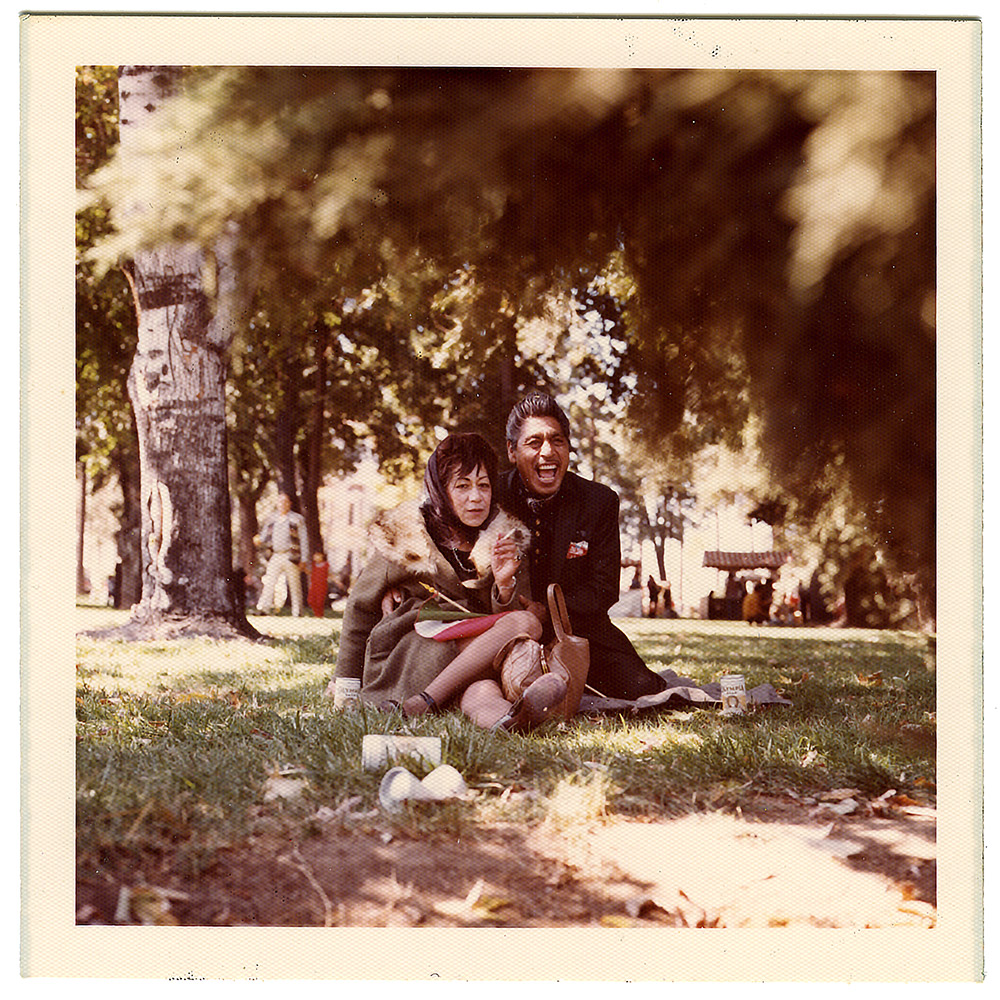
Vintage Photo: Couple Celebrating at the Park
Thursday, January 05, 2017
I am a photographer
"I photograph to satiate the primal urge to hunt, capture and possess." - Jesús Manuel Mena Garza, 01/04/17
Tuesday, April 26, 2016
Documenting the Chicana and Chicano Experience
Wednesday, October 08, 2014
2014 NCLR ALMA Awards
- Guillermo del Toro, Award for Industry Excellence presented by Zoe Saldana
- “Orange is the New Black” Cast Members Selenis Leyva and Dascha Polanco, Special Achievement in Television
- “Cesar Chavez,” Special Achievement in Film
- Pitbull, Special Achievement in Music
- Special Tribute to the 2014 Hispanic Recipients of the Congressional Medal of Honor presented by Michael Peña
Wednesday, November 20, 2013
Sen. Elizabeth Warren, Populism and the Latino Establishment of the Clinton Era
By Javier Rodríguez from La Plaza del Mariachi
Nov. 18, 2013
If you are not part of the 50% Facebook users who post and reveal their superficial concerns continuously and tirelessly (sounds like me, Jesús Garza ... Javi has got me pegged) - to the chagrined of the other half after reading this piece, you may or will probably begin to observe Massachusetts Junior Sen. Elizabeth Warren’s intrepid but profound leadership in the US Senate. Recently, in a move that’s totally out of the ordinary, she tested the waters in confronting the “AS USUAL PRO BIG BUSINESS MINDSET IN THE CAPITOL,” by questioning a trio of federal watch dogs who were providing a report to a Senate Committee that oversees corporate $million and $billion mal practice against the 99%, otherwise known as white collar crime.
According to reports, the Senator subtlety, from the side, asked the regulators, “what efforts were being conducted to uncover potential criminal activities in this case.” The question hit like a bucket of cold water. For a moment, you could hear a pin drop in the chamber. The bureaucrats froze, paused and stammered.
As the American people know quite well, with hardly any exceptions, these criminals never end up in prison, but rather, are always bailed out by “Agency Settlements” which are in real terms “diminutive fines” that do not correspond to the crimes committed. Usually in question, are funds stolen from society by sidetracking government regulations. Because of this and similar political moves, Warren is charmingly referred to as a “populist” in media circles, a label that sticks on the forehead of public opinion.
The magnitude of the corporate crimes has reached astronomical proportions. According to one source, there are over 300,000 such cases on file. We just witnessed a settlement of several billion dollars against JP Morgan. Recall that in the beginnings of the Iraq war, Halliburton defrauded us to the tune of $180 million and who knows how much more and what was given back. Then, the latest, the financial thieves that brought us the last and ongoing housing crisis from where we have yet to recover. This one is considered the largest transfer of wealth in American history, in the trillions, where Latinos lost 66% of their properties, African Americans about 50% and Whites 19%, and this, the grandest of all theft is well documented. To add molten volcano lava to the injury, incredibly, their businesses were bailed out by our social treasury. As with everything else since the advent of capitalism, this round of frauds and the profits were privatized but the resolution, to save the day, was socialized and paid for by the 99%. On top of it, they get $82 billion in annual government subsidies and as the 2012 presidential campaign reaffirmed, they pay less taxes than their secretaries.
The ruling class is legally armored by hundreds of years of accumulated capitalist law so as to never have to worry about going to prison or facing the death chamber for defrauding “tens and even hundreds of millions of people at a time, always causing impoverishment as a rule and death in many instances.”
In the ranks of conscientious radical trade unionists in America, the simplest and highly sarcastic way of defining the pro corporate mindset during union organizing campaigns is the fact that Senator Warren appears not to wear carpet layer kneecaps to properly kneel in front of the ruling class or their emissaries, nor does she use the injected silicone to enlarge the lips, to properly be able to practice corporate kissing.
Worldwide, the populist label is also a definite favorite of corporate media to disdainfully define the social and democratically elected governments and their leaders who dare challenge the powerful capitalist class, the classist judicial system and the bureaucrats, judges, politicians and the desk journalists behind it.
A good comparative involves the eight independent Latin American governments who do not adhere to the dogmatic doctrine of bowing to the global empire and the negotiated Free Trade Agreements, which of course are not free, but obscene profit oriented venues to submit the poorer countries into giving up their economic independence and solvency. One of the glaring examples of the negotiated Free Trade inequality are the prohibited subsidies to farmers of the third world, but not to those of the Western block, which reserve an inherent and unquestionable right, astonishingly, even in the written agreements, a la bravota pues, to help their farm corporations outbid the native farmers of Mexico -the historical and submissive el traspatio, the backyard of America-. Since the onset of the North American Free Trade Agreement (NAFTA), Mexican farmers and campesinos have been driven into miserable economic conditions, forcing them, by the millions, to sell their lands and to migrate to the north. Prior to the agreement, the Carlos Salinas de Gortari Administration predictably forced a constitutional amendment that restructured and privatized farm land ownership in Mexico.
In the case of the selling of NAFTA, the marketing campaign message pedaled by the Mexican government to convince public opinion in Canada, Mexico and the US, including the growing US Mexican Latino population, to support it, was a banger repeated hundreds of times by the corporate media, “NAFTA will elevate Mexico to the status of the first world,” and unabashedly, sin pelos en la lengua, affirmed, “Mexican immigration to the north will stop” forever and ever in fantasy land. which became effective on 1 January 1994,
Salinas and President Bill Clinton waged a successful campaign that recruited what I coined then in an Op-Ed column “the nascent Latino Political Class.” It was as I recalled, a short list made up then of NCLR, NALEO, MALDEF, LULAC, SWVREP, a host of Latino appointed and elected leaders led by LA Supervisor Gloria Molina, then considered the most powerful Latina politician in the country and finally the most prominent Latino Media Corporations, La Opinion, Univision, and Telemundo. Interestingly, because of its twelve year relationship with the PRI and the fact they has also served as advisors to the Mexican Government and the Secretariat of Foreign Affairs of Mexico, the now extinct One Stop Immigration of LA and its national network was also an integral member of the Latino Pro NAFTA Coalition. All this in the context of the 1988 mega electoral fraud with the infamous tree day computer meltdown, that installed Salinas in the presidency to preside over the continuity of Neo-Liberalism in Mexico, begun in 1982 with Miguel de la Madrid. On the American side George Bush began the first round of negotiations, but upon his defeat, the process continued with Democrat Bill Clinton.
The Harvard schooled Salinas understood the psychology of the Latino establishment and invested millions to bring them on aboard the NAFTA project. A Latino public relations firm headed by former Governor Anaya of New Mexico was hired to do the bidding on the air and on the ground. The chosen organization to promote the popular Latino support nationally was Southwest Voters Registration and Educational Project SWVREP and the key figure that lead the successful drive for the Mexican government was its director, Antonio Gonzalez, also founder of the Latino Congreso in 2006. However the ideologue on his side was Dr. Raul Hinojosa and his assistant Dr. Armando Vazquez Ramos. The Coalition organized three public conferences, presented as neutral gatherings in Los Angeles and San Antonio, but the die had been cast with a hidden agenda.
The debate around NAFTA in the US ensued and intensified in 1992-93 and on the side of the Mexican left opposing the agreement were two of Mexico’s most prominent speakers and columnists of the time, Jorge Castaneda and Adolfo Aguilar Zinzer. They toured the US, published several op-ed pieces in the national newspapers and also entered the national conversation talk shows.
Because of my lengthy involvement in the Mexico solidarity work since 1968 I wrote a scathing column against NAFTA that I published in February 1992 in the LA Times, La Opinion and other venues, which as I recall was titled, “Is Mexico Co-opting Latino Leaders?” Besides outlining the contradictions of inequality of the neo liberal tool, my angle primarily centered on the cooptation of the Latino leadership by the Mexican government. The topic had an extensive history which moved rapidly during the Luis Echeverria administration of 1970-76 and finally crystallized with Salinas. It was an aggressive campaign of dining and wining and national awards to Cesar Chavez, Gloria Molina, etc.
We debated on the pages of the mentioned newspapers and also on radio and TV, but to no avail, it was a battle of deafs/fue una Guerra de sordos. What was at stake for the Empire was the advancement of capitalist globalization and neo liberalism and the Free Trade Agreement were key components. For Mexico it was consolidating the nation as a regional leader and winning the coveted North American markets. For the Latino Establishment, NAFTA was a first step to wage a successful national political campaign with the nod of both the Mexican and US governments. Gonzalez for a time became a sort of Latino King Pin. As former Senator Art Torres put it back in the 90s, “Antonio has become quite important, he has access to President Clinton’s private line.”
Was the sacrifice worth it? Mexico’s province was corporatized, millions were torn from their lands, their jobs and their families. With the dogmatic and continued implementation of the economic model by successive Mexicans governments, assisted by the latest electoral mega frauds -which by the way were orchestrated by American and Spanish election engineers- against leftist Andres Manuel Lopez Obrador, poverty has grown spectacularly to the tune of 50 plus millions; 29% of the work force is employed in the informal economy(street vendors); the war has ravished the rule of law; We have yet to make it to the First World; immigration continues unabated and death by the thousands accompanies it; and the Republicans won’t let loose of reform with a path to citizenship.
I am hopeful that the future stock of DREAMers may come in the form of “Elizabeth” Rodriguez, Mateo, Sanchez, Romero, etc., etc. ZAZ
*Javier Rodriguez is a journalist, a blogger and a media and political strategist. A long time social activist, he is presently a co-founder of the Millions of Voices Coalition in LA that on Sept. 22 moved thousands of people in Downtown LA for Immigration Reform. He was also the initiator and directed the making of the 1.7 million historical immigration march in Los Angeles on March 25, 2006, as well as the May 1st 2006 Great American Boycott. Back in 1982-86, he directed the mass street mobilizations in LA that led up to the Amnesty Law IRCA of 1986; He recently traveled for 5 ½ months thru Mexico in 2012, observing and writing about the country’s political process, the aftermath of a highly questioned presidential election, the drug war and migrants. His blog is Larayueladejavier.wordpress.com and his email bajolamiradejavier@yahoo.com
-30-
Sunday, October 27, 2013
Identity Crisis: An Arrested Development
The debate as to what to name Chicana/o Studies will have future repercussions. The proposals are not new; they are not innovative; and they are symptomatic of the historical struggle of Mexican origin people in the United States to identify themselves.
At California State Northridge the solution appeared simple in the 1990s. It made sense to support Central American students and create a Central American program. They make up 12/14 percent of LA’s Latino population, and changing the name to Chicana/o –Latino would not have solved anything.
This schizophrenic behavior of the name changers has worsened the existing identity crisis; it has resulted in an erasure of history. You can bet that there will political fallout in the future. Words and history have meanings.
Saturday, June 08, 2013
The End of the Solid South
The American Prospect
By Bob Moser
The region's emerging majority is progressive. Its capitols are more conservative than ever. Something's got to give.
The final rally of Barack Obama’s 2008 presidential campaign took place on symbolically charged ground: the rolling fields of Manassas, site of the first major battle of the Civil War. It was the last stop on an election eve spent entirely in the South: Jacksonville, Charlotte, and finally Northern Virginia. In the autumn chill, an estimated 90,000 people spread out across the county fairgrounds and waited for hours to cheer a new president—and a new South.
By this point, Virginians knew Obama well. In February, he had beaten Hillary Clinton 2 to 1 in the state’s Democratic primary, a blow to her floundering bid. After clinching the nomination, he’d kicked off his general-election campaign in rural Virginia and been a frequent visitor since. Bucking conventional wisdom, Obama’s team had invested heavily in three Southern states: not just perennial battleground Florida but also Virginia and North Carolina, which had not voted Democratic for president since 1964 and 1976, respectively. No Democrat—not even Bill Clinton—had made a serious attempt to win North Carolina or Virginia since Ronald Reagan claimed it in 1980. But Obama was gambling on an emerging South—one that is younger than the rest of the country, far more ethnically diverse than the old black-and-white paradigm, and more liberal-leaning than any Southern generation to precede it.
That emerging South was arrayed in the dark hills around Obama as he flashed into the spotlight. On soil where whites once fought to the death for the right to enslave blacks, this throng had gathered to hail the soon-to-be first black man to be elected president. The next day, Obama carried all three of his Southern targets—55 electoral votes for the party. For Southerners, the message was unmistakable: The future has arrived. The Solid South is dead.
When Americans talk about the South, they tend to be talking about the past. When they talk about Southern politics, they tend to be talking about the old, stereotyped “Solid South”—that uniformly conservative, racist, anti-union, snake-handling cluster of former Confederate states that voted en masse for Democrats from the pre–Civil War through civil rights, then switched their allegiance to the former “party of Lincoln” beginning in the 1970s. Once LBJ and the Democrats betrayed the cause of white supremacy and Richard Nixon cooked up the “Southern Strategy,” the region became as solidly Republican as it once was Democratic. End of story.
Southern politics has never been quite so uncomplicated as that. It took decades for Republicans to outnumber Democrats, and Republican control of the region has never matched the Democrats’ former hegemony. The South has been contested ground for 40 years, with the GOP dominating federal elections and gradually cutting into the Democrats’ hold on state and local offices—culminating in 2012, when Arkansas’s legislature became the last to go Republican. (Virginia’s Senate has a partisan split.)
Over the next two decades, it will become clear to even the most clueless Yankee that the Solid South is long gone. The politics of the region’s five most populous states—Virginia, North Carolina, Georgia, Florida, and Texas—will be defined by the emerging majority that gave Obama his winning margins. The under-30 voters in these states are ethnically diverse, they lean heavily Democratic, and they are just beginning to vote. The white population percentage is steadily declining; in Georgia, just 52 percent of those under 18 are white, a number so low it would have been unthinkable 20 years ago.
By the 2020s, more than two-thirds of the South’s electoral votes could be up for grabs. (The South is defined here as the 11 states of the former Confederacy.) If all five big states went blue, with their 111 electoral votes, only 49 votes would be left for Republicans. (That’s based on the current electoral-vote count; after the next census, the fast-growing states will have more.) Win or lose, simply making Southern states competitive is a boon to Democrats. If Republicans are forced to spend time and resources to defend Texas and Georgia, they’ll have less for traditional battlegrounds like Ohio and Pennsylvania. Even if Democrats aren’t competitive in those states for another decade, they will benefit from connecting with millions of nonvoters who haven’t heard their message. They are building for a demographic future that Republicans dread: the time when overwhelming white support will no longer be enough to win a statewide election in Texas and Georgia.
Republicans will not give up easily. Their counter-insurgency began soon after Obama’s three Southern victories. It was propitious timing. The Tea Party, a mostly Southern phenomenon, was turning Obamaphobia into a political movement. Big conservative donors, their money freed up by Citizens United and other court decisions, were ready to spend unprecedented amounts on obscure state assembly races and judgeships (to elect those fired-up Tea Partiers, in many cases). Republicans recognized that 2010 might be their last great chance to expand their gains in the South. They made the most of it.
In a bad year for Democrats nationwide, it was a disaster in the South. Two years after North Carolina voted for Obama, both chambers of the general assembly went Republican for the first time in 120 years. In Florida, the Tea Party launched Marco Rubio into the U.S. Senate. The year before, in Virginia’s off-year elections, right-wing Republicans had been elected governor and attorney general. Republicans now controlled all but four legislative chambers in the region.
With those statehouse majorities, the GOP had won the larger prize it sought: control of legislative and congressional redistricting. The party redrew the maps with gusto, giving it favorable districts for the next decade. The trick is watering down the impact of minority voters by moving them from competitive districts into those that are already minority-held. That way, the blacker and browner districts get blacker and browner, and 60 percent Democratic districts become 70 percent Democratic. The white districts, in turn, get whiter—and more Republican. In North Carolina, which ended up with the South’s most egregiously misshapen map, half of the state’s black population of 2.2 million was drawn into one-fifth of its legislative and congressional districts.
Civil-rights and civil-liberties groups argued that Republicans were using race illegally as the primary basis of redistricting. But the courts mostly upheld the maps, and the results were startling. In 2012, Republicans won legislative majorities in every former Confederate state for the first time. (In Virginia, the Senate is evenly split by party, 20-20.) Overall, the South had now elected 222 more Republican legislators than it had in 2008. Georgia’s Democrats made up 47 percent of the statewide vote in 2008 and 2010, but after redistricting they could only elect a maximum of 31 percent of statehouse members. The gerrymandering was just as effective in congressional elections. In Virginia, Obama won by 4 percent statewide, but Republicans captured 10 of 13 seats in the U.S. House.
Southern politics is more fractured than it’s ever been. Obama threw down the gauntlet in 2008, and Republicans answered in 2010 and 2012. The voters are moving left, while the state governments are lurching right. The only safe prediction is that after 150 years of being largely ignored in national elections, the South is about to become the most fiercely contested, and unpredictable, political battleground in America.
It’s been almost four decades since journalist and historian John Egerton famously declared the South “just about over as a separate and distinct place.” He was writing about a newly integrated 1970s South that was suddenly teeming with suburban tracts and office parks, urbanizing so rapidly that it could hardly be recognized. To this day, Americans still think “rural” when they think “Southern.” But there’s nothing very rural about the South anymore. Florida is 91 percent urban, Georgia and Virginia 75 percent, and in probably the biggest surprise, Texas is 85 percent urban.
With the suburbs and office parks came new Southerners. At first it was mostly Northern professionals, who began moving down in the 1950s and 1960s for low taxes, affordable homes, and jobs in banking (Charlotte), energy (Houston and Dallas), technology (the Research Triangle Park and Austin), and government-contract work (Northern Virginia). Many of the “relocated Yankees,” as they were sometimes fondly called, were registered Republicans—but they were more moderate than their Southern partymates, especially on culture-war issues. Those transplants became swing votes, and they haven’t stopped coming.
The demographic big bang didn’t begin in earnest, however, until the 1990s. Large numbers of African Americans had begun moving South in what would become known as the “great remigration.” From the early 20th century until the 1960s, more than seven million blacks fled the Jim Crow South in the Great Migration to pursue a better life, mostly in the industrial North. It was the largest domestic migration in American history. Now hundreds of thousands are returning. Last decade, 75 percent of the growth in America’s black population was in the South. Atlanta and its endless suburbs gained 491,000 African Americans in the past decade, more than any other city. Some are middle-class blacks whose families once relied on government jobs up North that are now disappearing. Some are caring for older relatives left behind in the Great Migration. Some are simply coming home to reunite with their families, finding a region that has undergone seismic changes since the South’s segregated “way of life” finally came to a merciful end.
While blacks were remigrating, Latino populations were expanding rapidly. Birth statistics tell the story: By 2010, 49 percent of newborns in Texas were Latino. Among the big five Southern states, Virginia has the lowest rate at 12 percent. Hundreds of thousands of young Latinos become eligible to vote in the South every year, and that number will be climbing for decades. At least for now, this strongly favors Democrats, who win Latino votes by large margins. Florida used to be the exception, because first-generation (and often second-generation) Cuban Americans were staunch, anti-communist Republicans. But younger Cuban Americans have joined a new immigrant population in Central Florida to help flip the state in the Democrats’ favor.
The key is getting Latinos to the polls—and it’s been a challenge in most Southern states. In 2010, for instance, Latinos were 38 percent of Texas’s population. But just 16 percent of eligible Latinos voted as Republicans won historically big margins in both legislative chambers. The poor turnout is partly a factor of youth. Latinos are, on average, a decade younger than Anglos. Most are not in the habit of voting. If they live in a state like Texas or Georgia, it’s likely that nobody has ever courted their vote.
Once Latinos begin to vote in proportion to their population, the change that they will bring to Southern (and American) politics won’t be limited to a shift in party loyalties. It will be manifested in a new progressivism as well.
Republicans like to talk about how Latinos are “hardworking, religious, family-oriented,” as if those qualities automatically made people conservative. In fact, an exit poll from 2012 showed the opposite: Latino voters are not only more liberal than Republicans; they’re sometimes more liberal than Democrats. On same-sex marriage, 59 percent said yes, against 48 percent of all voters. Should abortion be legal? Sixty-six percent said yes, against 59 percent overall. On economic issues, Latinos’ liberalism tends to be even more pronounced (the same is true for African Americans). Fifty-five percent said last year that they have a negative view of capitalism. They want more spending on public schools. They want universal, public-run health care. They want government to take a strong hand in the economy. Taxes? Raise them, if it means better social services. The same goes for every part of the South’s emerging majority—African Americans, Asian Americans, and under-30 whites who voted for Obama in 2008 and 2012.
Given the progressive tilt of the South’s coming majority, it’s no wonder that Scott Keeter, head pollster at the Pew Research Center, calls the region “a ticking time bomb for Republicans.” The Southern GOP is 88 percent white, and the white population is aging. Republicans will buy some time with their friendly legislative districts buffering any losses. They’ll continue to try to make it harder for minorities and young people to vote—and if the Supreme Court strikes down Section Five of the Voting Rights Act this year, it will be easier to suppress votes in the South.
There’s a cost to the time Republicans are buying. The Tea Party legislators who brought Republicans to power in 2010 are moving the party further right on practically every issue—at the same time that voters are tilting back toward the center. That’s creating the kind of situation that unfolded last year in Virginia. Republican lawmakers pushed a bill requiring every woman who requests an abortion to have an invasive sonogram procedure. In an election year, in a battleground state that is trending Democratic, what sense does such sure-to-be-divisive legislation make? None at all, unless you’re in a state—or a region—that is smack in the middle of a demographic revolution that is fueling a political one. It is a confusing business.
In the South’s new battlegrounds, 2020 shapes up as a pivotal year. If Democrats have gathered enough strength by then to send majorities to Richmond, Raleigh, Atlanta, Tallahassee, and/or Austin, they can tear up the Republican maps from 2011 and make it dauntingly difficult for the GOP to regain its majorities. That’s likeliest to happen in Florida, Virginia, and North Carolina; Democratic majorities could take longer in Texas and Georgia, where Republicans are more deeply entrenched.
But the politics of the big Southern states are all betwixt and between, as natives like to say. If Republicans can find a way to hold on to their majorities through 2020, they will stay competitive, on the state level at least, for another decade. Ultimately, they won’t be able to keep winning unless they can convince Latinos and African Americans to vote Republican. If they do, Southern Republicans could become a model for the national GOP—the states that figured out how to persuade Latinos to vote Republican.
But it will be no quick or easy matter for the Southern Republican Party—built on a Chamber of Commerce foundation and lifted to victory by evangelical Christians—to find a message that can appeal to the South’s new electorate. How do you build bridges to voters whose views would sound, to your average Southern Republican, socialistic and downright un-American?
More likely, destiny will follow demography. The South’s big states could soon be undergirding a durable national Democratic majority that’s capable of lasting as long as the New Deal consensus. Liberalism would have a chance to flourish anew—not just in state capitols but in Washington, D.C., as well. This would be an emphatic break from history. From Teddy Roosevelt’s Square Deal to Franklin Roosevelt’s New Deal to Barack Obama’s stimulus and heath-care overhaul, the biggest obstacle has always been Congress’s solid white wall of Southern conservatism. That wall is crumbling. In the future, if you can be progressive and win Texas or Georgia, the American political order will transform in ways we can barely comprehend.
-30-
Tuesday, January 10, 2012
National Association of Latino Arts & Culture (NALAC) Names Adriana Gallego Deputy Director
Gallego's hiring follows the addition of nationally recognized writer and digital media creator, TJ Gonzales as NALAC's Marketing and Outreach Associate. Also, Maria Tapia was brought on as the Executive Assistant to Executive Director Maria De Leon.
"I am pleased that Adriana will be joining NALAC as Deputy Director. She comes to NALAC with multiple years of experience at the Arizona Arts Commission developing grants programs and providing professional development services. Adriana is an alumnus of the NALAC Leadership Institute and has been involved with NALAC over many years. I am also pleased with the other new additions to the NALAC staff, TJ Gonzales and Maria Tapia. We will continue to strengthen NALAC's infrastructure over the coming months with additional staff to allow us the capacity to address the challenges facing the Latino arts community and the larger arts industry," said NALAC Executive Director, Maria Lopez de Leon.
During her tenure as Director of Strategic Initiatives at the Arizona Commission on the Arts, Gallego developed programs, grants, partnerships and services in support of arts organizations, artists, universities/schools, community groups and government agencies She served on many advisory boards and committees including the Transportation Enhancement Review Committee, the Asset Building for Artists of Color Advisory Board, the Flagstaff Cultural Partners Arts Advisory Board and the Arizona Public Art Network. As a painter, Gallego's artwork is forged from ideals about equality and understanding rooted in the Civil Rights and Feminist movements, with sensibilities born out of her upbringing alongside the United States-Mexico border. She received the Border-Ford Bi-national Painting Award and has completed several mural commissions in Arizona and California.
Commenting on her selection as NALAC's Deputy Director, Gallego said, "In my experience, NALAC's guiding principles are not only inspiring, but they are transformative in practice. I very much look forward to contributing to this trajectory in the service of cultivating a vibrant, diverse Latino arts and culture sector."
The addition of Gallego, Gonzales and Tapia in their respective positions comes as NALAC prepares for the 2012 National Conference to be held in Philadelphia, PA from October 17th to October 21st.
-30-
Friday, July 01, 2011
Summer Institute of Arts and Languages
Wednesday, March 23, 2011
LATINOPIA.COM: New Latino Website Premiers
[Click header to go to website. Click photo to enlarge.]
Music, recipes, poetry, art, cinema, theater and history make up the rich cornucopia of Latino culture showcased on www.Latinopia.com a new website set for launch March 19, 2011.
The brainchild of veteran Los Angeles television director and documentary filmmaker Jesús Salvador Treviño, the video-driven website is designed as a one-stop web destination for all things Latino.
“As U.S. Latinos enter the digital age, we need a website that can offer videos about all aspects of our history culture and life,” explains Jesús Treviño, whose television credits include programs like Law and Order-Criminal Intent, The Unit, Criminal Minds and Resurrection Blvd and who shot and edited much of the video footage on Latinopia.com.
“We’re starting with five-minute videos in seven subject areas--interviews, music performances, short films, theater plays and authors reading from their works,” Trevino explains. “We are excited that top Latino writers, artists and musicians from around the U.S. have seen the value of Latinopia.com and are enthusiastically sharing their time, stories and creativity.
A click on Latinopia’s Art section will take the visitor to video profiles of Chicano, Puerto Rican and Cuban American artists, painters and muralists such as Gilbert “Magu” Lujan, Ester Hernández, Frank Romero, Yolanda López, César Martínez, Rupert García, José Montoya, Gronk, Judy Baca, Carmen Lomas Garza, Zarco Guerrero as well as print interviews and special features.
The Literature section features a timeline on the emergence of Chicano, Puerto Rican and Cuban-American literature in the United States in addition to listings of Latino books. Video interviews include such important Latino writers such as Rudolfo Anaya, Pat Mora, Dagoberto Gilb, Judith Ortíz Cofer, Alberto Rios, Denise Chavez and Luis J. Rodríguez. Dramatic re-enactments and additional footage bring their works to life.
The website’s Theater section includes video interviews with Chicano, Puerto Rican and Cuban American playwrights, actors and stage directors and groups like Culture Clash as well as excerpts from plays written performed and directed by Latinos in New York, Los Angeles, San Antonio, Chicago, Miami, Los Angeles and San Francisco; among them Crystal City 1969, Gaytino, Regeneración, and The Silver Dollar.
Interviews with leading Chicano, Puerto Rican and Cuban musicians are an attraction in the Music section: Los Lobos, Little Joe and La Familia, Flaco Jimenez all discuss their art. There are also performances by such groups as Mitote, Los Pochos, La Santa Cecilia, Olmeca.
In Cinema and Television many of the nation’s leading Latino actresses and actors discuss their work and making their way in Hollywood: Hector Elizondo, Lupe Ontiveros, Jimmy Smits, Edward James Olmos, America Ferrera, Evelina Fernandez and are among those to be featured. Behind the camera talent will also be featured such as writer/producer Dennis Leoni (Resurrection Blvd), Director of Photography Rey Villalobos (Nine to Five, Urban Cowboy) and Director Leon Ichaso (El Cantante).
A visit to the History page will reveal videos of important historical events in Chicano and Latino life along with event timelines, biographies and documents. It includes profiles of important Chicano, Puerto Rican and Cuban American leaders and historical figures such as Jose Marti, Cesar Chavez and Dolores Huerta.
Latinopia Food offers Latinopia’s recommendations on the best places in major cities in the United States to eat Mexican and Latino food along with “how-to” videos on making great Mexican food--enchiladas, guacamole, Spanish rice, salsa-- as well as Puerto Rican and Cuban American cuisine.
“We are launching modestly with a few dozen videos,“ Jesús Treviño explains, “but we add new videos each week and will grow the site into more than hundred videos by the end of the first year. Seeing is believing. Check us out at www.Latinopia.com ”
“Once we establish an audience of regular visitors, we plan to expand beyond short videos into original webisodes and longer form dramas geared to the Latino public. The potential is as rich and limitless as is the life and culture of America’s 47 million Latinos.”
-30-
Friday, November 26, 2010
Latino Art Now Video
Friday, November 05, 2010
Museums unite to chronicle post-war LA art scene
By Zorianna Kit
Reuters
More than 60 California cultural institutions are coming together to tell the story of the birth of the Los Angeles art scene, in the largest such collaboration ever undertaken in the region.
Southern California museums and university programs such as the Getty Museum, the Los Angeles County Museum of Art, the Hammer Museum and the University of California, Los Angeles (UCLA) Chicano Studies Research Center will take part in the 2011-2012 event, titled "Pacific Standard Time: Art in L.A 1945-1980", organizers said on Thursday.
Each of the institutions will make a contribution to the story of art and social change in Los Angeles through simultaneous exhibitions and programs.
"What began as an effort to document the milestones in this region's artistic history has expanded until it is now becoming a great creative landmark in itself," said Deborah Marrow, interim president of the J. Paul Getty Trust, which has initiated the event through grants totaling $10 million.
"We know that this era has had a million moments of impact on arts and culture across the United States and beyond," added Mark Siegel, chairman of the Getty's Board of Trustees.
The event will begin in October 2011 and will run through April 2012 at locations including Los Angeles, San Diego, Santa Barbara and Palm Springs.
The exhibitions, festivals and programs will showcase the influence of post-war California architecture, Pop Art, the emergence of African-American artists and 1970s feminist performance art.
-30-
Wednesday, September 29, 2010
The State of Latin American Art
Dr Mari Carmen Ramirez, Wortham Curator of Latin American Art and Director, International Center for the Arts of the Americas at the Museum of Fine Arts Houston, discusses Latin American Art at the Aspen Ideas Festival
What follows are my notes based on a talk given by Dr. Mari Carmen Ramirez at the Aspen Ideas Festival, July 10, 2010:
The ICAA:
The International Center for Arts of the Americas (ICAA) at the Museum of Fine Arts Houston is a unique resource center for the study of 20th Century Latin American and Latino Art. Established in 2001, its mission is to transform perceptions of Latin American and Latino Art and open new avenues of intercultural dialogue and exchange. The ICAA's signature initiative is the Documents of 20th Century Latin American and Latino Art: A Digital Archive and Publications Project whose web-based digital archive - which is scheduled to launch in the Fall of 2011 - will provide free universal access to key writings by artists, artistic movements, critics, and curators from Mexico, Central and South America, the Caribbean, and the United States.
The Problem:
Much of Latin American and Latino Art of the 20th century is poorly documented. The market, particularly the international market, for much of the work was not developed until relatively recently. For example, Sotheby's only created a category for Latin American Art in 1979 and there is no category or mainstream market for Latino art. An accessible resource that taps into the intellectual foundations of this art is needed.
The ICAA at Houston is now ten years old.
Our principal goals are to:
Recover and digitally publish primary and critical documents relevant to Latin American and Latino art of the 20th Century.
Provide open access to these documents for all those interested in 20th century Latin American and Latino Art.
Publish selections of these documents in the form of thematic anthologies that will complement the digital archive.
Establish a dynamic digital archive and research program devoted to providing a sound basis of scholarship for this work.
Recovery:
As part of our efforts we have initiated a systematic effort to recover original documents relevant to Latin American and Latino Art of the 20th century. This effort is encompassed by the ICAA's Documents Project. These include key documents from the artist's own papers and collections as well as contemporaneous press and art criticism. Our work is made difficult by a precarious infrastructure in many of the countries, poor distribution and lack of policies aimed at preserving books, archival material, and key documents.
Curate:
To address these and other issues we have created a "think tank" comprised of scholars and experts on the art produced along this cultural axis who generously contribute their expertise and are helping the ICAA further our goal to preserve and make accessible documents that will change perceptions of Latin American and Latino art. To date, the Center has published 11 books and catalogs and held 4 major international symposia.
Access:
We have established regional centers for the study of Latin American Art in 10 cities that include: Buenos Aires (Argentina), Santiago/Valparaiso (Chile), São Paulo (Brazil), Lima (Peru), Caracas (Venezuela), Bogotá (Colombia), Mexico City, Los Angeles, South Bend (Indiana), and Houston. The project also has research affiliates in San Juan (Puerto Rico), Miami, and New York. In each location we recover documents, scan and digitize them, catalogue and annotate them. Beginning in Fall 2011, we will make them all publicly available, free of charge, in the project's specially designed Website. Through this monumental undertaking, we are creating a "multinational super information highway."
This data is intended to provide a sound intellectual foundation for the long-term growth and development of the field of Latin American and Latino art. Our hope is that this archive will help fill gaps in the worldwide knowledge and appreciation of this art as well provide the necessary research tools for scholars, students, collectors, museum and arts professional, and anyone else interested in this art.
Scholarship:
At present we have over 100 researchers distributed amongst the ten project sites. Our headquarters are in Houston. The project's team members include senior and junior art historians, researchers, librarians, IT specialists, editors, translators, and administrators. We are governed by a 17-member Editorial Board and a 10-member steering committee. By the time we launch the project's website in Fall 2011 we will have a collection of over 10,000 critical document and more than 55,000 related images. We are committed to continue to expand this archive which, in theory at least, is limitless.
By art world standards, in which the perceived glamor resides in promoting artists and organizing exhibitions, the often tedious work of archiving and documenting is hardly enticing. The ICAA's work, in particular, is mostly behind the scenes and has an assembly line character. However, it fulfills the indispensable role of adding the crucial information and context to exhibitions and publications that enable a deeper appreciation of the art presented.
Several illustrations of the type of documents collected were shown in photos. These include photos artists at work, artists' notes, contemporary newspaper reviews, and gallery handouts.
Examples:
The profusely illustrated documents by Caracas' radical collective El Techo de la Ballena
-Luis Felipe Noé's art criticism of the 1950s (Argentina)
- Brazil's "Ruptura Manifesto"
-Documentation of a series of debates between Antonio Berni and David Alfaro Siqueiros in Argentina during 1933
- The precursory responses to a survey published in Havana's Revista de avance from 1927 to 1929 that debated the existence and definition of the concept of Latin American art
-The critical work of the Guatemala-born, Mexico City-based artist, Carlos Mérida that illuminates the work of other artists at a time when there was little established art criticism of their work.
-The recipes for colors and tonalities developed by Hélio Oiticica, the Brazilian avant-garde artist, for his Grand Nucleus installation (1960-68)
In 2011 we will launch the ICAA digital archive. The archive will be a free online resource for all. Simultaneous to the launching of the site, the ICAA will publish the first volume in the parallel Critical Documents of Latin American and Latino Art book series, 13 thematic anthologies that will provide English translations for documents from the online resource. Our hope is that the web-based archive and the book series will provide a visible space of Latin American Art in the United States and elsewhere and will transmit a rich legacy of knowledge to future generations.
Questions from the audience.
Q: Have we transcended the need for Latin American Specialists?
MCR: Absolutely not. Latin American Art is now mainstream yet there are still huge gaps in our understanding of the thousands of artists and movements at work in the more than twenty countries that make up the region throughout the 20th century. There is a lot of information out there about the contemporary manifestations of this art but very little serious historical scholarship. The field has grown horizontally yet lacks depth. This is what the ICAA's Documents Project is trying to address. We need a high degree of scholarship to support the understanding and appreciation of Latin American and Latino art in both its historical and contemporary manifestations.
Promoters of the global view argue that Latin American art is now global, yet we need to bear in mind that all art is both local and global. We cannot side-step the local and what it implies in terms of the contextual factors affecting the emergence and development of a particular form of art. Latin American art is no exception.
What is really at stake behind the "global" position is a market-driven, economic process that has transformed the status of Latin American art in contemporary artistic circuits. Globalization has turned Latin American art into a strategic economic resource. Over the last 10-15 year this art has become a favorite commodity in the current market, providing additional justification for careful scholarship and documentation. Curiously, all this attention has created a movement to re-regionalize, a tendency which calls for expert knowledge such as the one that the ICAA is trying to provide.
A persistent issue in the field is that Latin American art has traditionally been considered to be derivative. Those of us working in this field over the last three decades have set out to prove that this is not the case. Since the early 20th century, Latin American artists have engaged in original research. They have made important theoretical contributions to art and aesthetics and have produced forms of art that in many cases have anticipated important developments in Europe and the United States. To understand these developments we need to get roots of this art and understand its development in depth. This can only be done through key writings and other documentation that shed light on the intellectual process that nurtured the art. This is the ultimate goal of the ICAA Documents project.
Q: What is Latin American Art and what is Latino Art? How do they differ?
MCR: Latin American Art is an operational term used to describe art actually made in the more than twenty countries that make up Latin America and that encompass Mexico, Central and South America, and the Caribbean. Latino art refers to the work of artists of Latin American origin (usually by birth, family ties, or education) who work primarily in the United States.
Q: Doesn't the term Latino Art unfairly segregate artists? After all do we call Pollock a Polish-American Artist or de Kooning a Dutch-American artist? What do we call artists of Latin American origin who were born in the US?
MCR: I do not believe that the term Latin American or Latino Art is segregating as we use it. As I have said, this is another pressing reason why we need to document this work and also, I believe, to study this art in the social milieu in which it arose, either in Latin America or the United States. We do want to understand the social context of the work. We do want to examine patterns of inversion or assimilation of received artistic tenets.
We call artists of Latin American origin living in the United States "Latinos." This is a political term that signals the largest ethnic majority in the United States at present. The use of this term does not segregate these artists, instead it brings attention upon their roots and cultural heritage. As an ascendant minority, these artists need legitimization. We do have Museums of African American Art in the United States and there is a National Museum of Women's Art. However, I believe Latinos are best served by displaying their art next to the art of other groups, particularly North American, European, and even Asian artists.
Q: Does your center also include architecture as art? Are you collecting original drawings by Latin American architects as does MOMA for example?
MCR: No. At the moment our collection does not include architecture.
Q: Will you extend your collection and research to Colonial Art of Latin America?
MCR: We may extend our collection to include colonial art, but have no plans at present to expand our research and documentation work in this area. Other institutions such as the Los Angeles County Museum of Art (LACMA) and the Denver Art Museum have established programs dedicated to Colonial Art. We gain by dividing the effort.
Q: And Chicano Art?
MCR: Both our research and our collection include "Chicano Art" (the art of Mexican-Americans, mostly living in California, Texas and the Southwest). To that effect, we have partnered with other research centers devoted to Chicano Art, such as UCLA's Chicano Studies Research Center and the University of Notre Dame's Institute for Latino Studies.
Q: And Puerto Rican Art?
MCR: It is interesting that both Chicano and Puerto Rican art in the United States form an important part of the Civil Rights legacy and dialog. The Documents Project has actively collected documentation on both island-based Puerto Rican art as well as Nuyorican art in the United States through partnerships and researchers ceded at the University of Puerto Rico's museum in San Juan and Hunter College's Center for Puerto Rican Studies in New York City, respectively.
Best Fishing Combo For Oregon Coast Striped Bass
I ASKED GOOGLE Ai: Suggest a rod and real combo for catching 20 pound striped bass off the coast of Oregon? PHOTO: August 2026 fishing in C...
-
By Ben Cadena Where do you start to talk about an old friend compatriot and fellow musician? He left us too early but had been faring poorl...
-
I'll have several photographs on display @ the Cheech Exhibition: February 7 – September 6, 2026 Chicano Camera Culture: A Photograph...