Showing posts with label documentary. Show all posts

Wednesday, April 04, 2018

My Review of the Manfrotto MVH500A Fluid Drag Video Head with MVT502AM Tripod

In this video review, I delve into the world of ENG with the Manfrotto MVH500A Fluid Drag Video Head with MVT502AM Tripod. This concise report could be quite informative for those interested in a tripod and fluid head combination for video production. This is a solid option for those seeking a high-quality fluid head and tripod combo for Electronic News Gathering (ENG).

My wife Professor Ann Marie Leimer uses this video tripod with her Lumix GH5 perched atop to interview Chicanx artists and academics. A professional setup indeed. After many years of hands-on experience, I sincerely believe that Manfrotto is an excellent brand worthy of your professional consideration. Feel free to contact me should you have any questions about this product, video or post. If you have the time please like, subscribe and share my YouTube video.

Click below to start. Thanks!

Thursday, February 01, 2018

Big Bend National Park Photo Adventure


I am headed to Big Bend in a week. I plan to take pictures of infrastructure and the landscape. I will be using a Nikon D800 to capture stills and a Lumix G85 for 4k video. My Chevy Colorado truck has a camper shell. Yes, I will be truck bed camping. I plan to be in Big Bend for only a couple days only. I have to return to my class in Fort Worth on Friday. 

Tuesday, March 17, 2015

Banal or Brilliant: Photographing Wichita Falls and Surrounding Communities

Jesús Manuel Mena Garza

Like my tastes in food and fashion, I prefer tried and true formulas. A simple meal and a basic pair of jeans works for me. When I look through my camera lens I want to capture the glorious details of the everyday. The simple is more elegant and less fussy than the pretentious.

Since I shoot a lot of everyday scenes I ask myself, at what point does the banal become esoteric or artistic? When I see my final edited photograph I posit,  did I produce a glorified snapshot or something more valuable?

So at what point does a simple photograph transform into fine art? Well, that decision is up to the arbiters of taste. Those anointed by our society either because of pedigree, income, affiliation or education to know better than us. The other side of the coin is that they also have a vested interest in the currency of art.

Recently, several museums, corporations and individuals have purchased photographs costing as much as $5,000,000. At that price, they definitely have a vested interest in making sure their investment appreciates (and is appreciated). The work may be poorly executed (banal in my humble opinion), but if the arts plutocracy decides the wall size print of a "department store interior" is worth millions, who are we to conclude differently. They and their minions are going to write and announce that their "piece of art" is actually worth so much more. Brilliant!

Click my (banal) photos to enlarge


Wednesday, February 04, 2015

Jesús Garza's 2015 Kickstarter Campaign

I have initiated a Kickstarter (http://kck.st/1uTI7QG) photography campaign. My goal is to gain funding for a standard zoom lens and basic studio lights. This equipment will allow me to pursue my goal of capturing new portraits and environments. In the recent past I have taken these photographs using a Nikon D800 with a standard 50mm lens. The additional equipment will allow me to shoot a bit wider for effect and also tighter for better portraits.

I am not affiliated with a college or other organization that offers staff ready access to grants, equipment, supplies and venues. For over 40 years I have been self funded. I had to save for years so I could purchase my one and only digital camera. By asking for community support I hope to speed up the process and increase the quality of my work. I am providing those who contribute $100 a print valued at the same price. Click the following link to learn more about my Kickstarter campaign. http://kck.st/1uTI7QG

Monday, August 19, 2013

Fort Worth Chicano Documentary Photographer Jesús Manuel Mena Garza to Talk About His Work from 1970 to the Present at SJSU

Click photos to enlarge


Texas documentary photographer Jesús Manuel Mena Garza will present an hour-long photo show and lecture, A Chicano Photographer’s Journey: 1970 to the Present, on Sept. 25 at 3 pm at San José State University. The event is free and open to the public at the Dr. Martin Luther King, Jr. Library, Room 225/229.

Midwestern State University Professor Dr. Ann Marie Leimer said, “This new presentation illuminates why Garza pursued his role of critical observer. He explains the various influences in his artistic life and details the process that helped him evolve into a prominent documentary photographer.” Garza’s new work is quite diverse – from intimate portraits of Chicana and Chicano academics to issues of abandonment and loss in Texoma.

Professor Leimer adds, “During the past decades, Garza has extensively published and exhibited several documentary photographic series. His Chicano Photographer series explores important aspects of the American experience, historic events and cultural practices often marginalized by the dominant culture.”

The presentation occurs in conjunction with Garza’s current exhibition at the library. A panel discussion on the 40th Anniversary of El Centro Cultural de la Gente (Garza was a member) will take place in the same room from 6 to 7:30 pm. There will be a reception following in the Cultural Heritage Center (Fifth Floor).

Location and Time:
Dr. Martin Luther King, Jr. Library, SJSU
Wednesday, Sept. 25, 2013, Room 225/229, Second Floor
150 East San Fernando Street, San José, CA 95112
3 to 4:20 pm with a reception at 7:30 pm
Free and open to the Public

Jesús Garza’s Portrait and Press Kit:
http://www.jmmgarza.com/html/00press_kit.html

Sponsored by the Dr. Martin Luther King, Jr. Library; San José State University School of Journalism and Mass Communication; the César E. Chávez Community Action Center – SJSU Associated Students; Department of Mexican American Studies; and SJSU’s Chicano/Latino Faculty & Staff Association.

Wednesday, October 05, 2011

Jesús Garza's Chicano Photographer show (1970-1975) continues for 30 more days


[Photo of César Estrada Chávez by Jesús Garza. Click image to view and/or download larger version. Suitable for printing.]

Chicano Photographer, an exhibition by Riverside, California documentary photographer Jesús Manuel Mena Garza opened at the San Bernardino County Museum (SBCM) Schuilling Gallery, March 26, 2011. The exhibition continues to November 6.

The photographs were captured from 1970 to 1975. During this period, Garza took intimate photographs of Chicano icons César E. Chávez, Rodolfo “Corky” Gonzáles and others. The photographs provide a retrospective glimpse from the unique perspective of the photojournalist and activist. The SBCM exhibition lists thirty-one select images from the photographer’s Imágenes Xicano Archive, a portion of which has already been exhibited on both coasts.

University of Redlands Professor Dr. Ann Marie Leimer adds, “During the past decades, Garza has extensively published and exhibited several documentary photographic series. The Chicano Photographer series explores important aspects of the American experience, historic events and cultural practices often marginalized by the dominant culture.” Photographs from the series have already been published in journals and books. Dr. Leimer recently completed a book on the photographic series. The exhibition is perfect for students 5 to 95. Please feel free to contact the museum or artist for more information.

San Bernardino County Museum
Schuilling Gallery
2024 Orange Tree Lane
Redlands CA 92374
Voice (909) 307-2669 ext. 227 Fax (909) 307-0689
www.sbcountymuseum.org

-30-

Tuesday, May 19, 2009

About Documentary Photography


[From my website, jmmgarza.com. Photo copyright 2009 Jesús Manuel Mena Garza. All rights reserved. Click on image to enlarge.]

Some documentary photographers treat their subjects like quarry in the jungle. They stalk them, take their shot and then hang their desiccated representation on a distant sterile wall. The jungle is the Amazon or the barrio, it is all the same. As outsiders, their images lack any humanity and show a visceral disdain for their subjects.

At the art reception, the shooter can be seen prancing around, weaving fanciful tales of his adventures to the spellbound audience. The assembled, saturated by the stench of privilege, sip on wine while esoteric rhythms waft in the background. The photographs remain mute. Surrounded, the captured photographs witness the decadence.

Jesús Manuel Mena Garza
February 12, 2007

-30-

Monday, March 30, 2009

UCR Class to Investigate Documentary Photography


[Photo: John's Furniture, Globe, AZ Series, Click image to make larger. Copyright 2009 Jesús Manuel Mena Garza.]

California photographer Jesús Manuel Mena Garza will illuminate his and other documentary photographers work in a class offered at the University of California, Riverside, Extension. The course is titled, Documentary Photography and is scheduled for May 5 through June 2, 2009.

Garza explained, “The new class will give students an opportunity to explore how photography interprets our society. As a photographer, I feel it is important to capture a vanishing America before it inevitably disappears. The beauty of our communities and people should be immortalized on photographic paper.”

The photographers adds, “Students in the course will learn the art of visual storytelling — whether for a single editorial image, for feature stories or books or for creating a personal record of things observed. Students will explore ways to execute photos through a range of styles and subjects and create a story line from concept to final print.”

The class will inform students on diverse photographic processes. Students will learn to take better images with strong, sensitive and effective visual qualities by producing several themed projects. These same projects can work as a portfolio.

-30-

Monday, September 15, 2008

Palm Desert Documentary Photography Class


Documentary Photography
Jesús Manuel Mena Garza
ART X484.34


Learn the art of visual storytelling -- whether for a single editorial image, for feature stories or books or for creating a personal record of things observed. In this class, you explore ways to execute photos through a range of styles and subjects and create a story line from concept development to picture editing and sequencing.

You learn to take better images with strong, sensitive and effective visual qualities by producing several themed projects that can work as a portfolio. The class will take place at the University of California at Riverside's Palm Desert campus.

When:
Saturday, October 04, 11, 18 and 25, 2008
10:00 a.m. to 3:30 p.m

Where:
University of California, Riverside - Palm Desert
75080 Frank Sinatra Drive
Palm Desert, California
92211

Contact:
Veronica Hernandez
University of California at Riverside Extension
(951) 827-2564
vhernandez@ucx.ucr.edu

###

Monday, March 03, 2008

Nikon D3: Sucha' Great Camera

Yes, I already own a Hasselblad, a 4x5, various Nikon, Canon and Minolta SLRs but what I really want is a new Nikon D3. What a great camera.

I have been taking pictures since the mid-60s and this is by far the most exciting and useful camera I have ever laid my eyes upon. Now all I have to do is ante up about $20,000. No easy feat.

Here is my proposed shopping (wish) list:

  • Nikon D3
  • SB-800 AF Speedlight
  • AF NIKKOR 20mm f/2.8D
  • AF NIKKOR 35mm f/2D
  • AF-S Micro-NIKKOR 60mm f/2.8G ED
  • AF NIKKOR 85mm f/1.8D
  • AF-S NIKKOR 400mm f/2.8G ED VR
  • AF-S NIKKOR 24-70 f/2.8G ED
  • AF-S VR Zoom-NIKKOR 70-200mm f/2.8G IF-ED

My primary setup would be the D3 matched with a Nikkor 35mm prime lens. That combination would be great for documentary work. The Nikon can shoot at 1,600 ASA without a problem. In the early 70s, I and other photojournalists had to resort to special processing to get that ASA. Now all you have to do is flip a switch. How about 3,200… Wow!


I figure in two years I will spend the dough required to at least get the latest Nikon and one quality lens. In the interim, I will have to be content to scan my Hassy negs. So far, this hasn’t been a problem. My prints from my scans have been good enough for exhibitions and books.

Tell me what you think about my proposed setup. Yes, it is a lot of stuff to lug around, but the equipment would fit nicely in a hard case. I estimate 80 percent of my shooting would be with the 35mm lens. Now that would be sweet. I just can't wait.

-30-

Monday, February 18, 2008

Fine Art, Digital and Documentary Photography Classes and Workshops


Jesús Manuel Mena Garza is available for instruction, lectures, panels and lunch!


Fine Art Darkroom Techniques
The Digital Darkroom
Photojournalism and Documentary Photography
Digital Photography


Fine Art Darkroom Techniques

* The Zone System
* Modified Developers
* Archival Washing - Making Your Print Last A Lifetime
* Toning - Extend the Range and Life of Your Prints
* Selecting Papers and Chemistry
* Dodging and Burning
* Selecting and Using Enlargers, Lenses and Other Equipment
* Preparing Your Prints For Exhibition

The Digital Darkroom

* Photoshop Basics - Image Editing and Manipulation
* Photoshop Advanced - Layers, Monitor and Printer Calibration, etc.
* Negative, Transparency and Print Scanning
* Color and Black and White Printing
* Large-Format Printing
* Selecting Papers and Inks

Photojournalism and Documentary Photography

* Story Boarding
* Previsualization
* The Narrative - Your Unique Vision
* Photography Equipment - Cameras, Lenses and Lighting
* Composition
* Archiving
* Travel Photography

Digital Photography

* Learn how to use your digital camera (one-on-one instruction is now available - 2 hours minimum plus travel charges)
* Current Digital Technologies - Selecting The Right Equipment
* The Digital Work Space
* Making Your Computer Work For You
* Photoshop Basics - Image Editing and Manipulation
* Memory and Storage Systems
* Portrait Photography - Cameras, Studio Lighting, Backgrounds and Composition
* Location Photography

Garza was an instructor at San Francisco's prestigious Academy of Art University. The photographer has more than 30 years of professional experience. Along with exhibiting his photographs, Garza's images have been published in books, catalogs, magazines, posters and on the Internet. Please feel free to contact him should you have any questions about classes or photography.

-30-

Friday, January 25, 2008

San Bernardino Valley College Presents Chicano Photographer Exhibition

I would like to thank everyone who came to opening of the Chicano Photographer exhibition at San Bernardino Valley College. I enjoyed meeting everyone and it was an honor to the opening of the exhibition at Valley Coleges's Gresham Art Gallery on Jan. 24.

On display were my documentary photographic series. The traveling exhibition, Chicano Photographer, explores the Chicano community and activism during the dynamic 70s. Ann Marie Leimer, Ph.D., gave a lecture on the political climate during the decade. Her presentation added context to the black and white photographs. Leimer and I later answered questions from the audience. Usually your lucky to get one or two questions, but I was asked quite a few.

The exhibition continues to Feb. 7, 2008. Anyone having questions about the series can contact Dr. Leimer at (909) 748-8505.


[Click on photos to enlarge. Copyright 2008 Jesús Manuel Mena Garza. All rights reserved.]


I enjoyed talking to the audience individually and as a group. I had the opportunity to discuss future projects including documentary photographs of the Navajo Nation and Oaxaca, Mexico artisans. During these lengthy discussions I enjoyed explaining photographic composition, darkroom techniques and my new business interest in real estate. All in all, the audience was very receptive. Many in the audience asked for my autograph and to pose with them for pictures. Now I now how Eric Estrada feels. I hope their pictures come out.

Some gave the exhibition a two thumbs up. Thanks!

If your museum or gallery is interested in presenting this show, please feel free to contact me at (909) 557-7151.

-30-

Monday, September 24, 2007

Chicano Photographer Speech - St. Mary's College of Maryland


[Photo: Chicano Education Pilgrimage, 1971. Click on image to enlarge. Copyright 2007 Jesús Manuel Mena Garza. All rights reserved.]

Chicano Photographer Exhibition Speech, October 17, 2007

Intro

Good afternoon. Before I begin my remarks, I would like to acknowledge the many people that have helped make this exhibition possible. I would first like to thank Professor Cristin Cash and the members of the Art and Art History department faculty for extending the invitation to myself and Dr. Ann Marie Leimer and bringing us the beautiful St. Mary’s campus.

I was born and raised in San José, California and this is my first visit to the East Coast. I am grateful for this tremendous opportunity to share my work with St. Mary’s students and the University community. I must also especially acknowledge Gallery Director Catherine Dunn for her coordination of the show. I also want to thank students from Professor Cash’s Curatorial course for their assistance in mounting the exhibition.

I will be talking for about fifteen minutes how I came to be an artist, my process as a photographer, and the images. I would welcome any questions you might have at the conclusion of my presentation.

Becoming a Chicano Photographer

When I was eight years old, I remember shuffling through a drawer where I found 35mm negatives my sister Dolores had hidden. I pulled them out and held them to the light. They looked like film strips used in elementary school projectors during the late 1950s and early 1960s. The celluloid miniatures held a certain mystery. I wondered how you could make a print from such a small negative. What made this transformation possible?

From this raw beginning, I pursued the many skills necessary to be a professional photographer. I advanced from first taking simple snapshots to eventually exhibiting in galleries. My role as critical observer empowered me, but developing technically and aesthetically as an artist required a great deal of effort and continual experimentation. It also required coursework, taking countless pictures and endless discovery. Over the years, I learned how to effectively previsualize, capture, store and distribute my art.

During the 1970s, I explored and documented Chicano culture through photography. this time, Chicanos struggled to enter the American mainstream while retaining their identity. Previously, Chicanos and Chicanas, Mexican-Americans or Hispanics were known as the silent minority. In the 1970s, I became part of a new, loud and proud chorus.

I consider myself a Chicano photographer. But what does it mean to use the term “Chicano photographer”? Is it someone who only specializes in photographing Chicano subjects? What is Chicano subject matter anyway?

Should I be limiting my photographic work to only include stereotypical Chicano imagery, such as the Virgin of Guadalupe or a desert landscape complete with thorny cactus? I have gone to exhibits by Chicano and Chicana artists. They can often be divided into two categories. One large group consists of the Frida Kahlo imitators. The second category is resplendent with independent thinkers. Both are valid.

Frida’s legacy is manifest in the work of many contemporary artists. Frida will never die as long as dozens emulate her. This genre contains at least one of the following cultural clichés: the maguey, the Sacred Heart, the Virgen de Guadalupe, a struggling woman, roses. When I enter an exhibition and discover examples of such formulaic work, I always have the refreshments to look forward to.

I consider myself in the latter category — an independent thinker. I am not limited to preconceived or politically dictated notions of Chicano art. Chicano art is a hybrid of the Mexican and American experience. That experience is constantly evolving. It is also nuanced by region, gender and other variables. Personally, I have used my camera to explore the Chicano Movement, Americana, fashion models, and much more. And yes, I have also photographed representations of the Virgen de Guadalupe.

The Photograph

What makes a great photograph? There is no single path to achieve this goal and there is plenty of room for creative interpretation. Fine art photography requires two distinct skills — technical and aesthetic. To be a great photographer, you must combine the two.

The works of Ansel Adams, Edward Weston and Richard Avedon have influenced me in this regard. Warhol is another favorite. His audacity and marketing shrewdness have inspired me and made me laugh. Warhol was truly a master marketer. He was at his best when he not only mocked his project, but himself, the art world and tradition.

Another artist who influenced me was Diane Arbus. Her photographs of so-called “freaks” published in the 1960s opened my eyes. She exposed beautiful people and common people as well. Her lens was uncompromising.

Texas, California, Y Mi Familia

My story, at least in the beginning, is similar to many other Chicanos and Chicanas. My parents were modest farm workers. I was born in beautiful San José, California in 1952, the seventh of eight children born to Eusebio and Guadalupe Mena Garza. Guadalupe was born in 1914 in Carrizo Springs, Texas, and grew up in nearby Crystal City. My father, Eusebio, was born in 1907. He hailed from Coahuila in Northern Mexico and came to Texas as a child in 1916. The Garza family settled in Crystal City where Eusebio later met and married my mother.

My parents worked their entire lives as farm laborers. Like many campesinos, meaning migrant farmworkers, in Crystal City, our entire family migrated throughout the Midwest and West during the harvest season. Each winter, they would return home to Texas.

In the late 1940s, my father’s eldest brother Manuel led the extended Garza family to San José in search of increased opportunities. Again the entire Garza family worked in the fields while living in migrant labor camps. We picked fruit and vegetables at orchards and farms that later became prized locations for Silicon Valley’s computer industry's chip manufacturing plants.

Growing up in San José during the 1950s and 60s, I saw my hometown evolve from an agricultural oasis south of San Francisco to the capital of Silicon Valley. During this period, my parents bought a house in a racially diverse, working-class neighborhood in the city’s Northside.

My mother Guadalupe eventually began working at local canneries, although she also continued laboring in the fields. I worked in the fields during summers, on weekends throughout my middle and high school years, and occasionally in college. Manual labor is always a valuable commodity.

My parents were quite humble. I do not remember having any long conversations with either of them. My father usually sat in the corner reading the Spanish language newspaper. He also loved listening to Spanish language radio. Eusebio was very proud of his Mexican heritage and South Texas culture. I shared his love of Tejano music, dancing and spicy cuisine. To this day, I share this aspect of his South Texas soul.

My mother could neither read nor write, but she had a keen mind and a great creative spirit. She knitted, crocheted, made quilts and clothing as did many women of her generation. She enjoyed gardening and especially tending to her roses. I share her passion for flowers.

My mother and I returned to Crystal City several times to see members of the familia, family, that remained behind. In 1962, when I was ten years old, I traveled with my mother, my brother David and my sister Dolores’ in-laws. We stuffed eight people into a car. The trip lasted more than 24 hours. The trip took 24 hours and we did not stop once? or rarely stopped OR drove continuously

During this trip, I distinctly remember that I saw a sign posted on a dusty rural Texas saloon stating, "No Mexicans or Dogs Allowed." Although the adults ignored the sign and entered the saloon without incident, this experience revealed to me another side of the South.

I returned to Crystal City in 1969, during the historic high-school walkout. Chicano/as Chicana and Chicano high school students walked out of scheduled classes to protest racist policies that denied them opportunities typically afforded Anglo students. In this small Texas town, I witnessed the impact of poverty, segregation and activism, an encounter that shaped my future political and community involvement. This event galvanized high school and college students throughout the country.

The Birth Of A Photographer

My parents could not afford a camera or record player. So, at age eleven, I bought myself my first camera at La Pulga, the San José Flea Market. I used this simple twin-lens box camera to capture my initial portraits of close friends and neighborhood buildings, subjects I would continue to record throughout my career.

I processed my first exposed rolls of film at Arena’s Photography on Thirteenth Street in San José. There, Gaetano Arena magically transformed my negatives into prints. At least then, I thought it was magic.

From the beginning, my images had as their source my migrant farmworker heritage and my immersion in the dynamic political and artistic culture of El Movimiento, the political movement that emerged during the mid-1960s seeking social justice for Chicanos and Chicanas.

San José High

My artistic vision was shaped and nurtured at Roosevelt Junior High, San José High, San José State University (SJSU), the San Francisco Art Institute, and the Academy of Art College (now University). Drawn to the role of outside observer, the documentation of people and events formed the primary focus of my early photographic work. I served as photographer for both the junior and senior school newspaper and yearbook and discovered documentary photography and photojournalism as my calling.

In high school, I also learned basic serigraphy, or silk-screen printing, an important skill that helped financially support me through college. At various screen shops, I did everything from constructing screens to printing. It was great training for making Chicano Movement posters and flyers.

Growing Up Chicano

My parents let me to do my own thing when I turned 18. They weren’t strict; in fact, they were generally oblivious. I converted their old garage into a hippie palace. I had all the necessities of life including a king-size waterbed, stereo, sofa, and dozens of political posters. Covering a large window with the then ubiquitous upside-down American flag was my not so subtle protest against the war in Viet Nam.

My parents never understood the value of an education. I believed that they were not on my side. I had to make life-changing decisions on my own. My father stated on many occasions that being a laborer was good enough for me. He never went to college (nor elementary school) — why should I?

Just this year (2007), I learned from my eldest sister, Carmen, that I had been offered a full scholarship to a private school when I was in the first grade. Apparently, I did very well on a test. But my parents declined the offer saying that their son didn’t need to go to any fancy school. I wonder what my life would have been like had I been able to take advantage of this opportunity.

Another story about my parents: my father Eusebio did what he was told. In 1975, the police were looking for someone in the neighborhood. Rather than saying no, he let them search my garage bedroom. That day I lay ill with the flu. My girlfriend was visiting and had brought me a bowl of hot soup.

One officer caught a glimpse of me and said, “You disgust me.” I do not remember asking for his opinion. From his expression, I could tell that he didn’t like the lefty posters, waterbed and upside-down flag. He could tell I wasn’t a member of the Young Republicans.

The Chicano Film Institute

Immediately after high school, I worked as a photographer and cinematographer at the Chicano Film Institute (CFI) of San José. It was an excellent opportunity to document Chicano/as in Santa Clara Valley. I shot 16mm film of Teatro Campesino, the Farmworkers’ theatre founded by Luis Valdez, as well as slides for a presentation on de jure and de facto housing patterns in Santa Clara County, and many other projects. It was at this time that I began to identify myself as a “Chicano Photographer.”

I have many stories from the 70s that can shed light on the conditions Chicanos and Chicanas faced at that time. For example, I used to walk around the neighborhood of San José State University with a 16mm film camera. I had no film, but practiced zooming, panning and composing. One day, a San José police officer saw me and quickly grabbed my arm demanding, “Where did you get that camera?” I noted that I was a cinematographer and that I worked around the block. He responded harshly and continued to interrogate me for several minutes. Such was life for a longhaired lefty. This was not the first time I was hassled, and it would not be the last.

La Vida Suave - College Life

At an early age, I knew I would attend San José State College, now University. I had investigated their Journalism Department, knew the school had an excellent reputation, and that Dr. Joe Swan would be an excellent teacher. For me and many others, college was an opportunity for personal growth. I felt that there were no boundaries. This was the early 70s. There were hippies, be-ins, demonstrations, marijuana, miniskirts, free love and college classes, too.

As a photographer, I found plenty of creative opportunities. My camera was an excellent tool for personal expression. I had my first photo exhibit at SJSU the summer before I entered college. There would be many to follow. By the way, it took me eight years to finish college. I was the first and only one in my family to go to a university, and I did not have anyone to guide me through the process. I probably took too many esoteric classes. In retrospect, I should have finished in four years.

Not many Chicanos of my generation had the opportunity to take classes, join clubs and investigate new cultures. At SJSU, I served as president of three campus organizations and was a member of the United Farm Workers Support Committee and the Community Alert Patrol, or CAP. As part of CAP, I monitored and documented police activities. Through my political involvement, I met César Chávez, Corky Gonzáles, José Angel Gutiérrez and many other Chicano/a leaders.

El Centro Cultural de la Gente

Concurrently with my involvement in the university and broadcast communities, I served as Treasurer, Gallery Director, and Resident Photographer at El Centro Cultural de la Gente of San José, where I helped produce various exhibits of my work and that of other San José and Bay Area artists. El Centro Cultural de la Gente was a community based arts organization. El Centro was one of the epicenters of the Chicano Movement in San José during the 70s. Most of the photographs in this exhibit are from this period.

Conclusion

That concludes my talk. I appreciate your interest in my photographs. If you have any questions, I will try my best to answer them now.


-30-

Thursday, June 07, 2007

Chicano History Explored In Upcoming LA Exhibit and Panel Discussion

Struggle and Liberation: Photographs of Seminal Events and Icons of the 1960s and 1970s

Friday, June 29, 8 p.m.

Carlotta's Passion Fine Art
2012 Colorado Blvd.
Los Angeles (Eagle Rock), CA
(323) 259-1563


Moderator

Director, Jesús Trevino

Panel

Oscar Castillo
Dionne Espinoza
Jesús Manual Mena Garza
George Rodriguez

[Photo: UFW Marcher With La Virgen del Tepeyac, 1974. Click on image to enlarge. Copyright 2007 Jesús Manuel Mena Garza. All rights reserved.]
-30-

Tuesday, April 10, 2007

Comment About Documentary Photography

[Photo: Old Man From Juarez, Mexico, 1975. Click on image to enlarge. Copyright 2007 Jesús Manuel Mena Garza. All rights reserved.]


Some documentary photographers treat their subjects like quarry in the jungle. They stalk them, take their shot and then hang their desiccated representation on a distant sterile wall. The jungle can be the Amazon or the streets of a barrio, it is all the same to them.

As outsiders, their images lack any humanity and show a disdain for their subjects. At the photography reception, the shooter can be seen prancing around, weaving fanciful tales of his adventures to the spellbound audience.

The assembled, saturated by the stench of privilege, sip on wine. Esoteric rhythms waft in the background. The photographs remain mute. Surrounded, the captured photographs witness the decadence.

Jesús Manuel Mena Garza

-30-

Tuesday, January 23, 2007

Globe, AZ Photography Reception


[Photo: At the reception; University of Redlands President Stuart Dorsey, his wife Michelle and Dr. Ann Marie Leimer. Click on image to enlarge. Photo copyright 2007 Jesús Manuel Mena Garza. All rights reserved.]


I hope you made it to my Globe, AZ photography reception at the University of Redlands' Peppers Art Gallery on Jan. 17. It was a great success. Art lovers from throughout the Inland Empire enjoyed my documentary photographs. Please note that the exhibition ends on February 11, 2007. Feel free to contact me should you have any questions about my series. Click here to view Globe, AZ Series Photographs

-30-

Sunday, December 17, 2006

Chicano Photographer (excerpt)


[Photo: César E, Chávez, 1970, by author. Click on image to enlarge. Below, an excerpt from the proposed book project Chicano Photographer.]


Becoming a Chicano Photographer

At eight years of age, I remember shuffling through a drawer where I found 35mm negatives my sister Dolores had hidden. I pulled them out and held them to the light. They looked like film strips used in elementary school projectors during the late 50s and early 60s. The celluloid miniatures held a certain mystery. How could you make a print from such a small negative? What made this transformation possible?

From this raw beginning, I pursued and acquired the many skills necessary to be a professional photographer, advancing from taking snapshots to exhibiting in galleries. My role as critical observer empowered me, but ascension was problematic. It required coursework, taking countless pictures and discovery. I learned how to previsualize, capture, store, and distribute my art.

Through photography I explored the dynamic Chicano culture of the 70s. During this period, Chicanos struggled to enter the American mainstream while retaining their identity. Previously, Chicanos, Mexican-Americans, or Hispanics were known as the silent minority. In the 70s, I became part of a new, loud, and proud chorus.

I consider myself a Chicano photographer. But what is a Chicano photographer? Is it someone who only specializes in photographing Chicano subjects? What is Chicano subject matter anyway? It’s all very confusing. Should I be photographing stereotypical Chicano imagery?

I have gone to dozens of exhibits of Chicano artists. They can easily be divided into two categories. One large group consists of the Frida Kahlo wannabees. The second category is resplendent with independent thinkers. Both are valid.

Frida’s legacy is manifest in the work of many contemporary artists. Frida will never die as long as dozens emulate her. This genre contains at least one of the following naiveté representations; the maguey, sacred heart, Virgen de Guadalupe, a struggling woman, roses and such. When I enter an exhibition and discover examples of this formulaic work — I always have the refreshments to look forward to.

I consider myself in the latter category — an independent thinker. I am not limited to preconceived notions of Chicano art. Chicano art is a hybrid of the Mexican and American experience. That experience is constantly evolving. It’s also nuanced by region, gender and other variables. Personally, I have used my camera to explore the Chicano Movement, Americana, models, and much more. Yes, I have also photographed representations of the Virgen de Guadalupe.

I am a Chicano — and proud of it. Please don’t call me Hispanic. I am also a trained photographer. When all is said and done, I identify as a Chicano Photographer.

-30-

Friday, October 20, 2006

2007 Globe, AZ Show


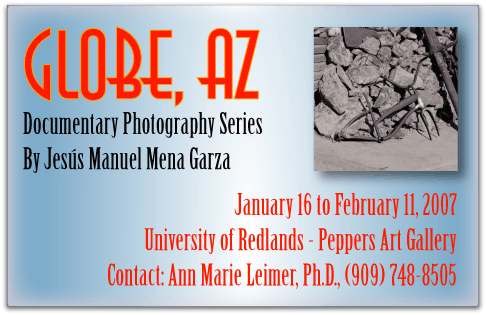
You're invited to my upcoming documentary photography exhibition, Globe, AZ. The show will take place at the University of Redlands (Redlands, California USA) at the Peppers Art Gallery, January 16 to February 11, 2007.

The reception is on January 17, 4:30 to 6 p.m. Come on down and enjoy the photos, free drinks (wine, beer and sodas) and plenty of snacks. I look forward to meeting you. Please tell all your friends. For more information about the show click on the header of this article or go to my website: http://www.jmmgarza.com.

You can also contact:

Ann Marie Leimer, Ph.D.

University of Redlands
1200 East Colton Avenue
Redlands, CA 92373-0999
(909) 748-8505
ann_leimer@redlands.edu


-30-

Sunday, December 11, 2005

Globe, AZ Photo Series


Like the sun-baked buildings that dot the desert landscape, the inhabitants of Globe and Miami, Arizona, survive gracefully, showing their age. The two cities live next to each other huddled in the hills. The heat that punishes Phoenix spares the high desert. In the Hill Country of Central Arizona, residents find themselves at a crossroads between national trends and their desire to control and define their community. Taken during the summer of 1995, these photographs reveal an America still rural and conservative.

This area came into existence when the San Carlos Apache Nation ceded valuable portions of its reservation to powerful mining interests. Crushed, fired, and processed, the copper extracted from the red and green rock created wealth for multinational corporations for more than a hundred years. The white sticky powder heaped high along the highway is part of the regions legacy. Arizona's Cobre (Copper) Valley would be a mecca for tourists, if not for the scarred hills.

My photographs evoke nostalgia for Americana, remnants you still find scattered in remote and untouched parts of our country. When I first came to Globe, I was struck by the eerie silence at night. There were no sirens or gunfire from the barrio to awaken me. The stars sparkled brightly, the air smelled clean, and, like the 50s in California, you could purchase leaded gas because no smog regulations exist. With so few people in such a large area, pollution laws were lax. Los Angelinos can be envious of some things in the Cobre Valley.

During the process of taking these photographs, I recalled my youth in San José, California. I remembered fondly how San José once had a downtown with small friendly theaters, department stores, and a sense of community. I remembered when prune orchards lined Main Street and Intel, Apple, and Silicon Graphics were fantasy. Everything changed with the invention of the integrated circuit. That is when San José was radically and forever transformed into Silicon Valley, the center of high technology. My hometown has since grown ponderous and fruit orchards have given way to bland warehouses and suburban strip malls.

Even though my hometown has evolved into a big city, I find solace knowing that small communities like Globe and Miami remain the same. My images of these communities document not only the environment, but also reveal its beauty by abstracting the details. I focus on the texture of a building, emphasizing the elements of the photograph that translate into the subtle but essential tonal values.

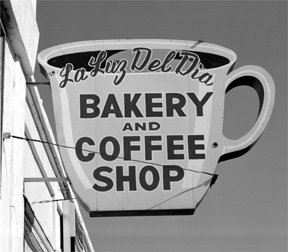
I rejoice in photographing sun-baked buildings with peeling paint; they give evidence to history's passing. The faded coffee shop sign and Gibson's Clothing Store remind me of a bygone era, before the new Wal-Mart took away their customers. My work documents a precarious rural America whose sites have become curios to be immortalized on photographic paper, their value increasing with every new mall erected in Seattle, Austin, and Cleveland. This vanishing America gains value by remaining the same.
---
The images in this series were shot on a Hasselblad 500CM/150 T*. The negatives were scanned on a Scitex Leaf Scanner.

Please feel free to contact me should you have any questions about my pictures or text. I look forward to hearing from you.

The photogrphic series is located on my web site: http://www.jmmgarza.com/html/Gibsons.html

-30-

Best Fishing Combo For Oregon Coast Striped Bass

 I ASKED GOOGLE Ai: Suggest a rod and real combo for catching 20 pound striped bass off the coast of Oregon? PHOTO: August 2026 fishing in C...