Showing posts with label UCLA. Show all posts

Wednesday, October 27, 2021

 I've lived in many college towns. Both in Texas and California. Universities have varying degrees of civic interaction. From insular to interactive. 

Let me detail my experiences. I started life in the San Francisco Bay Area near SJSU and I currently reside in Fort Worth near TCU. 


I'm going to subjectively rate these schools from 1 to 5. Five being "very involved" in the community.


UCLA photography lecture. 2011


SJSU -3

Stanford -2

UC Berkeley - 2

UCLA - 5

CSULA - 4

UT Austin - 4

Midwestern State - 4

TCU - 1


TCU wants you to go to their football, baseball and basketball games. That's where they make money. Sadly, their primary community art gallery is located in a tiny strip mall off campus. Not much there.


UC Berkeley and Stanford are the proverbial ivory towers. It's all about academics and they don't offer much programming for the public. But they do much better than TCU.


UCLA is heavily involved in the Los Angeles arts and culture scene. When I lived in Southern California, it seemed every week there was either a lecture, an exhibition or an event my wife and I would find interesting. Same with CSULA.


So there you are. These are my impressions of various universities I've experienced. I loved going to UCLA and UT Austin. Too bad conservative TCU, just 10 minutes away, is a stick in the mud. I'd rather be in Austin or LA. Or in the Bay Area near my familia.


Wednesday, September 07, 2016

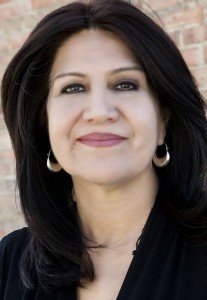
Evelina Fernandez’s Chicano Century Cycle

Article courtesy of www.americantheatre.org

In ‘A Mexican Trilogy,’ the actor/playwright tells the story of a family, and a people, with her own creative family, the Latino Theater Company.


Evelina Fernandez.

In the late 2000s, Evelina Fernandez began to write a play about an intergenerational Mexican-American family in Los Angeles, dealing with the loss of a son in Iraq, with the death of the beloved Pope John Paul II, and with assorted other challenges big and small. At the time she had no intention of joining the ranks of the epic durational play à la Angels in America or The Kentucky Cycle.
But she soon realized that there was more drama to be mined from the history of the fictional Morales family, which was loosely inspired by her own background. Soon a trilogy of plays took shape, and each part in the trio—FaithHope, and Charity—got staged in turn by the Latino Theater Company, which Fernandez runs with her husband, director José Luis Valenzuela, at the Los Angeles Theatre Center.
Now all three are being staged together as A Mexican Trilogy at LATC, Sept. 8-Oct. 9, in an ambitious undertaking that represents a kind of culmination for the nearly 30-year-old company. We spoke to Fernandez from the midst of rehearsals (and the inevitable rewrites).
Three plays at once is a pretty big undertaking, right?
I know, it’s huge—it’s too much. We’re in rehearsal right now, and I’m realizing: My God, it’s massive. But it’s exciting. I don’t think anything has been done like this, following Mexican-American history through multiple generations.
Eduardo Machado did his epic saga about Cuba and Cuban Americans, Floating Island Plays, back in the 1990s, but I think you’re right about the Mexican-American experience. Though now that I think of it, you were also in the movie American Me. Speaking of which, are you acting in this trilogy too?
I am. We’re a theatre company, so we all wear lots of hats. Originally I was not in Part 2 when we first staged it, but it was too hard to sit out there and watch—I hate being in the audience. I was like, “Get me back on the stage!”
Did you initially conceive this as a trilogy?
I wrote Part 3, Charity, first, and then I thought: There is more to say, not just by me personally but on the part of our company. It was a time—and it continues to this day—where we were hearing lot of anti-immigrant rhetoric. We get so frustrated, because there’s no acknowledgement of the long history of Latinos. We’ve been here for many generations, but we’re always portrayed as people who want to cross the border. So I thought, let’s do our part here and tell this story that hasn’t been told in its entirety. We take this family all the way from fleeing the Mexican Revolution to losing their son in the Iraq War.
So you started with the third play and flashed back?
Actually we began in 2011 with Hope, the second part. When we did readings, the 1960s story really resonated with our audience, so we decided to do that play first because it was in better shape. Then we did Faith, the first one, then Charity, the third. It’s kind of like Star Wars—everything was done out of order.
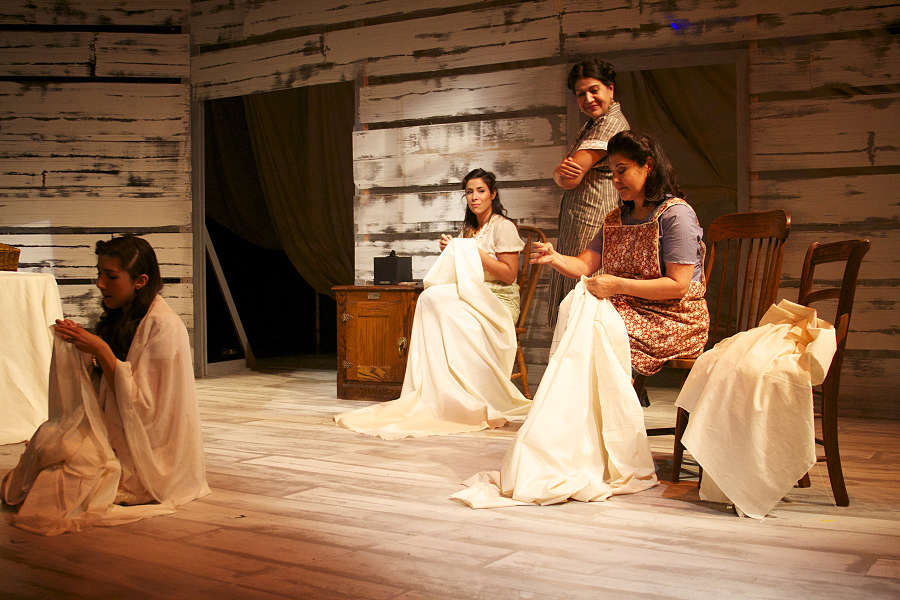


A scene from “Faith,” Part 1 of “A Mexican Trilogy” at Los Angeles Theatre Center. (Photo by Pablo Santiago)

Are you doing the usual multi-night and marathon options?
Yeah, we’re doing it both ways: You can come on Thursday and see Part A, on Friday see Part B, or you can come on Saturday and Sunday and see the whole thing with a dinner break.
But wait—it’s three plays…
We split the middle play in half; it was the only way we could do it. People can’t come more than two nights. If you only see Part A, you end at the Cuban Missile Crisis.
Did you have models in mind as you worked: Kushner, Robert Schenkkan, even August Wilson?
I can’t really say that I did. I wrote the three plays never thinking that we were going to do them all together. When we decided we were, we started to figure it out. But I’ve seen durational theatre; I sat throughThe Iceman Cometh with Jason Robards when I was 9 months pregnant. I certainly remember that! And we saw GATZ at REDCAT and just loved the whole experience. But our audiences so rarely get to experience something like this—I’m specifically talking about the Latino audience. Some of our board members were actually worried, like, “Do you think anyone will want to do this?” Interestingly, we haven’t sold many one-nighters; more people have bought the whole-day experience. Everyone’s interested in seeing the whole story in one big sweep.
I’m sorry to say I don’t know a lot about your background before the Latino Theater Company.
I’m from East L.A. I got involved with the Chicano movement, and my first professional theatre credit was in Zoot Suit. Luis Valdez basically took me and put me on the stage without any real formal training; I think he was taken by my authenticity. So I found myself as a female lead at the Mark Taper Forum at a young age, and that changed my life. I always thank Luis for giving me that opportunity and pointing me in a whole new direction.
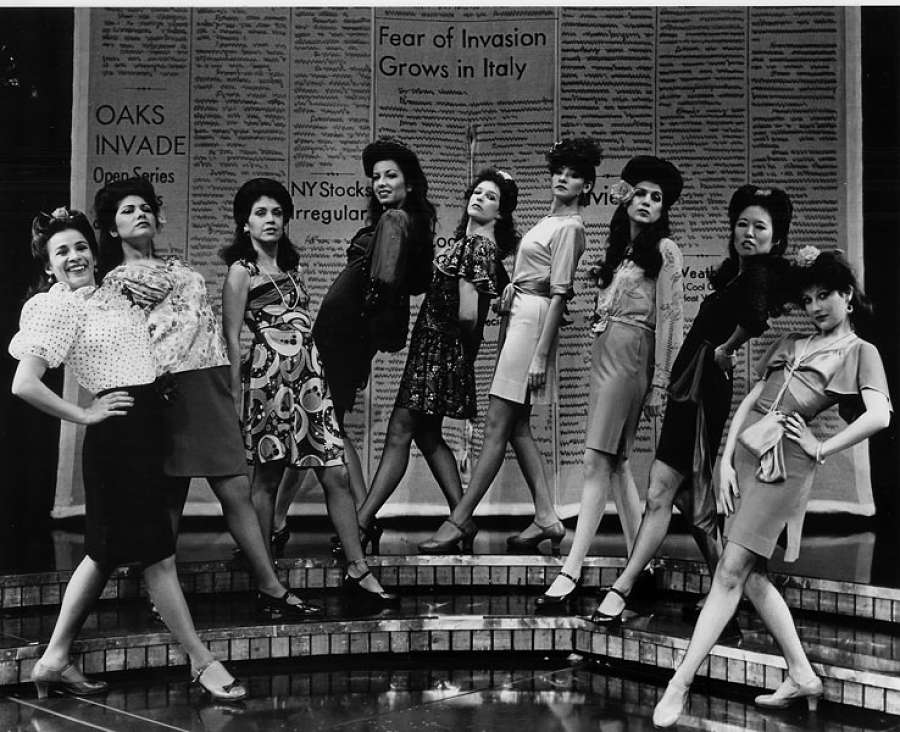


Alma Martinez, Rachael Levario, Anne Betancourt, Becky Gonzalez, Laura Owens, Bel Herandez, Evelina Fernandez, Susie Inyoue, and Dyana Ortelli in “Zoot Suit,” 1979.

I know Chicano and Latino theatre from roughly the late ’80s on, and I know a bit about El Teatro Campesino. What was Chicano theatre in L.A. like before that?
There was a big Chicano movement that grew out of the Civil Rights movement. During the Vietnam War there was a disproportionate number of Chicanos and African Americans being killed in Vietnam. There was a rise in protests against the war and against police brutality, and in favor of bilingual education and our history being taught in the schools. And because of El Teatro Campesino, there was a swell of Chicano theatres in the Southwest and even the Midwest. We used to have theatre festivals every year. There were maestros who came from Mexico and Latin America to train us in different kinds of theatre, and from that came our training, which is based in collective creation.
El Teatro de la Esperanza was a troupe I was a member of with José Luis in Santa Barbara; we also toured with it throughout the country and Cuba. When José Luis left Santa Barbara we came back to L.A., and he got the job at the Los Angeles Theatre Center. Latino Theater Company was born there.
That was an extraordinary time; I was lucky to be there for some of it.
It was. There was the Latino lab, the Asian lab, the African-American lab. It was an extraordinary time for diversity. When LATC closed, we originally went to the Taper, but then eventually we came back to LATC, and now we run it. It’s been close to 30 years. It’s unique to have a group of actors who have worked together for so long.
It’s true, there aren’t many examples—Wooster Group orSteppenwolf come to mind, though in the latter case they’ve grown into a big regional theatre.
Right. We still consider ourselves independent; we run our own theatre and we create and produce our own work.
Your training was in collective creation, but obviously you’ve also made plays as a sole author too. Where does this trilogy fit on that continuum?
This trilogy is not as informed by our ensemble as some of our other pieces, like Solitude or Premeditation, which we developed together though workshops. With the trilogy, even though there’s always input from the ensemble, I went off and wrote the pieces then brought them in. But for example, when I wrote Dementia, I knew that Sal Lopez was going to play the lead. I know that Sal can sing and dance, I know he can speak English and Spanish; those are all the elements I have to work with when I’m creating a character for Sal. We have developed a style, a way of working together. It always includes movement, dance, singing. We joke that in all our shows we laugh, we cry, and we have tequila shots.
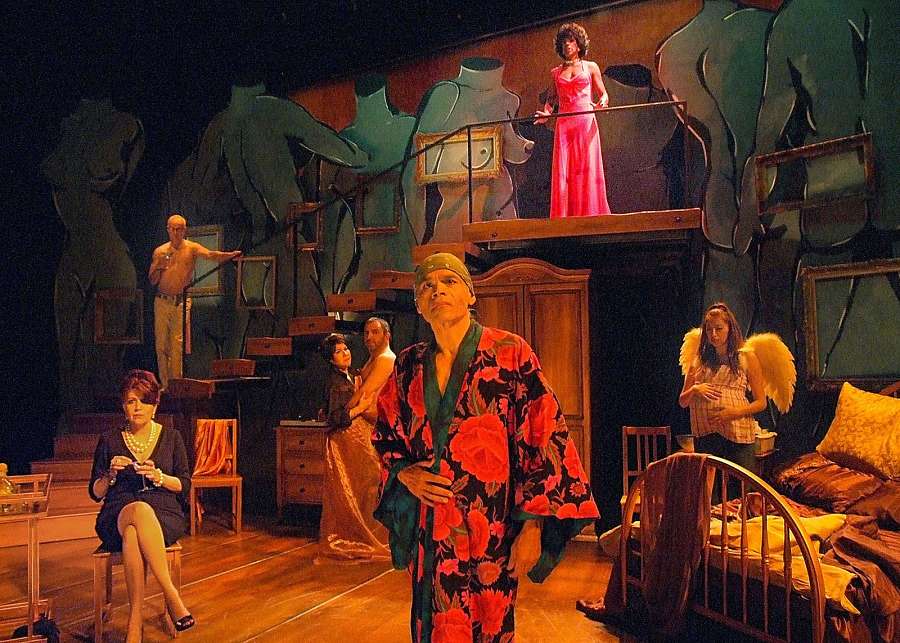


Sal Lopez, center, in “Dementia.”

And we write for a certain audience. We know the stories that are important to them. We also push the envelope and open their minds to different points of view. When we did Dementia, not too many people were writing about a gay Latino dying of AIDS. And there we had the gay audience sitting with the hardcore Chicano audience; bringing those two audiences together in the theatre was a great accomplishment for us.
I was intrigued that Part 1 and 2 have Arizona settings—Jerome and Phoenix, respectively—as that’s my home state.
My mom was born in Jerome, and Part 1 and 2 are loosely based on the history of my family. I was born in East L.A., then my father took us to Phoenix and I lived there for the first 9 years of my life, then we moved back to Los Angeles. Part 2 is based on a lot of my memories of living in Phoenix in a very dysfunctional Mexican-American family.
Phoenix is where I grew up, and I lived for a long time in L.A. My sense of the Latino cultures in each is that they’re quite different, even though both are predominantly Mexican-American.
Yeah, my relatives in Arizona are very different from my relatives in Los Angeles. Some of them are even Republicans in Arizona! I feel like it’s a slower development of social consciousness there—I’m just talking about my family, and just what I observed, but it develops and moves forward at a slower pace. L.A. is just so diverse in so many ways, not only culturally and ethnically; there are just so many different parts of the city, and the way people relate to each other is different.
Do you ever go back to Phoenix?
My childhood was not very pleasant. I always say of Phoenix, “Oh, it’s so hot—the heat is so heavy.” I just remember us not having much and having electricity turned off, and having to sleep outside under the weeping willow tree because it was too hot to sleep inside. So I have an aversion to Phoenix. But I do love Northern Arizona.
The Taper is bringing back Zoot Suit in its 2017 season. Are you looking forward to that?
Oh man, I’m so excited. It was such a big part of my life, and Luis was such a mentor to me. I heard somebody say, “Wow, I hope it’s successful,” and I said to them, “Are you kidding me?” I think it’s going to be a huge hit. It’s great that Luis is directing it again. When I was inZoot Suit, I was expecting my son, Fidel. Now both my children are actors. Wouldn’t it be amazing if they could audition for that?
This is a variation on a question I once asked August Wilson as he neared the end of his Century Cycle: Having documented such a long time span, how does the overall picture look to you? Have things improved or gotten worse? Are you hopeful for the future?
In Part 3, the granddaughter of Esperanza from Part 1 has just lost her son in Iraq, and they’re dealing with that loss. These are people who’ve gone through the Chicano movement. And then a young man arrives from Mexico with the dream of making it in the U.S., and he comes full of hope and full of questions; he wonders, “Why is there such pessimism? This is the best country in the world!” They have a conversation about the war. Rudy, the father, says, “I don’t want my son to go to war; I don’t believe in war.” And the young immigrant says, “Don’t you love your country? Don’t you believe you have to fight for your country?” I do see hope. As long as we keep coming, there’s always hope in the future.
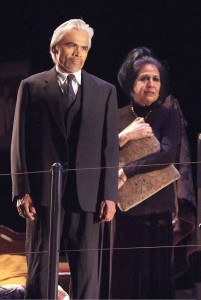


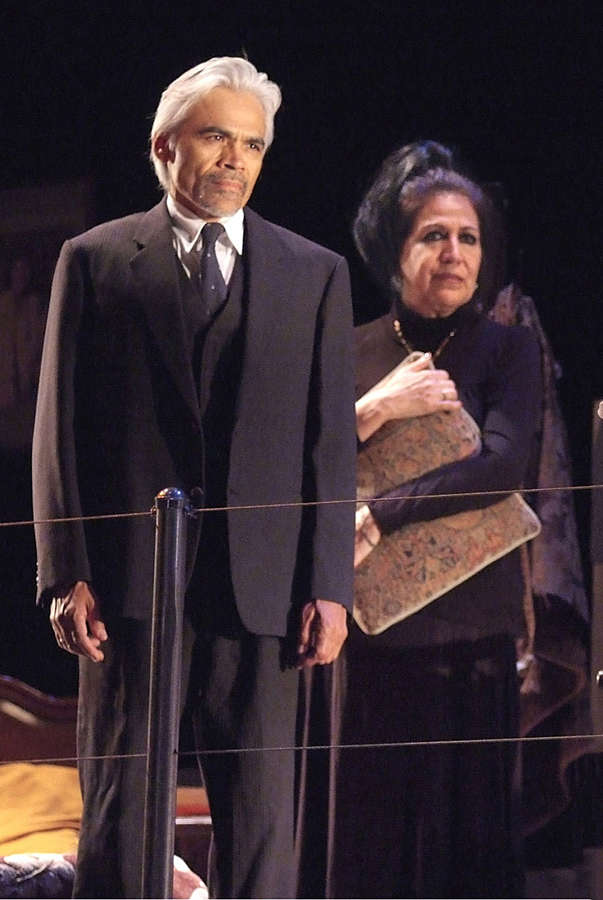
Sal Lopez and Evelina Fernandez in “Charity,” Part 3 of “A Mexican Trilogy” at Los Angeles Theatre Center. (Photo by Ed Krieger)

The other day, José Luis and I had this event in our home. We have a circle of friends who support our work; most are successful Mexican Americans, some are Guatemalans, Ecuadorians. Everybody has a story. We went around and each one of them told their story. I was so moved: Some said, “I’m first generation American,” or, “I was raised in a foster home,” “I was on welfare”—everybody had different backgrounds. But they were all very successful. I’m a high school dropout, and my children graduated from UCLA and NYU. So many times the focus in the media is on the negative things that happen in our community—the gangs, the poverty—and not on the success we’ve had in this country. I think that definitely outweighs the struggle, and the things we still have to overcome.
Last question. It’s called A Mexican Trilogy, but apart from a prologue in Part 1, it’s all set in the U.S. Can you tell me about the choice of the title?
I’ve gone back and forth on that so many times: Should it be A Mexican Trilogy or A Mexican American Trilogy? The full title is now A Mexican Trilogy: An American Story. It’s about claiming that ethnicity. This is the story of a people: You start with a people, and you end with the same people. They are Americans; they are also Mexicans.

-30-

Wednesday, July 09, 2014

UCLA Chicano Photographers

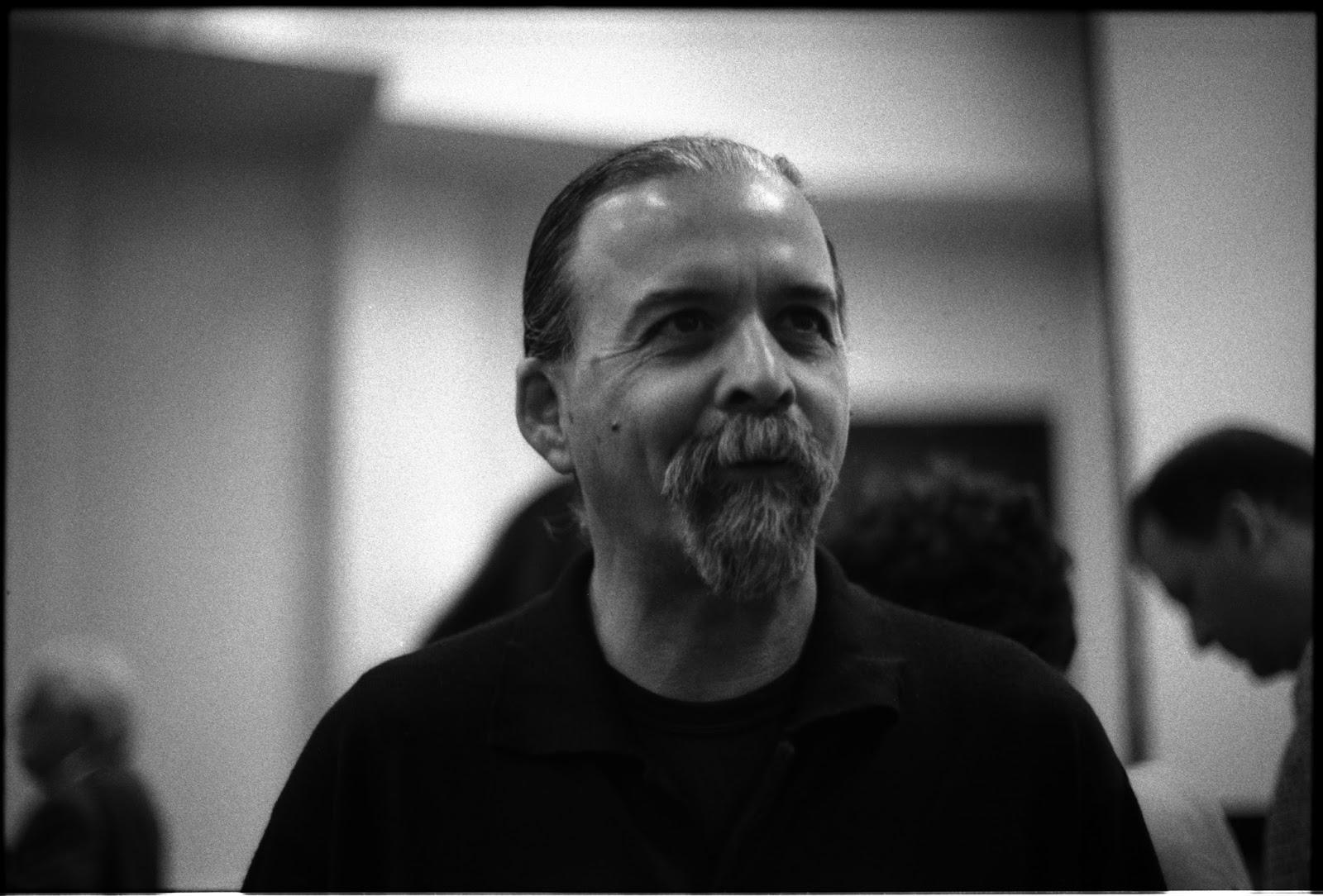
On September 25, 2011, I loaded my vintage 35mm Nikkormat camera with TMax 400 (black and white negative film) and photographed Oscar Castillo and Harry Gamboa, Jr. at UCLA. The two Los Angeles photographers were talking about their photographs taken several decades earlier. I felt incorporating the anachronism that is now film photography would celebrate and bring context to the historic event. Feel free to send me your comments.

Click photos to enlarge

Harry Gamboa
Harry Gamboa
Oscar Castillo

Oscar Castillo
UCLA

#OscarCastillo #HarryGamboa #UCLA #Chicano #Photographers

Copyright Jesús Manuel Mena Garza 2014. All rights reserved.

Friday, March 01, 2013

And now a message from the UCLA Chicano Studies Research Center

Director’s Message

It’s a conundrum, to be sure. What do you do when your longtime maid dies? After all, she practically raised your children. She cooked your eggs just so, lightly sprinkling them with something red. You asked her what, but you could not make out her response. (Sounded like “tapas”…) So do you send flowers to her family? Does she even have a family? Do you mention it in your year-end letter to friends and relatives? After all, she worked for you for almost forty years. These are delicate matters. It is what makes life in Hollywood so very challenging.

In 1976 Lupe Ontiveros earned her first role in Hollywood. She played a maid on Charlie’s Angels. Over the next thirty-six years she played, by her own account, more than 150 maids, holding her own against the likes of Jack Nicholson (twice). When she was not playing a maid, she played a prostitute or a madam. But she was also the patron saint of Chicano (and Latino) cinema, starring in now classic films: Zoot Suit, El Norte, Born in East L.A., My Family, … and the Earth Did Not Swallow Him, Selena, Chuck & Buck, Luminarias, and Real Women Have Curves. She had recurring roles in just about every Chicano-produced television series, and also Desperate Housewives. My personal favorite is her role as a drug lord in Taylor Hackford’s 1993 film Blood In, Blood Out. Without a doubt, her final shootout scene is matched in American cinema only by Queen Latifah’s in Set It Off. Lupe lived large on the silver screen.

Ontiveros passed away in July 2012 at age 69—much too early, to be sure. Yet she had an astounding career, especially in light of the limited roles available for Latino actors. Why, she even did voice work in an episode of Seth MacFarlane’s Family Guy. So imagine my surprise when the Oscars did not include her in the “In Memoriam” segment. The Oscars also snubbed Russell Means, Sherman Hemsley, and Phyllis Diller. These oversights took place during an Oscar ceremony that one writer called “a lengthy celebration of xenophobia and misogyny” (The Nation). Another writer noted, “The more we pass off old stereotypes, rooted in hate, as normal—as MacFarlane did again and again last night—the longer those stereotypes, and their ability to harm people, will be in place” (The Atlantic). The Academy took the brunt of the blame, since its membership—similar to the declining viewership for the Oscar broadcast itself—is older (age 62 is the average), almost entirely white (94 percent), and mostly male (77 percent). The rationale for having MacFarlane as the host had to do with reaching out to a younger audience, which he did. The strategy relied heavily on what one writer called “the ironic hipster self-aware racism of ‘being so cool that we know it’s racist [and] that it’s ok to participate in it. We’re above it’” (Salon.com). Indeed, two Hollywood notables in the coveted 18 to 49 demographic received Oscars for creative work rooted in some form of racial masquerade: Quentin Tarantino and Ben Affleck. Of course such an approach overlooks the fact that non-whites made up more than half of all births and accounted for over 92 percent of population growth between 2000 and 2010. These are delicate matters, indeed. Earlier this week, the Academy quietly added Lupe Ontiveros to its online “In Memoriam” page.

Chon A. Noriega

Director and Professor

-30-

Friday, September 30, 2011

An LA Chicano artist's best friend: Chon Noriega

[Photo is the cover of the October 2011 issue of Artforum Magazine]

Having lived in SoCal for several years now, I have gained a respect for UCLA professor Chon Noriega. Along with his minions, he has done an incredible job of promoting Southern California Chicano artists. Here are a few examples:

1) Helped gain exhibitions at major galleries including LACMA, the Autry, UCLA and the Getty (at the biggies not just the small barrio galleries)

2) Coordinated or created compelling articles and books on local artists (quite a few... not just a couple)

3) Promoted artists in important publications like the SF Chronicle, LA Times, Artforum, NY Times, etc. (he is a promoter)

4) Held panels and events that highlighted Chicano artists (rarely a Northern California Chicano or Chicana in sight)

5) Apparently, promoted the work of Chicano artists to international galleries and publications (Mexico, Europe, Asia... nice)

Chon's Los Angeles artistic and academic collaboration is groundbreaking. In San Jose, San Francisco, Berkeley, Austin, etc., Chicanos are typically relegated to smaller galleries even though their work is just as good if not better than their peers in Southern California. These communities don't have a hard-working academic like Chon making waves and news.

Typically scholars are sequestered in their ivory tower writing books and participating on the occasional panel. These tired academics are the norm, but Chon has broken out of this paradigm. This is great for LA artists and definitely bad news for other communities who lack an articulate and passionate person who is promoting Chicano and Chicana art "con ganas". Makes me wish I was born in Los Angeles... almost.

=30-

Monday, February 14, 2011

Mapping Another L.A.: The Chicano Art Movement

[Click header to go to original article]

October 16, 2011- February 26, 2012

Beginning with the establishment of the first Chicano art gallery in 1969 in East Los Angeles, Chicano artists began a collective re-imagining of the urban landscape through photography, graphic arts, murals, and large-scale architectural plans, as well as through painting, sculpture, installation, and drawing. While their approach was collective in spirit, and undertaken in the context of the Chicano civil rights movement, these artists engaged in varied and debated positions on aesthetics, media, ideology, and the social or community function for their art. Their work was at once local, identity-based, and global in orientation, exploring the uncharted spaces between Mexican tradition, Chicano vernacular, and American modernism. This exhibition maps the diverse social networks among Chicano artist groups and art spaces in Los Angeles during the 1970s. These include Asco, Centro de Arte Público (CAP), East Los Streetscapers, Goez Art Studio and Gallery, Los Four, Mechicano Art Center, Plaza de la Raza, Self Help Graphics and Art, and Social Public Art Resource Center (SPARC). In showing how these artists mapped another L.A. – as part of a social protest and community empowerment movement – the exhibit presents little-seen work and documentation that reveal a complex history of the artists as they both navigated and imagined the social spaces of Los Angeles.

Mapping Another L.A is part of L.A. XICANO, four inter-related exhibitions organized by the UCLA Chicano Studies Research Center as part of Pacific Standard Time: Art in LA 1945-1980, an unprecedented collaboration of more than fifty cultural institutions across Southern California, which are coming together to tell the story of the birth of the LA art scene. Initiated through grants from the Getty Foundation, Pacific Standard Time will take place for six months beginning October 2011.

This exhibition is curated by Chon A. Noriega, Terezita Romo, and Pilar Tompkins Rivas.

Tuesday, April 27, 2010

They’re Chicanos and Artists. But Is Their Art Chicano?

... It has long been said that the identity-based show is an evil whose necessity would disappear in a more equitable world, but museums and grant-giving foundations will continue to support this kind of project because of its appeal to various interest groups. In truth, it as much a bureaucratic artifact as a curatorial one.


Photos by Julieta Cervantes for The New York Times


By KEN JOHNSON
NY Times

Is it time to retire the identity-based group show? Back in the 1970s, exhibitions devoted to the work of women, blacks, gay people, American Indians and other disenfranchised groups brought into the mainstream all kinds of new styles and ideas. They changed the course of modern art history.

If it is hard to imagine that sort of exhibition making waves now, there is good reason. Artists of many different backgrounds and sexual orientations have been assimilated into the art world. There are more women than men in this year’s Whitney Biennial. Questions of equitable representation probably will never go away, but at this point, many artists would balk at being included in an identity-based show. They want to go to the big dance.

These thoughts were occasioned by “Phantom Sightings: Art After the Chicano Movement,” a confused and confusing exhibition at El Museo del Barrio presenting works by Mexican-Americans who have come of age since the 1990s. In the catalog the exhibition’s curators acknowledge that some artists who were invited declined to be in a “surname-based” show. (The exhibition was organized by Rita Gonzalez and Howard N. Fox, curators at the Los Angeles County Museum of Art, where it opened in April 2008, and Chon A. Noriega, of the Chicano Studies Research Center of the University of California, Los Angeles.)

In his foreword to the catalog, Michael Govan, director of the Los Angeles museum, observes that the 27 artists and collectives in the show are not grouped “by their own volition or consensus.” Selecting by ethnicity is “a curatorial artifact, a device to reflect and speculate on the issues facing Chicano artists today.”

It becomes readily apparent that the artists are not unified by any single style or conceptual approach. The work ranges from Victor Estrada’s funky-surrealist paintings to Sandra de la Loza’s complicated installation of old documents and a digitally manipulated video dedicated to Fort Moore, a historic site in Los Angeles.

Few pieces resemble the ideologically charged paintings and graphics of the Chicano movement, which blossomed in the late ’60s and early ’70s. Christina Fernandez’s large color photographs of laundromats represent an experience that people from many backgrounds know intimately. Without the works’ titles, you would not know that Delilah Montoya’s sumptuous, wide-angle landscape photographs depict stopping places on illegal-immigrant trails out of Mexico. Turning ugly subjects into beautiful pictures is something photographers do all over the world.

Some works relate to Chicano art, but with knowing, retrospective sophistication. Carolyn Castaño’s brightly painted, cartoonish portraits of pretty Mexican women surrounded by flocked and glittery stripes or floral patterns could be mistaken for cheap beauty parlor décor (in a good way). Folksy, signlike paintings and cases displaying sneakers and sandals made of painted cardboard by Gary Garay similarly refer to low-budget commerce and extend to the present the Chicano movement’s affectionate embrace of “low-brow” Mexican-American culture.

Eduardo Sarabia’s room covered with faux-antique blue-on-white tiles with emblematic designs alluding to the drug wars adroitly combines popular tradition and contemporary political savvy. And Alejandro Diaz’s display of distressed cardboard signs bearing hand-written messages, like “I beg to differ” and “Wet Back by Popular Demand,” play with themes of homelessness and racism with unusual good humor. He first exhibited them while wearing a white suit outside of Tiffany & Company in New York.

The most impressive effort in this quasi-populist vein is Margarita Cabrera’s sculpture of a full-size yellow Volkswagen Beetle, a car that was produced in Mexico from 1967 to 2003. Made of mainly sewn-together pieces of colored vinyl, it evokes the soft sculpture of Claes Oldenburg. According to the catalog, it also draws attention to the poor working conditions of industrial laborers in Mexico.

The curators explain in the catalog that the point of the exhibition is not to show the evolution of a particular visual or formal style but to demonstrate how Mexican-American artists have adapted mainstream conceptual strategies to more local concerns. It is the top-down opposite of the Chicano movement, which raised conventions of popular culture into the realm of high art, and it looks as if the biggest influence on most of these artists were M.F.A. programs.

“Black on Black,” a sculpture by Juan Capistran consisting of a black Minimalist slab leaning against another bent one, as if with sexual intent, looks like the sort of postmodernist riff on formalist abstraction associated with artists like Peter Halley, Sherrie Levine and countless others who have toyed with Modernist semiotics.

Finish-fetish-style panel paintings by Rubén Ortiz-Torres, rendered in glossy and glittery auto-body paint, conflate Modernist abstraction and custom-car painting. “Rigor Motors,” a pair of sculptures in the form of coffins by Ruben Ochoa and Marco Rios — one is half upright with an automobile bucket seat inside — allude to a car culture of death.

Death is more grimly invoked by Ken Gonzales-Day’s display of old postcards bearing pictures of people standing around under trees. Before selective erasure by the artist, they depicted lynched Mexican-Americans, and thus symbolize a pernicious historic amnesia.

Taken altogether, it is not clear what this show says about today’s Mexican-American artists. Are they doing something unusual that the art world needs to catch up on? Not those in this show. Is it news that they are as creatively diverse as American artists in general? It should not be.


It has long been said that the identity-based show is an evil whose necessity would disappear in a more equitable world, but museums and grant-giving foundations will continue to support this kind of project because of its appeal to various interest groups. In truth, it as much a bureaucratic artifact as a curatorial one. A more astutely focused, judiciously selected exhibition might lead to different conclusions, but this one will not alter the impression that last rites for this type of show are in order.

“Phantom Sightings: Art After the Chicano Movement” continues through May 9 at El Museo del Barrio, 1230 Fifth Avenue, at 104th Street, East Harlem; (212) 831-7272, elmuseo.org.

-30-

Tuesday, March 31, 2009

Crean Archivo Digital de Antiguas Canciones Mexicanas


[Click headline to go to UCLA The Strachwitz Frontera Collection of Mexican and Mexican American Recordings]

Por E.J. TÁMARA © 2009 The Associated Press

El primer mariachi grabado, las canciones de un supergrupo pionero de lo que ahora se conoce como música norteña y las interpretaciones de la primera "Reina de la música tejana" son parte del archivo más grande de su tipo, 41.000 antiguos temas mexicanos que ahora están disponibles al público en formato digital.

Las joyas musicales del Cuarteto Coculense, Lydia Mendoza y el dúo precursor de música norteña Los Alegres De Terán son algunas de las piezas digitalizadas a partir de discos de 78 rpm grabados entre principios de 1900 y la década de los 50, bajo varios sellos discográficos.

"Este legado musical que nos dejan con esta colección no se compra con dinero", afirmó el jueves Hernán Hernández, integrante de Los Tigres del Norte, banda de música norteña que en el 2000 donó medio millón de dólares a UCLA para el estudio, investigación, adquisición, mantenimiento y diseminación de música tradicional y folclórica latina.

Pero debido a restricciones de derecho de autoría, la Colección Strachwitz Frontera de Discos de Música Mexicana y Mexicoamericana, disponible en la Universidad de California en Los Angeles (UCLA), cada una de las canciones sólo puede ser escuchada en su totalidad en computadoras del centro superior. Desde fuera de la UCLA sólo se puede escucharse los primeros 50 segundos de cada canción por internet.

Los discos originales de la colección, incluyendo los de 45 y 33 rpm que están por digitalizarse, pertenecen al alemán Chris Strachwitz, presidente de la Fundación Arhoolie, quien dijo que se enamoró de la música regional mexicana por la pasión que dejan traslucir las voces e instrumentos.

"Tiene el mismo tipo de soul y fuerza y agallas que vi en lo mejor de jazz, blues y country ... puede ser muy bonito. Es fuerte pero bonito. No sé como decirlo pero me sobrecoge", indicó Strachwitz, quien coleccionó música durante unos 60 años.
El Cuarteto Coculense es identificado como la primera banda urbana de mariachi. Conocida también como "La Alondra de la Frontera", Lydia Mendoza grabó más de 200 canciones en más de 50 álbumes durante su carrera de 60 años que comenzó en 1928. Los temas de Los Alegres De Terán, formado por Eugenio Abrego y Tomás Ortíz, fueron transmitidos por radio en Nuevo León alrededor de 1947, pero sólo acapararon audiencias grandes luego de comenzar a grabar en McAllen, Texas, de acuerdo con http://www.arhoolie.com

"La Colección Frontera será un recurso invaluable para estudiantes, investigadores y el público en general que quiera aprender más sobre la herencia musical en español de Estados Unidos", dijo Chon Noriega, director del Centro de Investigaciones de Estudios Chicanos.

Otros artistas incluidos en el archivo son: el Marichi Vargas de Tecalitlán, Los Hermanos Chavarría, de San Antonio, y los dúos femeninos Dueto Río Bravo, Las Hermanas Mendoza y Las Norteñitas.

En internet:

Colección Frontera en UCLA: http://frontera.library.ucla.edu
Fundación Arhoolie: http://www.arhoolie.org
Fundación Los Tigres del Norte: http://www.lostigresdelnortefoundation.org
Centro de Investigaciones de Estudios Chicanos: http://www.chicano.ucla.edu

-30-

Monday, December 22, 2008

Chicana, Chicano studies has grown with UCLA


Now a full-fledged department, the field has developed through many years of student support

By Neha Jaganathan

When Carlos Manuel Haro stepped into the Rieber dining hall in 1965 and noticed that he was the only minority student, he was motivated to join a newly born cultural and academic movement which now puts UCLA in the position to be the third university in the country to offer master’s and doctorate programs in Chicana and Chicano studies.

“Once you have an undergraduate major and graduate program, you can say the department has now fully arrived,” said Alicia Gaspar de Alba, current chair of the César E. Chávez Department of Chicana and Chicano Studies.

Gaspar de Alba said that two weeks ago, the proposal for the graduate program cleared the first of many steps in the academic review process after being unanimously approved by the Faculty Executive Committee.

Haro, a postdoctoral scholar at the Chicano Studies Research Center, has been at UCLA since 1965 and said the academic field has come a long way since that time.

“Given that my initial introduction to UCLA was a sense of being a bit lonely ... where I could identify one or two (other Chicano students) as I walked around campus, that’s a dramatic change to today.”

But the birth of the César E. Chávez Department, as well as the creation of the Chicano Studies Research Center, was not without several challenges and obstacles, all of which were overcome by student activism.

In 1966, Haro attended the first ever meeting of Chicano students, which was organized after another undergraduate student manually sorted through information cards in Kerckhoff Hall to find individuals with Spanish last names.

Haro said the meeting, though only attended by 11 students, gave rise to the larger full-fledged organization United Mexican-American Students, which started in 1967.

“The organization, although initially one of social interaction, became much more important as we started to take on issues that were of concern,” Haro said.

The organization began to focus on issues such as under-representaton of minority groups on campus, mentoring support and increasing financial aid, Haro said.

Reynaldo Macias, currently the acting dean of the Department of Social Sciences, was also a student at UCLA in the late 1960s, and as a member of UMAS, was involved in the Chicana/o movement on campus.

Mecias said the summer of ’68 saw several meetings of planning- and agenda-setting committees, one of which resulted in what was then called the Mexican-American Research Center.

In particular, the research center was the result of an intra-university effort called the Plan de Santa Barbara, when students from several campuses met at UC Santa Barbara to lay the foundations for a research center, Haro said.

The research center, which was created in 1969, eventually led to the formation of an interdepartmental Chicana and Chicano studies program in 1973, according to the research center.

But the interdepartmental program had several deficiencies, Gaspar de Alba said.

In an interdepartmental program, faculty members have other primary commitments to the departments in which they were actually hired.

The interdepartmental program underwent significant change in 1993, when student protesting followed a refusal by Chancellor Young to grant full department status to Chicana and Chicano studies.

The protest involved a hunger strike and sit-in in May of 1993, during which time more than 90 students were arrested, according to the research center.

As a result of the hunger strike, Chancellor Young created the César Chávez Center in June of 1993, Gaspar de Alba said.

The Center acted as a quasi-department, able to perform most of the functions of a department without the legitimacy of the label, Gaspar de Alba said.

“It was an experiment by the administration to see whether (Chicana and Chicano) studies would hold up as an autonomous unit,” she said.

She furthered that this quasi-department faced a lot of initial challenges, including poor leadership and resistance from student organizations which wanted a different set of faculty members.

“It’s a phoenix department because it rose from the ashes of its previous incarnation.”

In June of 2005, Chicana and Chicano Studies officially became a department, Haro said.

“That was historical, not only because the administration was finally meeting the primary hunger strike agreement, but because we were fleshing out the vision of students in 1969,” Gaspar de Alba said.

But she said the department was originally named the Undergraduate Department of Chicana and Chicano Studies and only since 2007 has been known by its current name, the César E. Chávez Department of Chicana and Chicano Studies.

While most scholars agree that the field of Chicana and Chicano studies has come a long way in the last 50 years, they also feel that it still has many goals to accomplish.

“At the college level, programs have to expand. They are limited in terms of the number of students they can accept,” Hora said.

-30-

Best Fishing Combo For Oregon Coast Striped Bass

 I ASKED GOOGLE Ai: Suggest a rod and real combo for catching 20 pound striped bass off the coast of Oregon? PHOTO: August 2026 fishing in C...