Monday, August 06, 2007

Late July 2007 Trip to the San Francisco Bay Area


[Photos: Top photo, Jesús at Muir Beach north of San Francisco, next photo, Jesús and Ann Marie with their new grandchild Jacob in San José. Click on image to enlarge. Copyright 2007 Jesús Manuel Mena Garza. All rights reserved.]

Here are the requisite photographs from our trip to the Bay Area. We had a great time visiting our daughter Estrella, her husband Jimmy and the kids in San José. We stayed at my sister Carmen's ranch also in San José and enjoyed the great weather. It was a nice respite from the hot temps in the Inland Empire.

Later in the week we crossed the Golden Gate Bridge into the fanciful world called Marin County. There we stayed with Ann's friends in San Raphael. It was great to be in this beautiful and affluent part of the country. One day we spent playing in the pool on another we went hiking from the Green Gulch Zen Center to Muir Beach. When Ann and I lived in SF we enjoyed this short and easy hike from the Zen Gardens to the always (it seems that way) foggy beach.

The new photos include our latest grandchild (in the diaper) Jacob.

-30-

Tuesday, July 03, 2007

LA Chicano Photography Panel Discussion A Success

[Photo: Panelists discuss photography and the Chicano Movement in LA. Click on image to enlarge. Copyright 2007 Jesús Manuel Mena Garza. All rights reserved.]

Carlotta’s Passion Fine Art of Los Angeles hosted a panel discussion on essential literary and visual documentation of the Chicano Movement on Friday, June 29.

Photographers Oscar Castillo, Jesús Manuel Mena Garza, George Rodriguez and scholar Dionne Espinoza, Ph.D. headed the panel. This panel discussion took place during the exhibition Struggle and Liberation: Photographs of Seminal Events and Icons of the 1960s - 1970s. Hollywood Director Jesús Trevino moderated the panel.

The panel discussion examined the photography, events and issues of the Chicano Movement (El Movimiento Chicano of the late 1960s and early 70s). The audience stood up, asked questions and freely gave their perspective. In the end, the event proved to be informative and inspiring. More than 100 people attended.

-30-

Thursday, June 07, 2007

Chicano History Explored In Upcoming LA Exhibit and Panel Discussion

Struggle and Liberation: Photographs of Seminal Events and Icons of the 1960s and 1970s

Friday, June 29, 8 p.m.

Carlotta's Passion Fine Art
2012 Colorado Blvd.
Los Angeles (Eagle Rock), CA
(323) 259-1563


Moderator

Director, Jesús Trevino

Panel

Oscar Castillo
Dionne Espinoza
Jesús Manual Mena Garza
George Rodriguez

[Photo: UFW Marcher With La Virgen del Tepeyac, 1974. Click on image to enlarge. Copyright 2007 Jesús Manuel Mena Garza. All rights reserved.]
-30-

Wednesday, May 23, 2007

Chicano Photographer Show In Los Angeles


[Photo: Los Mascarones, 1974. Click on image to enlarge. Copyright 2007 Jesús Manuel Mena Garza. All rights reserved.]

Carlotta’s Passion Fine Art of Los Angeles, California presents eleven photographs from the documentary series Chicano Photographer by California photographer Jesús Manuel Mena Garza, June 9 through July 1, 2007. The photographs are part of the exhibition titled, Struggle and Liberation: Photographs of Seminal Events and Icons of the 1960s and 1970s. The public is invited to a reception on June 9, 6 to 10 p.m.

University of Redlands’ Professor Ann Marie Leimer said, “Garza has extensively published and exhibited several documentary photographic series during the past decades. This series explores important aspects of the American experience, pieces of which are often marginalized by the dominant culture.”

During the 70s, Jesús Garza toured with theater groups in Mexico and California. From this vantage point, he took intimate portraits of people fighting for human rights. From César E. Chavez to Rodolfo ’Corky’ Gonzales, the photographs provide a retrospective glimpse from the unique perspective of a photojournalist and activist.

A more comprehensive exhibition that includes presentations and workshops by the artist will be held this fall at Saint Mary’s University of Maryland in Saint Mary’s City, Maryland and in spring 2008 at Valley College in San Bernardino, California. The photographs at Carlotta’s Passion have been previously exhibited during 2006 in Los Angeles, San José and Riverside galleries. This is the first time the photographs will be on sale as part of a limited edition.

-30-

Exhibition location: Carlotta’s Passion Fine Art, 2012 Colorado Blvd., 
Los Angeles (Eagle Rock), CA 90041.
Gallery telephone: (323) 259-1563
View photographs: http://www.jmmgarza.com/cp/

Tuesday, April 10, 2007

Comment About Documentary Photography

[Photo: Old Man From Juarez, Mexico, 1975. Click on image to enlarge. Copyright 2007 Jesús Manuel Mena Garza. All rights reserved.]


Some documentary photographers treat their subjects like quarry in the jungle. They stalk them, take their shot and then hang their desiccated representation on a distant sterile wall. The jungle can be the Amazon or the streets of a barrio, it is all the same to them.

As outsiders, their images lack any humanity and show a disdain for their subjects. At the photography reception, the shooter can be seen prancing around, weaving fanciful tales of his adventures to the spellbound audience.

The assembled, saturated by the stench of privilege, sip on wine. Esoteric rhythms waft in the background. The photographs remain mute. Surrounded, the captured photographs witness the decadence.

Jesús Manuel Mena Garza

-30-

Wednesday, March 21, 2007

Cool Seattle


[Photo: Taken with my cell phone camera, the view from my sister and brother in-law's International District condo in Seattle. On a clear day you can see Mount Rainier (Little Tahoma). Click on image to view larger. Photo copyright 2007 Jesús Manuel Mena Garza. All rights reserved.]

I enjoyed (maybe not) a short respite from Cali when I visited Seattle earlier this month. It was my first chance to visit the region for an extended period. I even drove the three hours to inspect Portland. Let me give you my short evaluation of the city of Seattle.

  1. Overcast and dreary (go to REI and buy a trendy little winter outfit and blend in)
  2. Cold (yes, I prefer warm temps)
  3. Three hours from Portland (more of the same stuff except not as much cash)
  4. Rain... rain... rain...
  5. Great downtown (I give downtown Seattle an A)
  6. Contemporary music scene (more music than Jimmy Hendrix can shake a guitar at)
  7. Plenty of nightclubs (you won't be bored in Seattle.... cold yes!)
  8. Plenty of coffee (you may need it)
  9. Not very friendly (Seattle cool)
  10. Thriving (business is booming)
  11. Mountains (rugged and snow capped)
  12. Where are the sandy beaches?
  13. Water, water, everywhere... plenty of lakes and the ocean
  14. Bridges (Portland and Seattle have plenty of them)
  15. YUPPIES everywhere (where are the Latinos?)

I had a chance to check out Seattle and ended up a bit envious. The city has a dynamic downtown and interesting neighborhoods. Seattle has plenty of clubs, bars, restaurants and shops. Parking in much of the city is impossible though. One night I just turned back after finding no parking spaces available. I heard summers are pleasant in the Great Northwest. In August, I will probably not find a parking spot but at least I will finally see the sun.

-30-

Wednesday, February 28, 2007

Chicano Photographer Exhibition


[Photo: Chicano Photographer poster. Click on image to enlarge. Photo and design are copyright 2007 Jesús Manuel Mena Garza. All rights reserved.]


I have never been to the East Coast. That is about to change. This fall, I will be showing select prints from my Chicano Photographer series at St. Mary's College of Maryland.

Chicano Photographer is a historic collection of documentary photographs exploring the Chicano community and activism during the 1970s. The images illuminate the panoply of activists, artists and issues of that period. For this important book and exhibition project, I have gleaned images from several thousand slides and negatives from my personal archive.

During the 70s, I had the privilege of touring with theater groups throughout Mexico and California. From this singular vantage point, I took intimate portraits of people fighting for human rights. From United Farm Workers President César E. Chavez to Teatro de La Gente, the photographs are a retrospective glimpse from the unique perspective of a photojournalist and activist.

One thing is certain, you can't go back to the 70s and take pictures of iconic figures César E. Chávez and Rodolfo "Corky" Gonzales. That is what makes this photographic series so valuable.
-30-

Wednesday, January 31, 2007

NPR Latino Marketplace


A journalist at the national public radio show Marketplace is reaching out to Spanish-speaking communities to find people interested in sharing their experiences to help them better cover the Latino economy in the US. They would like to hear from employers, employees, small business owners, professionals, bloggers, immigrants, non-immigrants, etc.

Click here to go to questionaire

Contact:


Joellen Easton
Public Insight Analyst
Marketplace | Marketplace Money | Weekend America
American Public Media
jeaston AT americanpublicmedia DOT org

-30-

Tuesday, January 23, 2007

Globe, AZ Photography Reception


[Photo: At the reception; University of Redlands President Stuart Dorsey, his wife Michelle and Dr. Ann Marie Leimer. Click on image to enlarge. Photo copyright 2007 Jesús Manuel Mena Garza. All rights reserved.]


I hope you made it to my Globe, AZ photography reception at the University of Redlands' Peppers Art Gallery on Jan. 17. It was a great success. Art lovers from throughout the Inland Empire enjoyed my documentary photographs. Please note that the exhibition ends on February 11, 2007. Feel free to contact me should you have any questions about my series. Click here to view Globe, AZ Series Photographs

-30-

Sunday, December 17, 2006

Chicano Photographer (excerpt)


[Photo: César E, Chávez, 1970, by author. Click on image to enlarge. Below, an excerpt from the proposed book project Chicano Photographer.]


Becoming a Chicano Photographer

At eight years of age, I remember shuffling through a drawer where I found 35mm negatives my sister Dolores had hidden. I pulled them out and held them to the light. They looked like film strips used in elementary school projectors during the late 50s and early 60s. The celluloid miniatures held a certain mystery. How could you make a print from such a small negative? What made this transformation possible?

From this raw beginning, I pursued and acquired the many skills necessary to be a professional photographer, advancing from taking snapshots to exhibiting in galleries. My role as critical observer empowered me, but ascension was problematic. It required coursework, taking countless pictures and discovery. I learned how to previsualize, capture, store, and distribute my art.

Through photography I explored the dynamic Chicano culture of the 70s. During this period, Chicanos struggled to enter the American mainstream while retaining their identity. Previously, Chicanos, Mexican-Americans, or Hispanics were known as the silent minority. In the 70s, I became part of a new, loud, and proud chorus.

I consider myself a Chicano photographer. But what is a Chicano photographer? Is it someone who only specializes in photographing Chicano subjects? What is Chicano subject matter anyway? It’s all very confusing. Should I be photographing stereotypical Chicano imagery?

I have gone to dozens of exhibits of Chicano artists. They can easily be divided into two categories. One large group consists of the Frida Kahlo wannabees. The second category is resplendent with independent thinkers. Both are valid.

Frida’s legacy is manifest in the work of many contemporary artists. Frida will never die as long as dozens emulate her. This genre contains at least one of the following naiveté representations; the maguey, sacred heart, Virgen de Guadalupe, a struggling woman, roses and such. When I enter an exhibition and discover examples of this formulaic work — I always have the refreshments to look forward to.

I consider myself in the latter category — an independent thinker. I am not limited to preconceived notions of Chicano art. Chicano art is a hybrid of the Mexican and American experience. That experience is constantly evolving. It’s also nuanced by region, gender and other variables. Personally, I have used my camera to explore the Chicano Movement, Americana, models, and much more. Yes, I have also photographed representations of the Virgen de Guadalupe.

I am a Chicano — and proud of it. Please don’t call me Hispanic. I am also a trained photographer. When all is said and done, I identify as a Chicano Photographer.

-30-

Thursday, November 16, 2006

Talking To Myself... Again!

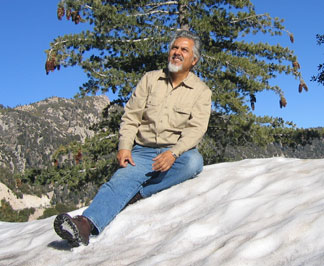
[Photo: The author is sitting in the snow near Big Bear, just 25 miles from Redlands. The paranoid schizophrenic is keeping an eye out for stray meteors.]

What am I going to do today is a question I often ask myself.

Living more than 60 miles from Los Angeles in the small 'burb of Redlands means that my options are few. Once every couple of months I go to LA, but it sure is a big pain because of the traffic congestion. Driving three to five hours in bumper-to-bumper traffic just to attend an LA event (like I have to do next month... again) is no fun. Traffic is insane here!

You may ask (or maybe not) what does this disgruntled Chicano do for fun in Redlands. Well, many days I just ride my bike to downtown. While in town, I generally order a decaf and peruse the LA Times. On the rare occasion that I feel adventurous, I drive to Riverside, San Bernardino or Big Bear.

In Riverside, I visit the handful of museums they have there. In San Bernardino, I meander into stores, looking at electronic products that I cannot afford (big screen TVs come to mind). At the lake near Big Bear, up in the mountains, I usually go fishing for trout. I am not very good at this, but I still love it.

If I were back home in San Jose, I would enjoy visiting family and friends. There I have brothers and sisters — daughters and grandchildren. I lived in Silicon Valley for more than 40 years and still have a precarious connection to the community. If I were back in the South Bay, I could enter into conversations and attempt to be useful. Here is Redlands, I don't talk or socialize much. Maybe I should try harder.

Luckily, I do have a computer to keep me company. I work on my photography and send plenty of emails. Today, I finished printing, matting, framing and packing an exhibition. Tomorrow I will prepare for a trip to Iowa. I will be visiting the in-laws. Why couldn't they live in Hawaii, instead of Slater, a town of less than 1,000 residents? During the growing season, fields of corn surround this hamlet. In November, all you see is miles of dirt or snow.

When I get to Slater, maybe I will come to the realization that I have it good in Redlands. Slater doesn’t have a bookstore or a coffee shop (they serve coffee only at the bar and at the gas station). In this oft frozen town, I would probably enjoy the warmth of a cup of java and a book. Please wish me luck as I come to terms with my life. The internal conversation continues.

-30-

Best Fishing Combo For Oregon Coast Striped Bass

 I ASKED GOOGLE Ai: Suggest a rod and real combo for catching 20 pound striped bass off the coast of Oregon? PHOTO: August 2026 fishing in C...