Showing posts with label garza. Show all posts

Sunday, January 11, 2015

Fort Worth, Texas Trinity River Photography

If you do an image search on the Internet for "Chicano" you will get back photographs of lowriders, gang members and tattoos. Essentially stereotypes. I see the Chicano experience much more broadly than that. I have captured images that range from portraits, events, infrastructure and landscapes. My reality and my home.

This duotone photograph of Fort Worth, Texas' Trinity River was taken last year. Originally in color, I transformed the image into various subtle black and white and sepia tones. Fort Worth has many rivers. This section of the Trinity River near downtown I find especially beautiful.

The original image is 24x36 inches. I have downsized the image and made it available for download as a letter size poster. The Adobe PDF can be printed via your home, office or commercial printer (Office Depot, Costco, Target, etc.). 

Click on the image below to download and feel free to share. Please send me your comments or questions.
Copyright 2015 Jesús Manuel Mena Garza. All rights reserved.

(682) 365-8702


Monday, July 06, 2009

Hurry Up and Wait For Your Sony BDP-S560 Blu Ray Player From SonyStyle


Like most of you, I hate being given the runaround. When I originally ordered my Sony Blu Ray player (BDP-S560) in mid-June, 2009, the folks at SonyStyle said it would ship on July 1. Well, apparently they weren't telling the truth. The SonyStyle website noted last week that the new Sony product wouldn't ship until late July. Today, the website noted in bright-red letters that the ship date has been moved to mid-August.

The folks (sales person) at SonyStyle said that I would get my player a month ahead of shoppers at BestBuy, Sears and other vendors. They were Sony. I believed them and now I have to wait for another month or two. By that time HDMI 1.4 versions may be out, making my $350 investment "old school."

-30-

Tuesday, May 19, 2009

About Documentary Photography


[From my website, jmmgarza.com. Photo copyright 2009 Jesús Manuel Mena Garza. All rights reserved. Click on image to enlarge.]

Some documentary photographers treat their subjects like quarry in the jungle. They stalk them, take their shot and then hang their desiccated representation on a distant sterile wall. The jungle is the Amazon or the barrio, it is all the same. As outsiders, their images lack any humanity and show a visceral disdain for their subjects.

At the art reception, the shooter can be seen prancing around, weaving fanciful tales of his adventures to the spellbound audience. The assembled, saturated by the stench of privilege, sip on wine while esoteric rhythms waft in the background. The photographs remain mute. Surrounded, the captured photographs witness the decadence.

Jesús Manuel Mena Garza
February 12, 2007

-30-

Wednesday, May 13, 2009

Real estate swings have affected minorities more than whites, study shows


Minorities bought homes at a faster pace than whites from 1995 to 2005, a Pew report says. But in recent years, declines in homeownership among blacks and Latinos were especially severe.

By Tiffany Hsu

The roller-coaster ride of the real estate market over the last 15 years has soared higher and plunged deeper for minorities nationwide than it has for whites, according to a study of homeownership released Tuesday.

The declines in homeownership among African Americans and U.S.-born Latinos in recent years were especially sharp, according to the study by the Pew Hispanic Center, a project of the Pew Research Center in Washington.

Overall, the homeownership rate nationwide dropped from 69% in 2004 to 67.8% last year, a loss of 1.2 percentage points. The rate for black households, though, fell 1.9 percentage points, to 47.5%, reversing increases over four years. The rate for U.S.-born Latinos peaked in 2005 but has since fallen 2.6 percentage points to 53.6%.

The declines among the two minority groups were surprisingly severe, said Robert Kleinhenz, deputy chief economist at the California Assn. of Realtors.

"I don't think it's a function of ethnicity, or at least not exclusively, but has a lot more to do with the socioeconomic situations these households find themselves in," he said.

For Californians, Kleinhenz suspects, the swings are magnified because of traditionally higher home prices and an ownership rate that usually lags behind the national rate by about 10 percentage points.

"We're seeing much more severe corrections taking place in a much shorter period of time," he said. "High home prices drove large segments of the California population to experiment with new types of financing, many of which turned out to be problematic. Households at the margin were trying to get their piece of California homes."

Kleinhenz believes that ownership rates nationwide will start picking up as early as next spring but after that won't reach peak levels any time soon.

During the boom time, roughly 1995 to 2005, minority groups reached for the American dream at a much faster pace than whites did. Homeownership among whites increased 5.6 percentage points to 76.1%, while increases among minority groups ranged from 11.7 percentage points (to 60.8%) for Asians to 6.8 percentage points (to 53.3%) for immigrants. The rate for Latinos rose 9 percentage points to 56.2%, and for African Americans, 7.5 percentage points to 49.4%.

The statistics showed that the gap in homeownership between whites and minorities had narrowed but still remained significant, according to the study's authors, Rakesh Kochhar, Ana Gonzalez-Barrera and Daniel Dockterman.

They also found that blacks and Latinos were more likely than whites to take out higher-priced subprime loans, designed for borrowers with low credit scores. Just 10.5% of loans to whites in 2007 fit that category, compared with 27.6% of loans taken out by Latinos and 33.5% by blacks.

One surprise from the study was that the drop in homeownership hit U.S.-born heads of households harder than immigrants, who were less likely to be homeowners anyway.

The Pew study analyzed data from private and government sources, including the Census Bureau and the Bureau of Labor Statistics.

tiffany.hsu@latimes.com

Monday, March 30, 2009

UCR Class to Investigate Documentary Photography


[Photo: John's Furniture, Globe, AZ Series, Click image to make larger. Copyright 2009 Jesús Manuel Mena Garza.]

California photographer Jesús Manuel Mena Garza will illuminate his and other documentary photographers work in a class offered at the University of California, Riverside, Extension. The course is titled, Documentary Photography and is scheduled for May 5 through June 2, 2009.

Garza explained, “The new class will give students an opportunity to explore how photography interprets our society. As a photographer, I feel it is important to capture a vanishing America before it inevitably disappears. The beauty of our communities and people should be immortalized on photographic paper.”

The photographers adds, “Students in the course will learn the art of visual storytelling — whether for a single editorial image, for feature stories or books or for creating a personal record of things observed. Students will explore ways to execute photos through a range of styles and subjects and create a story line from concept to final print.”

The class will inform students on diverse photographic processes. Students will learn to take better images with strong, sensitive and effective visual qualities by producing several themed projects. These same projects can work as a portfolio.

-30-

Friday, March 13, 2009

Just Another Repeater Radio Station


[Photo: Opie Taylor of the Andy Griffith TV Show... not radio]

Radio For the Rest Of Us?

I’ll keep this article brief. Most NPR stations are just repeater stations. They focus on programming that I consider East Coast highbrow. They rarely offer any local programming.

Here is how the NPR monolith works. Most NPR programming is produced at their flagship station, WGBH Boston. Before we get news and information, it is filtered (they have to make sure it isn't too progressive or contaminated by minorities) through a "sophisticated" Boston and New York filter. That is why NPR affiliates often blast the same material over the airwaves and dominate the left side of the radio dial. It gets awfully redundant.

Again, this bleached material has a definite East Coast bias. After listening to this corporate yammering (programming) you learn that East Coasters wouldn’t know a Chicano from a hole in the ground. This is not good news for us West Coast Chicanos. Changing NPR’s focus from YUPPIE news and features to more diverse fare is practically impossible. This is where the dinero (money) is and they are sticking to their network guns. But there is hope. The corporations don't own the future because Internet radio is on the rise.

Why is Internet radio so great? Apparently, production costs are relatively low, corporate donors aren't quite as important and you don’t have to own a big-fat production facility. In the interim, local repeater stations present vacuous programming like Boston Pops and A Prairie Home Companion. My wife loves this show.

Acculturated and somewhat assimilated, I also occasionally enjoy what the repeater stations offer, but I am not yet a clone of the famoso (famous) Opie Taylor - see photo above. I still like Tejano (American) music and an occasional story about people of color. The confluence of Chicanos and Internet radio will take place. Maybe the new paradigm shift has already taken place. It just isn't as obvious and as easy to access as the NPR stuff on the left side of the dial.

-30-

Wednesday, September 24, 2008

La Cosa Nueva Radio KSJS FM 90.5


Download this 8.5 x 11 inch 300 dpi JPG photo of La Cosa Nueva (C/N) Radio Collective. 

Yes, we dressed like that in the mid-70s. You can make this photo your own by following these simple instructions. First, click on the photo of C/N to enlarge. Drag the letter-size photo to your desktop or a folder. Now you are ready to print. Share the photo with your prof, cousins and friends.

During the 70s, C/N offered unique music, news and views. C/N programming was featured not only on San José's KSJS but Cupertino's KKUP and Berkeley's KPFA. Shows were created by a cadre of more than a dozen members.

Music ranged from Latin-rockers Santana, Azteca, Malo and El Chicano. Salseros Tito Puente, El Gran Combo, Grupo Folklorico Y Experimental Nueva Yorkino and Willie Colon. Mexican and Tejano stars that included Little Joe, Beto Villa, Cornelio Reyna and Javier Solis.

The Chicano and Rican members of C/N produced conferences, dances, events and much more. These unique programs were created at a time when San José's Latino community was hungry for programming that reflected their culture and experience.

From left to right: Antonio Lopez Jr. is now a photographer at SJSU. My favorite salsa fan, Walter "Chico" Irizarry has passed away. Michael Mercado currently resides in beautiful Livermore, California. Ramon Pinero has moved back to the East Coast. This time he lives in Florida. I, Jesús Garza live and turn to toast in the desert community of Redlands, California.

###

Monday, September 15, 2008

Palm Desert Documentary Photography Class


Documentary Photography
Jesús Manuel Mena Garza
ART X484.34


Learn the art of visual storytelling -- whether for a single editorial image, for feature stories or books or for creating a personal record of things observed. In this class, you explore ways to execute photos through a range of styles and subjects and create a story line from concept development to picture editing and sequencing.

You learn to take better images with strong, sensitive and effective visual qualities by producing several themed projects that can work as a portfolio. The class will take place at the University of California at Riverside's Palm Desert campus.

When:
Saturday, October 04, 11, 18 and 25, 2008
10:00 a.m. to 3:30 p.m

Where:
University of California, Riverside - Palm Desert
75080 Frank Sinatra Drive
Palm Desert, California
92211

Contact:
Veronica Hernandez
University of California at Riverside Extension
(951) 827-2564
vhernandez@ucx.ucr.edu

###

Monday, March 03, 2008

Nikon D3: Sucha' Great Camera

Yes, I already own a Hasselblad, a 4x5, various Nikon, Canon and Minolta SLRs but what I really want is a new Nikon D3. What a great camera.

I have been taking pictures since the mid-60s and this is by far the most exciting and useful camera I have ever laid my eyes upon. Now all I have to do is ante up about $20,000. No easy feat.

Here is my proposed shopping (wish) list:

  • Nikon D3
  • SB-800 AF Speedlight
  • AF NIKKOR 20mm f/2.8D
  • AF NIKKOR 35mm f/2D
  • AF-S Micro-NIKKOR 60mm f/2.8G ED
  • AF NIKKOR 85mm f/1.8D
  • AF-S NIKKOR 400mm f/2.8G ED VR
  • AF-S NIKKOR 24-70 f/2.8G ED
  • AF-S VR Zoom-NIKKOR 70-200mm f/2.8G IF-ED

My primary setup would be the D3 matched with a Nikkor 35mm prime lens. That combination would be great for documentary work. The Nikon can shoot at 1,600 ASA without a problem. In the early 70s, I and other photojournalists had to resort to special processing to get that ASA. Now all you have to do is flip a switch. How about 3,200… Wow!


I figure in two years I will spend the dough required to at least get the latest Nikon and one quality lens. In the interim, I will have to be content to scan my Hassy negs. So far, this hasn’t been a problem. My prints from my scans have been good enough for exhibitions and books.

Tell me what you think about my proposed setup. Yes, it is a lot of stuff to lug around, but the equipment would fit nicely in a hard case. I estimate 80 percent of my shooting would be with the 35mm lens. Now that would be sweet. I just can't wait.

-30-

Thursday, February 07, 2008

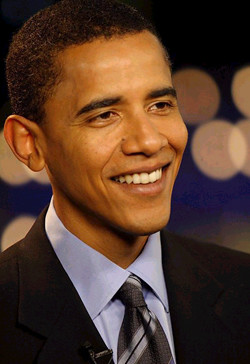
The Obama Effect


This year, after waiting decades and enduring many disappointments, finally, it appears that America's political paradigm is about to change. Yes, change is in the wind this election season and Barack Obama is its messenger. Obama has inspired this old Chicano like no other politician in the past 30 years. Spread the news, America has found a new leader.

Since I was child, I assumed that only old white men could run for president. That was just how it was because of economics and racism. Well, today is a new day and my cynicism has given way to optimism. Who would have ever thought that this 55 year old Chicano lefty could develop such a bright outlook.

Having participated in the Viet Nam antiwar and the social justice movements of the 60s and 70s, I find America is on the cusp of transcendent change because of Obama. This is great news. On the flip side, I now consider myself an anachronism, a curious relic of past race and class wars.

Today, I look to the future with optimism knowing that leaders like Obama have the intelligence and will to make America and the world a better place. For a lifetime I have been waiting for such an inspirational leader.

I firmly believe that Barack Obama is the by far the best candidate for president of the United States. Obama will end the Iraq war, work with both Democrats and Republicans to create a new health care system and strive for peace and stability around the world. Please vote for Obama for president. Yes, it is time for a change.

-30-

Friday, January 25, 2008

San Bernardino Valley College Presents Chicano Photographer Exhibition

I would like to thank everyone who came to opening of the Chicano Photographer exhibition at San Bernardino Valley College. I enjoyed meeting everyone and it was an honor to the opening of the exhibition at Valley Coleges's Gresham Art Gallery on Jan. 24.

On display were my documentary photographic series. The traveling exhibition, Chicano Photographer, explores the Chicano community and activism during the dynamic 70s. Ann Marie Leimer, Ph.D., gave a lecture on the political climate during the decade. Her presentation added context to the black and white photographs. Leimer and I later answered questions from the audience. Usually your lucky to get one or two questions, but I was asked quite a few.

The exhibition continues to Feb. 7, 2008. Anyone having questions about the series can contact Dr. Leimer at (909) 748-8505.


[Click on photos to enlarge. Copyright 2008 Jesús Manuel Mena Garza. All rights reserved.]


I enjoyed talking to the audience individually and as a group. I had the opportunity to discuss future projects including documentary photographs of the Navajo Nation and Oaxaca, Mexico artisans. During these lengthy discussions I enjoyed explaining photographic composition, darkroom techniques and my new business interest in real estate. All in all, the audience was very receptive. Many in the audience asked for my autograph and to pose with them for pictures. Now I now how Eric Estrada feels. I hope their pictures come out.

Some gave the exhibition a two thumbs up. Thanks!

If your museum or gallery is interested in presenting this show, please feel free to contact me at (909) 557-7151.

-30-

Thursday, November 29, 2007

Free Super Chicana/o Posters

Be the first in your neighborhood, barrio or gated community to download a FREE/GRATIS Super Chicano/a poster। You don't have to be a Super Chican@ to own any of these fantastic posters. Hispanics and others are also welcome to share in the glory. All you have to do is "click" on the thumbnail image of the poster to download.

Save your downloaded 11x17 inch PDF and print two copies (a laser printer works fine... an offset printer is better)। By the way, you can easily downsize the PDF to make a letter size (8.5 x 11) print. Generously give one poster to your Chicano/a Studies (Hispanic Studies may not count!) or photography professor. They will be absolutely impressed by your excellent taste.

If you're a Chicano/a Studies Prof, tenured or not, you should download my Chicano Photographer series brochure (8.5 x 11 inch). It details images from my Chicano Photography series that you may want for your next book or presentation. By the way, you are in luck, Jesús Garza is available for presentations, conferences, exhibitions, panels and especially lunch. Gracias!

-३०-

Tuesday, October 23, 2007

Speech Highlights Chicano Photographer Maryland Show

[Photo: Jesús gives a speech on his Chicano Photographer series at St. Mary's College of Maryland on October 17, 2007. Click on image to enlarge. Copyright 2007 Jesús Manuel Mena Garza. All rights reserved.]

My first trip to the East Coast was quite memorable. I had an opportunity to show my series Chicano Photographer and present a speech (more emotional than I had planned) at St. Mary’s College of Maryland. At the Maryland honors college I had the opportunity to work with Cristin Cash’s curatorial students. Many of these students had never put up an exhibition before. They seemed quite excited to learn and help. Yes, the students at this school are some of the best I have ever been around.

Again, this was my first trip to the East Coast. I had a chance to visit the nation’s capitol and vicinity. I never saw so much brick in all my life. In California brick isn’t quite as popular because of earthquakes. The area was also quite a bit greener than the "flamable" desert I live in.


Thanks again to Cristin Cash, Catherine Dunn and the great students of St Mary’s.

-30-

Tuesday, July 03, 2007

LA Chicano Photography Panel Discussion A Success

[Photo: Panelists discuss photography and the Chicano Movement in LA. Click on image to enlarge. Copyright 2007 Jesús Manuel Mena Garza. All rights reserved.]

Carlotta’s Passion Fine Art of Los Angeles hosted a panel discussion on essential literary and visual documentation of the Chicano Movement on Friday, June 29.

Photographers Oscar Castillo, Jesús Manuel Mena Garza, George Rodriguez and scholar Dionne Espinoza, Ph.D. headed the panel. This panel discussion took place during the exhibition Struggle and Liberation: Photographs of Seminal Events and Icons of the 1960s - 1970s. Hollywood Director Jesús Trevino moderated the panel.

The panel discussion examined the photography, events and issues of the Chicano Movement (El Movimiento Chicano of the late 1960s and early 70s). The audience stood up, asked questions and freely gave their perspective. In the end, the event proved to be informative and inspiring. More than 100 people attended.

-30-

Wednesday, May 23, 2007

Chicano Photographer Show In Los Angeles


[Photo: Los Mascarones, 1974. Click on image to enlarge. Copyright 2007 Jesús Manuel Mena Garza. All rights reserved.]

Carlotta’s Passion Fine Art of Los Angeles, California presents eleven photographs from the documentary series Chicano Photographer by California photographer Jesús Manuel Mena Garza, June 9 through July 1, 2007. The photographs are part of the exhibition titled, Struggle and Liberation: Photographs of Seminal Events and Icons of the 1960s and 1970s. The public is invited to a reception on June 9, 6 to 10 p.m.

University of Redlands’ Professor Ann Marie Leimer said, “Garza has extensively published and exhibited several documentary photographic series during the past decades. This series explores important aspects of the American experience, pieces of which are often marginalized by the dominant culture.”

During the 70s, Jesús Garza toured with theater groups in Mexico and California. From this vantage point, he took intimate portraits of people fighting for human rights. From César E. Chavez to Rodolfo ’Corky’ Gonzales, the photographs provide a retrospective glimpse from the unique perspective of a photojournalist and activist.

A more comprehensive exhibition that includes presentations and workshops by the artist will be held this fall at Saint Mary’s University of Maryland in Saint Mary’s City, Maryland and in spring 2008 at Valley College in San Bernardino, California. The photographs at Carlotta’s Passion have been previously exhibited during 2006 in Los Angeles, San José and Riverside galleries. This is the first time the photographs will be on sale as part of a limited edition.

-30-

Exhibition location: Carlotta’s Passion Fine Art, 2012 Colorado Blvd., 
Los Angeles (Eagle Rock), CA 90041.
Gallery telephone: (323) 259-1563
View photographs: http://www.jmmgarza.com/cp/

Tuesday, April 10, 2007

Comment About Documentary Photography

[Photo: Old Man From Juarez, Mexico, 1975. Click on image to enlarge. Copyright 2007 Jesús Manuel Mena Garza. All rights reserved.]


Some documentary photographers treat their subjects like quarry in the jungle. They stalk them, take their shot and then hang their desiccated representation on a distant sterile wall. The jungle can be the Amazon or the streets of a barrio, it is all the same to them.

As outsiders, their images lack any humanity and show a disdain for their subjects. At the photography reception, the shooter can be seen prancing around, weaving fanciful tales of his adventures to the spellbound audience.

The assembled, saturated by the stench of privilege, sip on wine. Esoteric rhythms waft in the background. The photographs remain mute. Surrounded, the captured photographs witness the decadence.

Jesús Manuel Mena Garza

-30-

Friday, October 20, 2006

2007 Globe, AZ Show


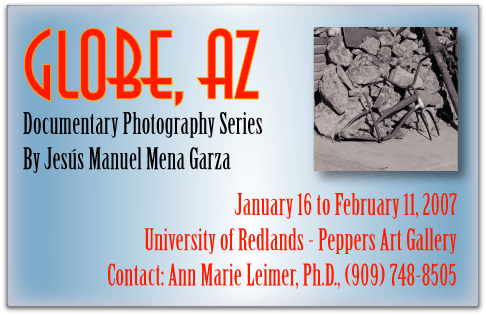
You're invited to my upcoming documentary photography exhibition, Globe, AZ. The show will take place at the University of Redlands (Redlands, California USA) at the Peppers Art Gallery, January 16 to February 11, 2007.

The reception is on January 17, 4:30 to 6 p.m. Come on down and enjoy the photos, free drinks (wine, beer and sodas) and plenty of snacks. I look forward to meeting you. Please tell all your friends. For more information about the show click on the header of this article or go to my website: http://www.jmmgarza.com.

You can also contact:

Ann Marie Leimer, Ph.D.

University of Redlands
1200 East Colton Avenue
Redlands, CA 92373-0999
(909) 748-8505
ann_leimer@redlands.edu


-30-

Wednesday, March 29, 2006

My Newest Granddaughter


Here is a recent picture of my newest granddaughter Ava Juliet Dodge. You have to admit she is quite beautiful. I guess it's true, good looks can skip a generation. I also have two other grandchildren, Marissa and Antonio. Maybe I will post their picture on my blog... soon.

-30-

Sunday, December 11, 2005

Jesús Manuel Mena Garza Biography


[Photo: My father, picking cotton in Texas circa 1925]

Photographer, artist, and audiovisual producer, Jesús Garza's artistic vision was shaped by his boyhood in San José, California, and later nurtured at Roosevelt Junior High, San José High, San José State University, the San Francisco Art Institute, and the Academy of Art College.

From the beginning, Garza's images have their source in his migrant farm worker heritage and his immersion in the dynamic political and artistic culture of El Movimiento, the political movement that emerged during the mid-60s seeking social justice for Chicano/as.

Jesús was born in 1952 to Eusebio and Guadalupe Mena Garza in San José, California. Guadalupe grew up in Crystal City, Texas, although she was born in nearby Carrizo Springs. Eusebio hailed from Coahuila in Northern Mexico and came to Texas as a child with his parents. The Garza family settled in Crystal City where Eusebio later met and married Guadalupe.

Jesús' parents worked their entire lives as farm laborers migrating through the central and western regions of the United States during the picking season and returning each winter to Crystal City. In the mid-40s, Manuel, Eusebio's eldest brother, led the extended Garza family to San José in search of increased opportunities.

Jesus' parents and siblings worked in the fields of Santa Clara Valley while living in various migrant labor camps. Growing up in San José during the 1960s, Jesús saw his city change from an agricultural oasis south of San Francisco to the capital of Silicon Valley. During the 50s and 60s, the Garza family's eight children picked fruit and vegetables at orchards and farms that later became prized locations for the computer industries chip manufacturing plants.

During this period, Jesus' parents bought a house in a racially diverse, working-class neighborhood. Guadalupe began working at local canneries, although she continued in the fields at various times of the year. Jesús worked in the fields during summers, on weekends throughout his school years, and during college.

Garza notes, "My parents were very modest. I don't remember having any long conversations with either of them. My father usually sat in the corner reading the Spanish language newspaper. My mother could not read or write, but she definitely had a keen mind. She knitted, crocheted, made quilts and clothing like most mothers of the period. She enjoyed gardening and especially tending to her roses. Today I grow roses in her memory."

Throughout Jesús' childhood, the Garza family returned to Crystal City several times to see members of the familia that had remained behind. During one trip when he was ten years old, with his mother, brother David, and several members of his brother-in laws family all stuffed in the car, he saw a sign posted on a rural Texas saloon stating, "No Mexicans or Dogs Allowed." Although the adults ignored the sign and entered the saloon without incident, the experience made a deep impression on Jesús.

Later in 1969, Jesús happened to be in Crystal City during the historic high school walkout when young Chicano/as angrily protested racist policies that denied them opportunities afforded Anglo students. In this small South Texas town, he witnessed the impact of poverty, segregation, and activism, an encounter that shaped his future political and community involvement.

Jesús' family could not afford a camera or record player. At age eleven, he bought himself his first camera at la pulga, the San José Flea Market. This simple twin lens box camera captured his initial portraits of close friends and neighborhood buildings, subjects he would record throughout his career. A few years later at Roosevelt Junior High, Garza witnessed the magic of the darkroom and its photographic processes for the first time. Under the supportive tutelage of instructors Prospero Anaya and Ron Root at San José High, Garza began to craft his photographic style and technique.

Drawn to the position of outside observer, the documentation of events and people formed the primary initial focus of Jesús' photographic work. He served as photographer for both the school newspaper and yearbook and discovered photojournalism as his calling. Mentors Anaya and Root closely guided him in course work every semester during high school and exposed him to the artistic environment of Bay Area galleries and museums during field trips with the Photo Club. As a result, when he graduated in 1970, Garza had a thorough understanding of photographic processes, techniques, and equipment.

Immediately out of high school, Garza worked for the summer as a cinematographer at the Chicano Film Institute of San José. Here he also established himself as a photographer, documenting the struggles of Chicano/as in the Santa Clara Valley. When he entered San José State University in the fall of 1970, he studied Photojournalism under Dr. Joe Swan and participated in the progressive causes of the time including antiwar demonstrations and protests that sought increased access for Chicano/as to education and media.

At SJSU Garza served as president of three campus organizations, as a member of the UFW Support Committee, and as a member of the Community Alert Patrol, or CAP, where he took photographs of police in the field to monitor and document police brutality. Through his participation in these events and organizations, Jesús met Cesar Chavez, Corky Gonzales, José Angel Gutiérrez and other Chicano/a leaders.

In 1973, the artist/activist expanded his creative endeavors from photography to broadcasting by producing radio programs with the Chicano/Puerto Rican Radio Collective, known simply as La Cosa Nueva. As member and later president of C/N, he developed unique bilingual radio programs for several Bay Area stations including KSJS, KPFA-B and KKUP. These Chicano/a-centric programs featured news, public affairs, and music from popular groups such as Malo, Azteca, Sapo, and Santana.

During the 70s, La Cosa Nueva's programs could be heard throughout the San Joaquin Valley and the Bay Area. Garza said, "The early 70s was a great time to socialize (party). I was very shy in high school, but after a couple of years in college, I was definitely into the swing of things. We had a great time working in radio. It was not uncommon to mix drinks and party at KSJS. It is my firm belief that some people participated in the political struggles of the period because of a deep-felt commitment to the cause. Others participated because they wanted to party. Both were valid reasons."

Concurrently with his involvement in the university and broadcast communities, Garza served as Treasurer, Gallery Director, and Resident Photographer at El Centro Cultural de La Gente of San José where he produced various exhibits of his work and other San José and Bay Area artists. In addition, he continued to exhibit his work in galleries throughout the Bay Area and Mexico. Then in 1974, he curated the first major retrospective show of Chicano/a art produced at the San José Museum of Art.

Later that year, he toured Mexico as resident photographer with Teatro de La Gente, Teatro Campesino, Teatro Quetzal and others as part of the Quinto Festival de Teatro Chicano, to document this historic event. This theater conference and series of performances, organized by Adrian Vargas and members of Teatro Nacional de Aztlán, was the first major conference in Mexico City to bring together theater workers from the United States, Mexico, and Latin America.

After seeing Jesús' work increasingly include fine art photography, close friend Antonio Perales Fierro, who had previously attended the San Francisco Art Institute, suggested that Jesús consider expanding his artistic training. After reviewing his portfolio, the prestigious Institute offered him a full tuition scholarship that he accepted in the fall of 1974. While he enjoyed the short respite from San José's more traditional art scene, criticism of his "Mexican" subject matter prompted Jesús to return to San José by mid-semester where he finished his degree at San José State by 1978.

In 1975 he met his first wife Esperanza Molina Maldonado. They were married in 1976. She was a bight student at DeAnza Community College and performed in local Chicano theater. They were married for three years and produced two children, Estrella and Esperanza. My now ex-wife lives in Lathrop, California and we see each other at our children's parties. My daughter Esperanza married José Santa Cruz in 1996 and they have two children, Marissa and Antonio. My eldest daughter Estrella married Jimmy Dodge in 2004 and they have one daughter named Ava Juliet. Esperanza works in Marketing, Estrella works in sales, José works in the Sheriff’s Department and Jimmy works for UPS. They all live in San José, California.

Now back to the past (1976) ... while completing his journalism degree, Jesús worked for one year at San José's KXRX/KEZR radio and later moved to Salinas to serve as a sports anchor and reporter for KSBW Television. Six months later he took over as News Director at KOMY, a bilingual radio station in Watsonville, where he produced programs for four years. These experiences left an indelible mark, making the artist keenly aware of the power of electronic media and technology in our society.

After his divorce in 1980, Garza moved back to San José and renewed his photography career by opening FotoMedia in downtown San José. In addition to offering photography and producing photography workshops, he provided a range of media services including advertising, graphics, and public relations. Several years later Jesús moved his business to a larger studio in his old neighborhood on North 13th Street where he served a diverse clientele ranging from the modest nuns at Holy Cross Catholic Church, to neighborhood families, to the strippers at Maria's Night Club. Commercial clients included Intel Corporation, Altera Corporation, Vallco Fashion Park, San José State University and various magazines and newspapers.

Resuming the exhibition of his work in 1987, Garza produced several photographic series employing both traditional and alternative processes. These projects ranged from two public slide presentations viewed both by traffic and pedestrians to silver and alternative process prints. One of the most notable of his exhibitions was produced by the Mission Cultural Center in San Francisco in 1992. They selected him to participate in a group show of eight photographers. Later that year, unfortunately, he closed his studio and moved to a safer neighborhood because gangs and drug dealers made parts of his old "barrio" increasingly dangerous.

In 1994 Jesús met his wife to be, Ann Marie Leimer at a San Francisco coffee shop, but first the radio world claimed him (once again) in 1995. He traveled to Globe, Arizona, to serve as the News Director at KJAA Radio located next to the San Carlos Apache Indian Reservation. He found himself immediately at odds with station management when he chose to broadcast news from all communities, not just the conservative groups supported by the station's owner. As a result, Garza returned in the fall of 1995 to San Francisco, a more progressive city. A year later, he married his girlfriend Ann.

In the Bay Area, Jesús became a faculty member for the Motion Picture and Video Department at the Academy of Art College in San Francisco for the next several years. At the Academy, he taught and presented workshops on photography and film while exhibiting in San Francisco galleries including El Balazo and the Luggage Gallery. During the mid-90s he also produced and hosted, "The Barrio Experience." This Saturday afternoon radio show was broadcast by Stanford University's KZSU-FM. The program featured Latin music, bands, and interviews. Garza notes, "I really enjoyed working with Stanford students. It was amazing to gain insight into their privileged world."

While in San Francisco, Jesús and Ann shared an avid interest in art and diverse cultures. Together they embarked on a journey that would take them to Texas. On May 15, 1999, Jesús moved to the Lone Star state so Ann could pursue her dream of a Ph.D. in Latin American Art at the University of Texas at Austin. Garza noted, "I have now come full circle and returned to Texas, the state my parents left for a better life in California." In 2000, Jesús and Ann bought a 1927 bungalow-style home in Lockhart. Here Jesús and Ann grew roses, just as Jesús’ mother did in San José. They served as a daily reminder of her creativity. The couple share Lupe's love of flowers.

Lockhart, known as the "Barbecue Capital of Texas," is 25 miles south of Austin, 15 miles east of San Marcos, and 60 miles northeast of San Antonio. Jesús' waistline was proof of the great comida (food) here! Jesús and Ann enjoyed fishing and camping at Padre Island. They both enjoyed dancing to Tejano music at various church jamaicas and visiting familia in Crystal City.

Garza paid the mortgage and his wife's tuition by working full-time at Pedernales Electric. Lyndon B. Johnson and Hill Country ranchers founded the electric cooperative in 1938. Today, the folks at PEC know that they are sitting on a gold mine. Like many utility companies, PEC likes to milk their customers for all they were worth. Garza worked for the co-op for more than five years doing public relations. In press releases, magazine articles, television and radio commercials he would tell the co-op's members to please conserve electricity; all the while the co-op was spending their money like drunken sailors.

Garza kept his hand in radio by working at KLBJ-AM in Austin. At this news station, he worked part-time as a news anchor and reporter. Attempting to be objective at this conservative station planted firmly in a liberal bastion like Austin was quite a challenge. But he enjoyed it.

In retrospect, if Garza only new what Texas was like, he would of never of left his beloved Bay Area. Happily, Garza is back in beautiful California and his wife has her Ph.D. Was going to Texas worth it? Only time will tell.

Garza currently resides in Redlands, California with his wife (now) Dr. Ann Marie Leimer. In the fall of 2005 she was awarded a professorship in the Art and Art History Department at the University of Redlands. Ann and Jesús plan to make this area their home.

On the publishing front, Garza's photographs were published in Cesar Chavez, Amazing Americans, McGraw-Hill. The Fight in The Fields, Susan Ferriss, Harcourt Brace & Company. The Devil in Silicon Valley: Race and Mexicans in Northern California, Dr. Stephen Pitti, Assistant Professor of History and American Studies at Yale University, Princeton University Press. In 2003, Jesús’ documentary photographs were included in the exhibition Chicano Now/Visions that toured the US.

Garza has developed an extensive archive during his thirty years as a photographer. His collection includes Imágenes Xicano, a series of documentary photographs from the 70s that provide a unique history of the Chicano/a movement and form a primary core of his photographic production. These photographs continue to be used in books, articles, and exhibits. These images are also the foundation of his new book, Chicano Photographer. Garza also has produced a PowerPoint presentation entitled Chicano Photographer. It is available free to qualified schools and nonprofits. Go to www.jmmgarza.com for more information.

Other photographic series include his images of Chicano Theater (another book project) during the 70s, Mexico, Arizona, and New Mexico. While in Texas, Jesús documented the character of the region, especially the unique architecture and other features of communities like Lockhart, Gruene, and Crystal City. Jesús currently operates JMM Garza Media Services, and his website at www.jmmgarza.com.

-30-

Globe, AZ Photo Series


Like the sun-baked buildings that dot the desert landscape, the inhabitants of Globe and Miami, Arizona, survive gracefully, showing their age. The two cities live next to each other huddled in the hills. The heat that punishes Phoenix spares the high desert. In the Hill Country of Central Arizona, residents find themselves at a crossroads between national trends and their desire to control and define their community. Taken during the summer of 1995, these photographs reveal an America still rural and conservative.

This area came into existence when the San Carlos Apache Nation ceded valuable portions of its reservation to powerful mining interests. Crushed, fired, and processed, the copper extracted from the red and green rock created wealth for multinational corporations for more than a hundred years. The white sticky powder heaped high along the highway is part of the regions legacy. Arizona's Cobre (Copper) Valley would be a mecca for tourists, if not for the scarred hills.

My photographs evoke nostalgia for Americana, remnants you still find scattered in remote and untouched parts of our country. When I first came to Globe, I was struck by the eerie silence at night. There were no sirens or gunfire from the barrio to awaken me. The stars sparkled brightly, the air smelled clean, and, like the 50s in California, you could purchase leaded gas because no smog regulations exist. With so few people in such a large area, pollution laws were lax. Los Angelinos can be envious of some things in the Cobre Valley.

During the process of taking these photographs, I recalled my youth in San José, California. I remembered fondly how San José once had a downtown with small friendly theaters, department stores, and a sense of community. I remembered when prune orchards lined Main Street and Intel, Apple, and Silicon Graphics were fantasy. Everything changed with the invention of the integrated circuit. That is when San José was radically and forever transformed into Silicon Valley, the center of high technology. My hometown has since grown ponderous and fruit orchards have given way to bland warehouses and suburban strip malls.

Even though my hometown has evolved into a big city, I find solace knowing that small communities like Globe and Miami remain the same. My images of these communities document not only the environment, but also reveal its beauty by abstracting the details. I focus on the texture of a building, emphasizing the elements of the photograph that translate into the subtle but essential tonal values.

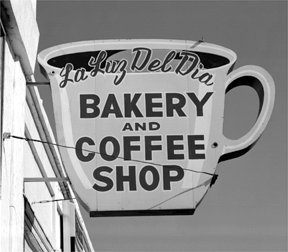
I rejoice in photographing sun-baked buildings with peeling paint; they give evidence to history's passing. The faded coffee shop sign and Gibson's Clothing Store remind me of a bygone era, before the new Wal-Mart took away their customers. My work documents a precarious rural America whose sites have become curios to be immortalized on photographic paper, their value increasing with every new mall erected in Seattle, Austin, and Cleveland. This vanishing America gains value by remaining the same.
---
The images in this series were shot on a Hasselblad 500CM/150 T*. The negatives were scanned on a Scitex Leaf Scanner.

Please feel free to contact me should you have any questions about my pictures or text. I look forward to hearing from you.

The photogrphic series is located on my web site: http://www.jmmgarza.com/html/Gibsons.html

-30-

Best Fishing Combo For Oregon Coast Striped Bass

 I ASKED GOOGLE Ai: Suggest a rod and real combo for catching 20 pound striped bass off the coast of Oregon? PHOTO: August 2026 fishing in C...